Billions of dollars linked to Iran have passed through U.S. banks despite sweeping sanctions, exposing a hidden vulnerability inside the financial system Washington relies on to isolate Tehran.
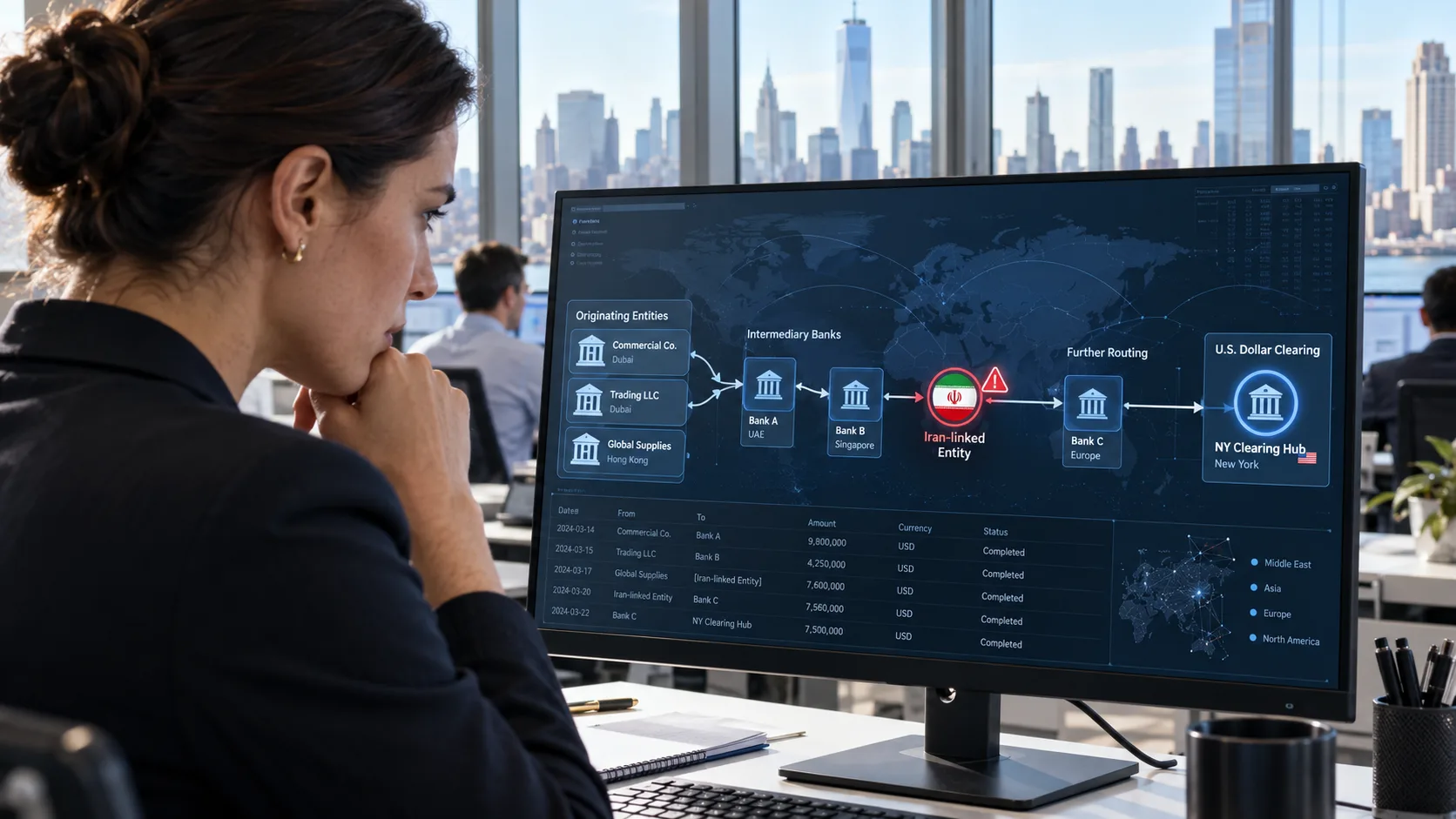
The transactions do not typically begin with an Iranian bank sending money directly to New York. They are routed through foreign banks, shell companies, currency exchanges and trading firms that conceal the Iranian connection before the dollars reach an American clearing institution.
That distinction matters. U.S. banks sit at the center of the global dollar system, yet they may see only the foreign institution immediately sending a payment. By the time a transaction reaches a clearing account, the Iranian beneficiary can be several layers removed.
For investors, the story reaches far beyond one enforcement action. It raises questions about bank compliance costs, the future reach of U.S. sanctions, the dollar’s global position and the growing financial links among Iran, China and the United Arab Emirates.
The $1.8 Billion Case That Put Banks on Alert
The Treasury Department’s Financial Crimes Enforcement Network proposed cutting Banque Misr’s United Arab Emirates operations off from U.S. correspondent banking access on August 28.
Treasury estimates that Banque Misr UAE processed roughly $1.8 billion between January 2024 and June 2026 for 103 companies that may be part of Iranian shadow-banking networks. According to the department, some of those customers appeared to be front companies used to evade sanctions, launder money or support entities tied to Iran’s defense establishment and Islamic Revolutionary Guard Corps.
The proposed action falls under Section 311 of the USA PATRIOT Act. If finalized, U.S. financial institutions would be prohibited from opening or maintaining correspondent accounts for Banque Misr UAE. Banks would also have to take reasonable steps to prevent other foreign correspondent accounts from being used indirectly to process transactions involving the branch.
The action applies to Banque Misr’s UAE operations, rather than the wider Egyptian bank. Banque Misr has said it is engaging with U.S. authorities and respects applicable legal and regulatory frameworks.
Treasury said the branch had dollar accounts with three U.S. banks but did not identify them. Banque Misr’s website lists JPMorgan Chase and Citigroup among its correspondent institutions. Both banks declined to comment to The Wall Street Journal, and neither has been accused by Treasury of wrongdoing in the announced action.
The broader number is even more striking. The Journal reported that Treasury identified approximately $9 billion in Iranian funds moving through American banks during 2024.
How Iran Reaches the Dollar System
Correspondent banking allows financial institutions to settle transactions in currencies and markets where they lack a direct presence. A foreign bank can maintain a dollar account at a U.S. institution, then use that account to process payments for customers around the world.
This arrangement makes global trade faster and cheaper. It also creates distance between the bank clearing a payment and the commercial activity behind it.
Iran exploits that distance through networks of intermediaries. A company in Iran may arrange a purchase from a supplier in China. Payment can move through a shell company in Hong Kong or Dubai, then through a foreign bank with access to a U.S. correspondent account. The American bank sees a transaction involving its foreign customer, while the Iranian origin or beneficiary remains obscured.
The Journal described an invoice for 150,000 circuit boards and sensors ordered by an Iranian engineering company from a Chinese supplier. The $650,000 payment instructions called for the transaction to pass through a U.S. clearing partner in New York. The components have civilian uses, including vehicle manufacturing, but they are also sought for drones and weapons. It remains unclear whether that payment was completed.
The example shows why conventional sanctions screening can fail. Names may be changed, ownership can be hidden and companies can be incorporated in jurisdictions far from Iran. A transaction that looks like ordinary trade between firms in China and the UAE may carry an undisclosed Iranian connection.
Why Leaving Some Channels Open Can Help Washington
The obvious response is to demand that regulators close every suspected route immediately. That approach could sacrifice valuable intelligence.
When Iranian-linked payments touch U.S. banks, they generate records. Those records can reveal recurring counterparties, transaction patterns and links between front companies. Pushing the entire network outside the dollar system could reduce Washington’s ability to observe it.
There is also systemic risk. Abruptly cutting off a major foreign bank can damage its home economy, disrupt legitimate payments and encourage U.S. banks to retreat from correspondent relationships broadly. That retreat, sometimes called de-risking, can isolate lawful businesses in emerging markets along with the intended targets.
Treasury’s measured approach toward Banque Misr UAE reflects this tradeoff. The agency proposed restricting one branch, opened a public-comment window and avoided action against the U.S. clearing banks. The structure suggests officials are trying to close a specific channel without causing a wider shock.The Signals That Matter Next
The Investor Takeaway
Iran’s access to U.S. dollar clearing exposes an uncomfortable reality: financial sanctions are powerful because the dollar system is open and global, and those same qualities give sophisticated networks room to hide.
Treasury’s campaign can make those networks more expensive and fragile. Success will depend on whether regulators and banks can identify the hidden Iranian connection before funds are cleared, while preserving the international reach that makes the dollar indispensable.
For investors, the key question is bigger than whether one foreign bank loses access to New York. The real issue is whether escalating enforcement strengthens the dollar chokepoint or gradually pushes more global commerce into systems Washington cannot see or control.
About Author