

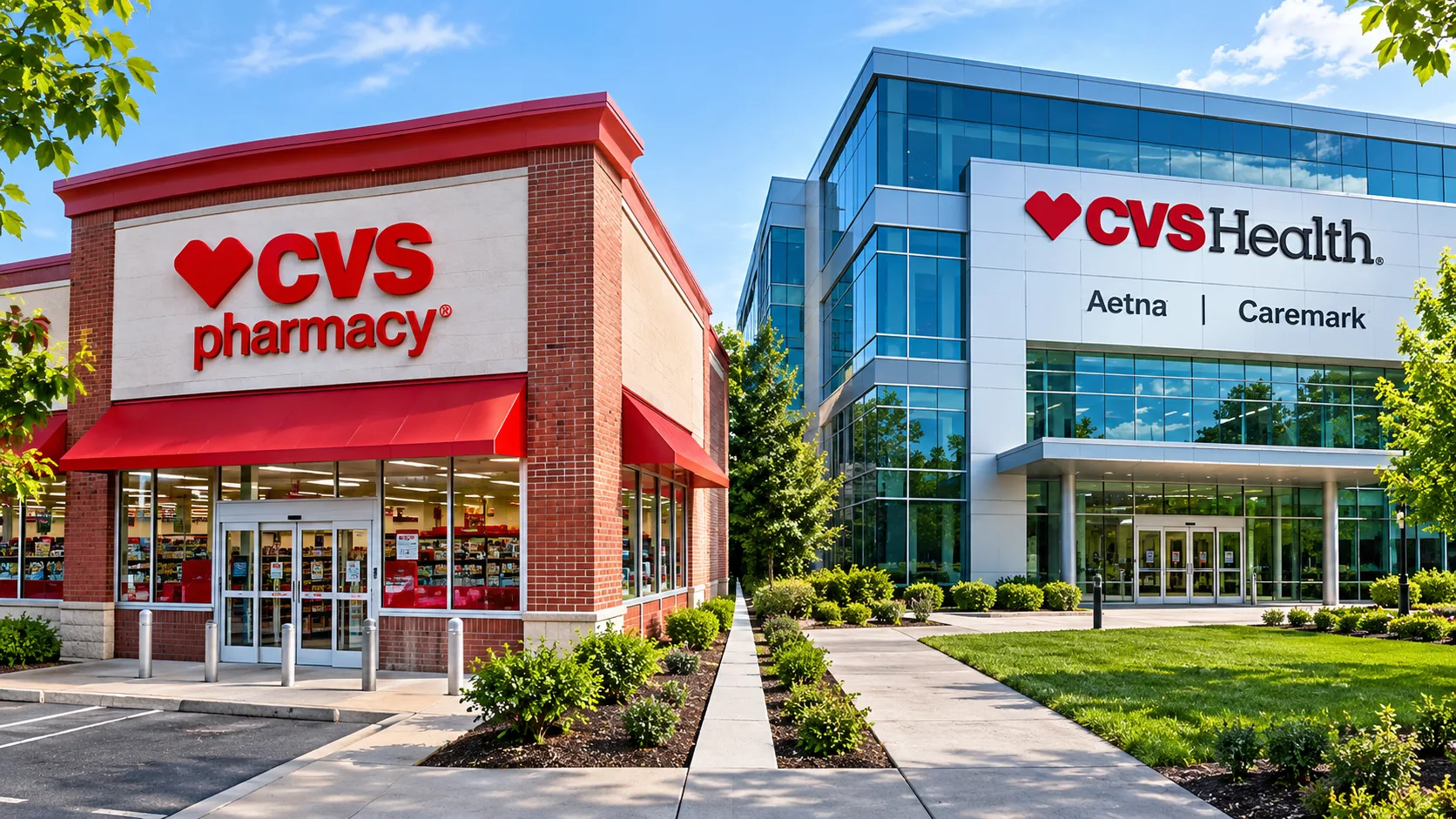
The healthcare giant announced Wednesday that it plans to divide into two independent, publicly traded companies by the first half of 2028. The decision marks one of the biggest corporate restructurings in the healthcare industry and could fundamentally change how Americans receive prescriptions, insurance coverage and medical care.
For investors, the breakup raises an important question: Could CVS’s two businesses be worth more separately than they are together?
CVS Is Splitting Into Two Companies
Under the restructuring, CVS will separate its nationwide retail pharmacy operations from its insurance, prescription drug management and healthcare services businesses.
The resulting companies will operate independently, with separate management teams, financial structures and investment priorities.
CVS Pharmacy will include approximately 9,000 retail pharmacies, mail-order pharmacy operations, MinuteClinic locations and the company’s Health100 technology services business. Prem Shah, currently a senior executive at CVS Health, will become its CEO.
CVS Health will retain Aetna, pharmacy benefit manager CVS Caremark, CVS Specialty, primary care provider Oak Street Health and home healthcare company Signify Health. Current CEO David Joyner will continue leading that business.
Existing CVS shareholders will receive ownership interests in both publicly traded companies once the separation is completed. CVS intends to structure the transaction so that it is tax-free to the company and its shareholders for U.S. federal income tax purposes.
The breakup remains subject to final board approval, regulatory filing requirements and other customary conditions.
A $78 Billion Bet Is Being Unwound
The decision represents a dramatic reversal of the strategy that transformed CVS from a drugstore chain into one of America’s most powerful healthcare conglomerates.
In 2018, CVS completed its approximately $78 billion acquisition of Aetna, combining one of the nation’s largest pharmacy chains with a major health insurer. The idea was to create an integrated healthcare company capable of handling everything from insurance coverage and prescription benefits to retail pharmacy visits and primary care.
CVS subsequently expanded deeper into healthcare delivery, acquiring Oak Street Health and Signify Health as it pursued a larger role in managing patients’ medical needs.
The strategy gave CVS enormous influence over how healthcare services were delivered, financed and reimbursed. However, that growing reach also increased the complexity of managing the business and exposed it to regulatory scrutiny.
Nearly eight years after buying Aetna, CVS is now dismantling a central piece of that structure.
The company says separating its operations will give both businesses greater flexibility to invest, adopt new technology, improve efficiency and respond to changing conditions in healthcare.
Why CVS Is Breaking Up Now
The timing is particularly significant because CVS has been making progress in its turnaround under Joyner, who became CEO in October 2024.
The company has pursued aggressive cost reductions, streamlined operations and worked to stabilize its Medicare Advantage insurance business after higher medical expenses damaged profitability.
CVS shares have also recovered substantially since Joyner took control, suggesting investors have become more confident in management’s ability to improve performance.
Yet the underlying business remains complicated.
Retail pharmacies face pressure from reimbursement rates, labor expenses and changing consumer behavior. Insurance operations must contend with medical costs and government reimbursement policies. Pharmacy benefit managers face growing pressure over drug pricing and their relationships with pharmacies and insurers.
Keeping all these businesses under one corporate umbrella requires management to balance competing financial priorities.
Separating them could allow each company to pursue strategies better suited to its own market.
There is also a potentially important financial benefit: Investors may be willing to assign different valuations to the pharmacy and insurance businesses once their individual profitability becomes easier to evaluate.
Washington’s Drug Pricing Crackdown Adds Pressure
Another major factor surrounding the breakup is the increasing political scrutiny of pharmacy benefit managers, commonly known as PBMs.
These companies negotiate drug prices and administer prescription benefits for insurers and employers. CVS Caremark is one of the three dominant PBMs in the United States.
Critics argue that PBMs can create conflicts of interest when they operate within corporations that also own insurance companies and retail pharmacies.
For example, a company that controls prescription benefits and pharmacy locations may have financial incentives to steer patients toward affiliated businesses.
Lawmakers from both parties have questioned these arrangements, and several states have pursued restrictions on PBM ownership of pharmacies.
CVS has not identified regulatory pressure as the reason for the split. Nevertheless, separating its retail pharmacy operation could reduce some of the ownership conflicts that have attracted political attention.
One important limitation remains: Aetna and Caremark will continue operating within the same company. The restructuring therefore leaves a substantial portion of CVS’s vertically integrated healthcare model intact.
For investors, that means the new CVS Health will remain exposed to pharmacy benefit regulation, drug pricing legislation and changes affecting Medicare and commercial health insurance.
What the Breakup Means for CVS Stock
For shareholders, the central question is whether the restructuring will unlock value that has been difficult for Wall Street to recognize inside the combined company.
1. Two Companies Could Command Higher Valuations
Investors typically evaluate retail pharmacy businesses differently from health insurers and pharmacy benefit managers.
Retail pharmacies depend on prescription volumes, reimbursement rates, operating efficiency and consumer spending. Insurance businesses are evaluated more heavily on membership growth, medical costs, reimbursement rates and profit margins.
By separating these operations, CVS could give investors a clearer picture of each company’s earnings potential.
That transparency could help attract different groups of investors, including those seeking healthcare services exposure and others interested in established pharmacy operations.
However, a breakup does not automatically create additional value. Both businesses must demonstrate that they can operate efficiently without the financial and operational support of the combined company.
2. CVS Pharmacy Will Face a Major Test
The standalone CVS Pharmacy will control one of the country’s largest retail pharmacy networks, with approximately 9,000 locations.
That scale gives it substantial purchasing power, consumer recognition and access to millions of Americans who regularly fill prescriptions.
It also faces meaningful challenges.
Drugstores have struggled with reimbursement pressure, higher labor costs, retail theft and competition from online pharmacies and large retailers.
The independent company will need to demonstrate that it can produce sustainable profits while continuing to invest in technology and patient care.
One potential advantage is greater freedom to negotiate partnerships with insurers, drug manufacturers and pharmacy benefit managers beyond the existing CVS corporate network.
3. Aetna and Caremark Will Remain a Healthcare Powerhouse
The remaining CVS Health business will combine insurance coverage, prescription drug benefit management, specialty pharmacy services and healthcare delivery.
This structure could offer opportunities to coordinate treatment, manage prescription spending and improve profitability across several connected businesses.
However, much of its financial performance will depend on controlling medical expenses, particularly within Medicare Advantage.
Higher-than-expected healthcare utilization has previously pressured insurance profitability, and changes in government reimbursement can have significant consequences for earnings.
The new CVS Health will also remain exposed to political efforts to regulate PBMs and increase transparency in prescription drug pricing.
Could the Breakup Benefit CVS Shareholders?
CVS expects both companies to have investment-grade credit ratings, strong free cash flow and the ability to pay attractive dividends following the separation.
That could appeal to income-oriented investors, especially those who have traditionally viewed large healthcare companies as potential sources of stable long-term returns.
However, several important financial details have yet to be disclosed, including how debt will be divided, how many shares investors will receive in each company and the expected earnings of the two independent businesses.
The biggest potential opportunity is a valuation reset. If investors conclude that one or both standalone companies deserve higher earnings multiples than the combined CVS, the separation could generate additional shareholder value.
The principal risk is that separating the businesses could introduce new costs, weaken existing commercial relationships or reduce financial flexibility.
A company with a stronger valuation on paper still needs earnings and cash flow to support that valuation over time.
The Unexpected Opportunity in Retail Pharmacy
One of the more interesting aspects of the announcement is that CVS’s retail pharmacy business may be entering the separation from a stronger competitive position than investors expected several years ago.
The company has been working to improve pharmacy reimbursement through its CostVantage model while competitors have struggled with store closures and profitability.
A standalone CVS Pharmacy could potentially capitalize on weaker competition and use its national network to expand healthcare services.
The question is whether those advantages can translate into stronger margins without the support of the broader CVS organization.
That distinction could become increasingly important as investors begin valuing the two businesses separately.
What Investors Should Watch Next
The separation is expected to take until the first half of 2028, leaving several important milestones ahead.
- Financial disclosures: Investors will want detailed revenue, profitability, debt and cash flow projections for each standalone company.
- Dividend plans: CVS expects both businesses to support attractive dividends, but individual payout policies have yet to be announced.
- Medicare Advantage performance: Improving medical cost trends will be critical to the valuation of the remaining CVS Health insurance business.
- PBM regulation: New federal and state restrictions could affect Caremark’s profitability and the relationships between insurers, pharmacy benefit managers and retailers.
- Separation costs: Restructuring expenses, technology investments and changes to existing commercial agreements could influence the financial benefits of the breakup.
CVS’s November 4 earnings announcement adds another dimension to the investment story. The company reported third-quarter revenue of approximately $108.4 billion and adjusted earnings of $2.09 per share, while raising its full-year financial outlook.
Those results offer evidence that the business is improving, even as management prepares for a major transformation.
The Bigger Picture
CVS spent decades building a healthcare empire designed to bring pharmacies, insurance, prescription benefits and medical services under one roof.
Now, one of America’s largest healthcare companies is betting that a simpler corporate structure can deliver better financial results.
For patients, CVS says the transition should not interrupt access to prescriptions, benefits or healthcare services.
For investors, the stakes are considerably larger.
The separation could create two more focused companies with clearer earnings prospects and greater flexibility to pursue growth. It could also expose weaknesses that were previously obscured within the larger organization.
The real test will be whether CVS can turn one $117 billion healthcare giant into two businesses that Wall Street values more highly.
About Author