

Heliostar Metals already has revenue, US$43 million in cash and no debt. Its next gold project could be the much bigger story.
What if a gold company were already operating two mines—but one of its development projects carried a potential value greater than the company itself? See Why Heliostar’s Next Gold Project Could Be Worth More Than the Company
That is the investment case taking shape around Heliostar Metals Ltd. (TSX: HSTR; OTCQX: HSTXF). Its Ana Paula underground gold project in Mexico has an estimated after-tax net present value (NPV) of US$1.012 billion in a preliminary economic assessment using US$3,800-per-ounce gold. According to the advertiser’s comparison, that is almost twice Heliostar’s overall market value at the time of its analysis. The valuation is scenario-dependent, not a current asset appraisal or promised return.
Unlike many gold developers still waiting for their first revenue, Heliostar has two producing mines, ended June 2026 with US$43 million in cash and zero debt, and is targeting a construction decision at Ana Paula in mid-2027. Here is why that combination may deserve a closer look.

Why the Next Stage of a Gold Mine Can Matter
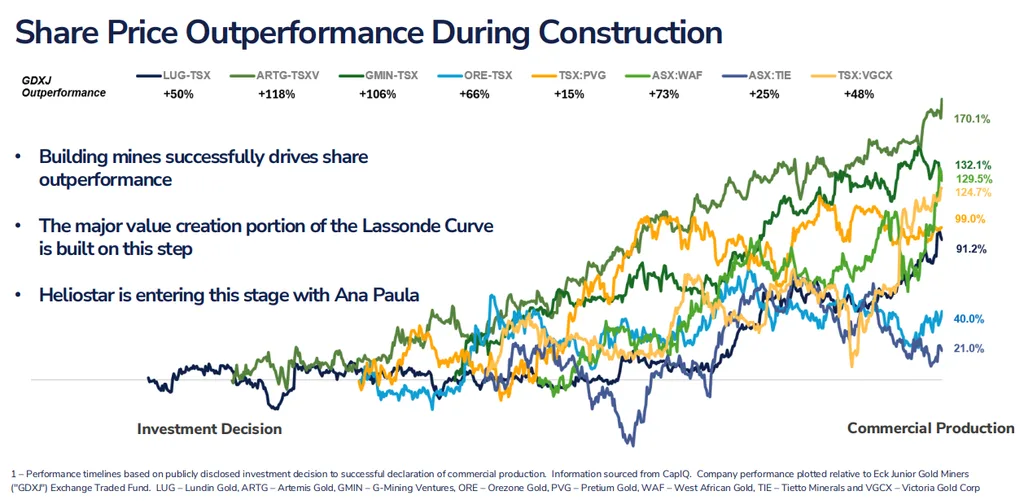
A mine can attract a different kind of investor as it moves from plans and permits toward construction and production. Mining investors sometimes call this the later phase of the Lassonde Curve, when successful execution can reduce uncertainty and change how the market values a company. It can also bring construction, financing, permitting and operating risks.
Consider Artemis Gold. While its Blackwater mine in British Columbia was under construction in late 2023, a director was buying shares around C$5.89. When Blackwater declared commercial production in May 2025, Artemis shares traded around C$20.42; by September 21, 2026, they were around C$39.50. That example illustrates a possible re-rating, not a forecast for Heliostar.
The advertiser also highlights historical outperformance versus the GDXJ junior gold miners fund between investment decision and commercial production: G Mining Ventures at 106%, West African Resources at 73%, Orezone at 66% and Lundin Gold at roughly 50%. These selected examples are not representative guarantees of future outcomes.
The Number That Makes Ana Paula Interesting
Ana Paula is located in Mexico’s Guerrero Gold Belt. A November 2025 preliminary economic assessment projected approximately 101,000 ounces of annual gold production after ramp-up at an all-in sustaining cost of US$1,011 per ounce, which the company placed in the lowest 13% of the global cost curve.
Under the study’s US$2,400 gold base case, Ana Paula had an estimated after-tax NPV of US$426 million and an internal rate of return (IRR) of 28.1%. Under its US$3,800 gold case, the figures increased to US$1.012 billion and 51.3%. Those are model outputs that depend on gold prices and other assumptions; they should not be interpreted as realized cash or a prediction of Heliostar’s stock price.

Drilling has intersected 83.2 metres at 17.35 grams of gold per tonne and 99.8 metres at 10.90 g/t. A deeper intercept returned 101.0 metres at 5.34 g/t in a zone that remains open. Heliostar describes the deposit as wide, high-grade and shallow, with conditions suited to bulk underground mining.
The company has added 25,072 metres of infill drilling since the preliminary study. Its feasibility work targets a 10-year mine averaging 100,000 ounces a year, processing 2,000 tonnes a day with a grinding circuit sized for up to 2,500 tonnes. Estimated project capital cost is about US$300 million; final economics and construction terms remain subject to further study and approvals.
→ See the Numbers Behind Heliostar’s Potential $1 Billion Gold Project
Two Operating Mines Could Change the Financing Equation
A common problem for early-stage mine developers is financing: the money needed to build a project can require significant new share issuance, diluting existing investors. Heliostar’s approach is different because it already has producing assets that may help fund its next mine.
The company acquired La Colorada, San Agustin and two development projects for US$5 million in 2024. It restarted La Colorada in January 2025 and San Agustin in December 2025, with first gold poured at San Agustin in January 2026. The mines are guided to produce a combined 50,000 to 55,000 ounces in 2026.
In the second quarter of 2026, Heliostar produced a record 14,803 gold ounces and generated record revenue of US$56.5 million. At June 30, it reported US$43.0 million in cash and zero debt. It forecasts around US$150 million of after-tax operating cash flow over two years to help finance Ana Paula, together with project debt. These forecasts are contingent on actual performance, capital requirements and financing conditions.
The Milestones Investors Can Watch
On October 13, 2026, Heliostar submitted environmental permit applications for Ana Paula’s underground mine design, which the company says would disturb about 65% less surface area than a previously approved open-pit design. The feasibility study was 34% complete in September and is targeted for the second quarter of 2027, ahead of a planned mid-2027 construction decision. First gold is targeted for the second half of 2028.
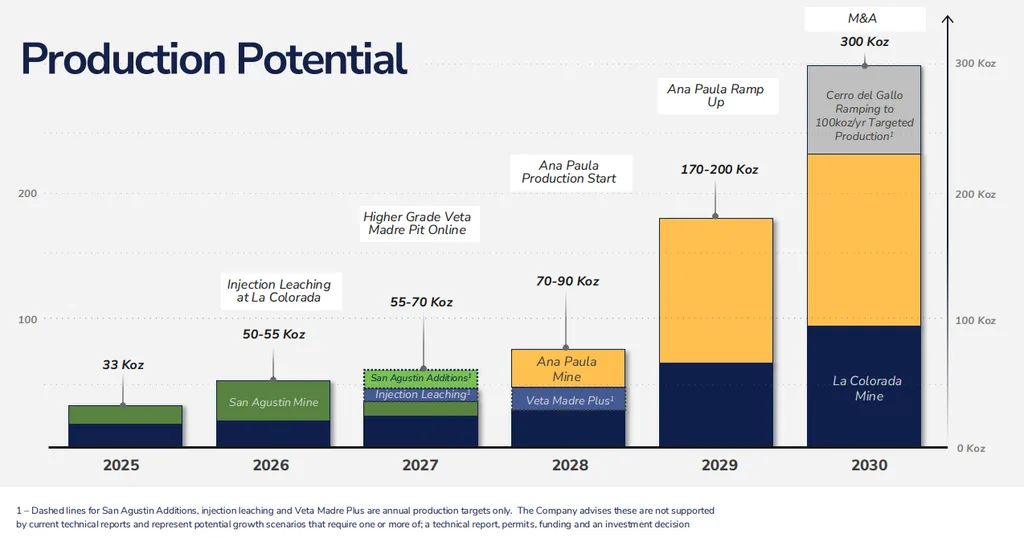
Ana Paula is not the only possible source of longer-term growth. Cerro del Gallo’s December 2025 prefeasibility study estimated an after-tax NPV of US$972 million at US$3,900 gold. Heliostar also holds Goldstrike in Utah, a project with an antimony component. The company has stated a goal of producing 500,000 ounces of gold annually by the end of the decade. These development scenarios are not current production guidance for all assets.
CEO Charles Funk previously led the Panuco discovery for Vizsla Silver. Chief operating officer Gregg Bush served nine years as COO of Capstone Mining and was senior vice president of Mexico for Equinox Gold. Heliostar joined the GDXJ in September 2026 and graduated to the Toronto Stock Exchange in October. Reported major shareholders include Eric Sprott (about 15%), Franklin Templeton (about 9.3%) and Adrian Day (about 5.6%).
What Investors Should Look at Next
Heliostar combines something uncommon among mine developers: producing operations, cash on the balance sheet and a large prospective development project approaching pivotal studies and approvals. The next questions are whether Ana Paula’s feasibility study supports the earlier economics, whether permitting and financing stay on track, and how much dilution—if any—will be needed.
Those developments could materially affect the investment case. Gold-price volatility, technical findings, permitting delays, higher costs and the risks inherent in mine construction could also affect results.
→ Review Heliostar’s investor presentation, project details and next milestones
Disclosure: Sponsored advertorial provided on behalf of Heliostar Metals. This is promotional material, not independent investment research or a recommendation to buy securities. All projections and forward-looking targets are subject to risks and uncertainty. Review the company’s current filings and risk disclosures before making an investment decision.
About Author