
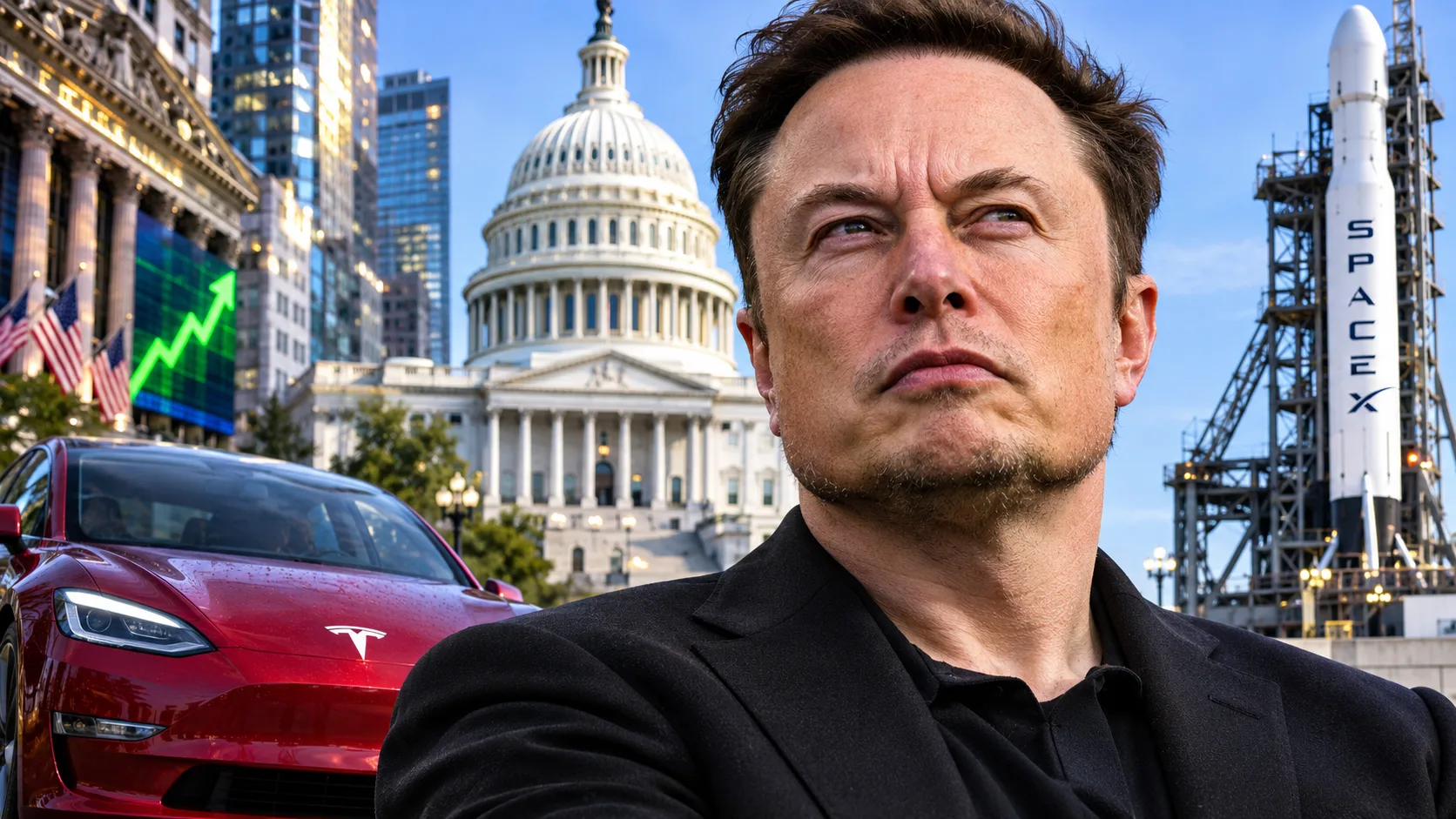
Elon Musk’s political gamble is turning into a costly Wall Street headache. Tesla and SpaceX shares plunged nearly 6% in Wednesday’s premarket trading after Democrats swept control of Congress and won major victories in Texas, where Musk has concentrated much of his business empire.
The selloff came as broader U.S. stock-market futures recovered from an overnight election shock and turned positive. At their reported premarket lows, Tesla and SpaceX had lost approximately $200 billion in combined market value, although those losses were subject to change when regular trading began.
Musk spent at least $446 million supporting Republican candidates and political groups during the 2026 election cycle. Now investors are confronting the possibility that his political involvement could bring heightened scrutiny of government contracts, artificial intelligence projects and a potential Tesla-SpaceX merger.
The election has created a new and potentially expensive problem for two of America’s most closely watched technology companies.
Wall Street Rallies While Musk’s Companies Take a Beating
Wednesday’s market reaction exposed a striking divide between the broader stock market and Musk’s businesses.
U.S. stock futures initially tumbled overnight as Democrats secured victories across the country, taking control of both the House and Senate. By Wednesday morning, however, those losses had largely reversed as investors considered the implications of divided government in Washington.
Tesla and SpaceX were moving in the opposite direction.
Reuters reported that both companies fell approximately 4.5% to 5% on Europe’s Tradegate trading platform. By 7:30 a.m. ET, Tesla was down approximately 5.7% in U.S. premarket trading, while SpaceX had declined roughly 5.8%.
At those levels, approximately $200 billion in combined market capitalization was under pressure.
The declines stood out because other major technology companies were experiencing more modest movements, while semiconductor stocks showed signs of resilience.
Investors appeared particularly concerned about the political and regulatory risks surrounding Musk’s businesses, although existing valuation pressures and technology-sector volatility also contributed to the uncertainty.
Musk Spent Nearly Half a Billion Dollars. Democrats Won Anyway.
Musk made an extraordinary financial commitment to Republican candidates during the 2026 midterm elections.
Campaign-finance reporting indicates he spent at least $446 million supporting Republicans and aligned organizations nationwide. Approximately $224 million went toward Republican candidates in Texas, including $158 million during September alone.
The spending failed to prevent major Democratic victories.
In Texas, Democrat James Talarico defeated Republican Ken Paxton in the U.S. Senate race, delivering the party its first victory for a Texas Senate seat since 1988. Democrat Gina Hinojosa also defeated longtime Republican Governor Greg Abbott.
Those results carry particular significance for Musk.
Tesla operates its headquarters and a major manufacturing facility in Austin, while SpaceX develops and launches rockets from Starbase on the Texas Gulf Coast. Musk has also backed ambitious plans for additional semiconductor and artificial-intelligence infrastructure in the state.
The political environment surrounding those investments has now changed dramatically.
Democrats will control congressional committees with authority to investigate government contracts, regulatory decisions and potential conflicts of interest involving major federal contractors.
Musk’s financial support for Republicans does not establish that Democrats intend to retaliate against him. Nevertheless, investors now face the possibility of greater scrutiny of companies closely associated with one of the election cycle’s most prominent Republican donors.
Political Backlash Could Become an Expensive Problem
The threat confronting Musk extends beyond negative publicity or political criticism.
Tesla and SpaceX operate in industries where regulatory approvals, government contracts and federal policy can have major financial consequences.
Kathleen Brooks, research director at trading platform XTB, warned Wednesday that the election had introduced an additional political risk premium into both companies’ valuations.
That means investors may demand a greater potential return to compensate for uncertainty involving regulation, congressional investigations or government policy.
The potential consequences include higher compliance expenses, prolonged regulatory reviews, delayed projects and additional questions about future growth.
For SpaceX, government relationships are particularly important because the company provides launch services and other technology to federal agencies, including NASA and national-security customers.
Tesla has significant exposure through autonomous-driving development, vehicle safety regulation and its expanding artificial-intelligence operations.
Greater congressional oversight could increase pressure on both companies to explain their activities and government relationships.
However, congressional investigations do not automatically establish wrongdoing, and there is currently no verified evidence that either company has suffered a government contract cancellation or regulatory penalty because of Tuesday’s election.
The financial risk depends on whether heightened scrutiny eventually affects operations, costs or revenue.
Texas’s New Governor Creates Another Headache for Musk
One of the most significant developments involves Texas’s incoming Democratic governor, Gina Hinojosa.
During the campaign, Hinojosa called for a moratorium on new data-center construction until lawmakers establish additional rules governing the industry.
That position could have consequences for Musk’s expanding artificial-intelligence ambitions.
Texas has become an important destination for large-scale technology investments because of its land availability, energy infrastructure and business environment. Musk has concentrated substantial operations in the state, making changes to development rules potentially important for his future projects.
Data centers require enormous amounts of electricity, water and infrastructure investment. Their rapid expansion has generated political opposition in some communities concerned about energy costs and environmental impacts.
Any new restrictions could complicate development schedules or increase project expenses, depending on their scope and implementation.
No statewide moratorium has taken effect simply because Hinojosa won the election. However, the possibility introduces additional uncertainty for companies planning major AI infrastructure investments.
For Tesla and SpaceX shareholders, that uncertainty arrives as investors are already demanding substantial future growth to justify the companies’ valuations.
The Tesla-SpaceX Merger Faces a New Political Obstacle
Another major concern is Musk’s potential plan to combine Tesla and SpaceX.
The companies have been linked to discussions about a possible transaction that would unite their operations under a much larger technology enterprise.
Such a combination could bring electric vehicles, autonomous-driving systems, robotics, rockets, satellite communications and artificial intelligence into a single corporate structure.
However, a merger involving two companies of this size would raise complicated questions concerning shareholder ownership, governance, valuation and regulatory requirements.
Now congressional scrutiny could become another obstacle.
XTB’s Brooks suggested that Democratic control of Congress could slow a potential merger through increased oversight, even though congressional investigators cannot directly prohibit a corporate combination.
Reports have indicated efforts to pursue an announcement during the first half of 2027, potentially allowing a transaction to advance while President Trump remains in office.
There is no finalized merger agreement, and the timing remains uncertain.
Tesla shareholders would also need to evaluate the financial implications of any proposed share exchange, including potential dilution and changes to voting control.
For investors, the election adds another complication to a transaction already facing substantial financial and structural questions.
Morgan Stanley Sees a Very Different Future for SpaceX
Despite Wednesday’s political selloff, one major Wall Street bank is becoming considerably more optimistic about SpaceX’s financial prospects.
Morgan Stanley analyst Adam Jonas has substantially increased his projections for the company, citing an improving earnings outlook and expanding opportunities involving space infrastructure and artificial intelligence.
According to a research update reported Wednesday, Morgan Stanley now forecasts approximately $175 billion in SpaceX revenue for 2027 and $289 billion in 2028.
Those figures represent increases of 93% and 84%, respectively, from the bank’s previous estimates.
The firm has also moved forward its forecast for when SpaceX could reach free-cash-flow breakeven by four years, while reducing projected borrowing requirements by approximately $280 billion.
Those are analyst forecasts, and actual financial results could differ considerably.
Still, the projections highlight a significant tension for investors.
SpaceX’s long-term business outlook may be improving even as its political exposure increases. If the company continues winning customers, expanding its technology capabilities and improving profitability, those developments could eventually outweigh the uncertainty surrounding Washington.
The same principle applies to Tesla, where future performance will depend heavily on electric-vehicle sales, autonomous technology and the company’s ability to deliver on its artificial-intelligence ambitions.
What Investors Should Watch Next
Wednesday’s selloff raises three immediate questions for Tesla and SpaceX shareholders.
Will Democrats launch investigations? Congressional committee announcements, hearings and formal inquiries will provide the clearest evidence of whether increased political scrutiny is becoming a significant operational issue.
Will Texas restrict AI development? Governor-elect Hinojosa’s position on data-center construction could affect future infrastructure investments. Investors should watch for specific legislative proposals and changes to permitting requirements.
Will the Tesla-SpaceX merger move forward? A formal agreement, regulatory filings or changes in the proposed timeline could materially influence both companies’ valuations.
There is also the broader market question.
If Tesla and SpaceX continue underperforming while major stock indexes recover, investors may conclude that company-specific risks are becoming a more important part of their valuations.
However, political uncertainty alone does not determine a company’s long-term financial performance. Earnings, cash flow, competitive advantages and regulatory outcomes remain essential.
Musk’s Political Gamble Has Created a New Investor Risk
The election has dramatically changed the political landscape surrounding Elon Musk’s companies.
After spending hundreds of millions of dollars supporting Republican candidates, Musk now faces a Democratic-controlled Congress and new Democratic leadership in Texas.
His companies remain major players in electric vehicles, aerospace, satellite communications and artificial intelligence. Those businesses also face greater uncertainty about government oversight, future infrastructure development and a possible merger.
Wednesday’s premarket selloff showed how quickly political risk can influence investor sentiment, even when the broader market is recovering.
Whether the losses become a lasting financial problem will depend on what happens next in Washington, Texas and the companies themselves.
For Tesla and SpaceX shareholders, the central question is becoming harder to ignore: How much could Elon Musk’s political involvement ultimately cost his business empire?
About Author