

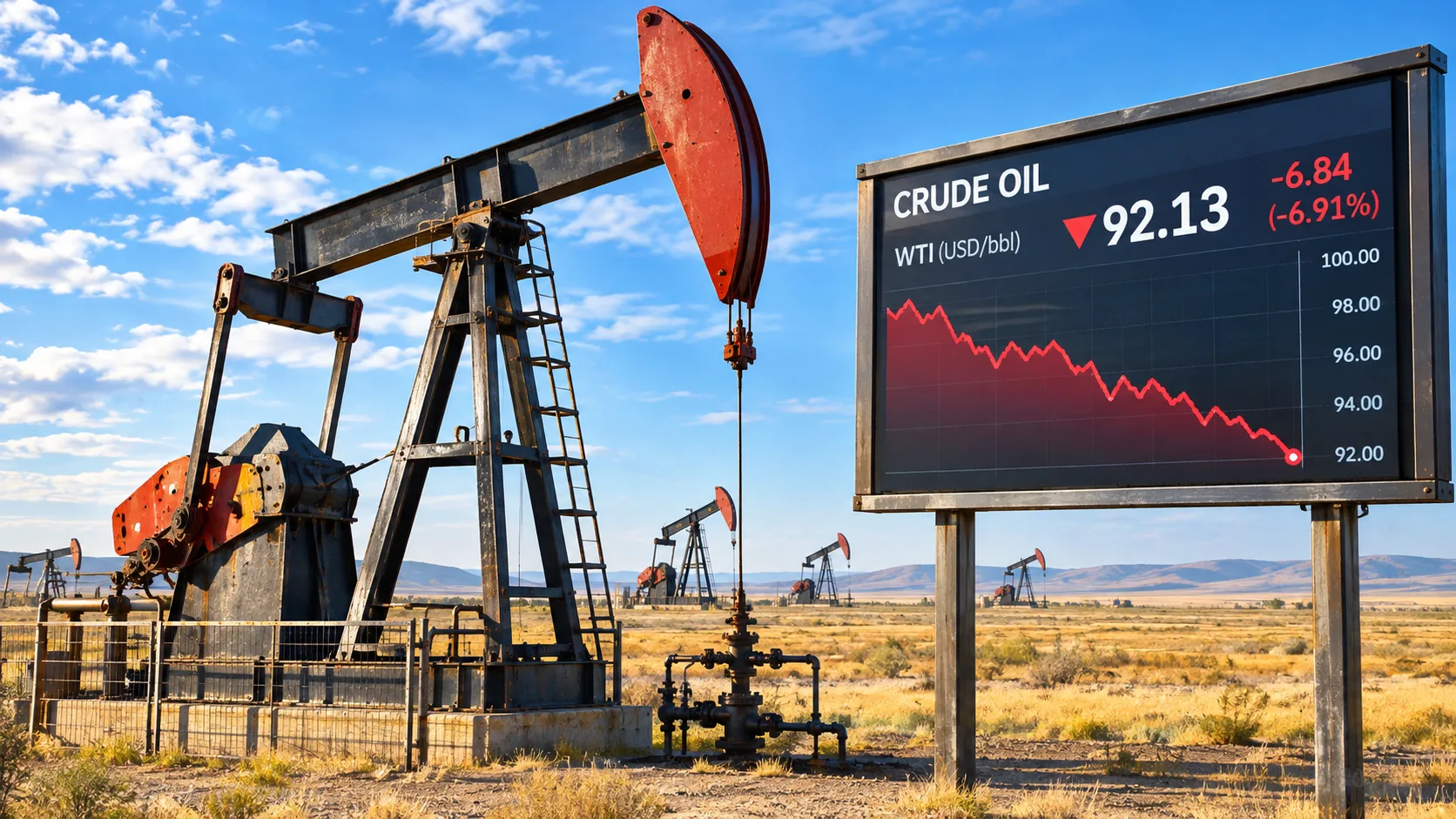
Oil prices are plunging at their fastest weekly pace since the COVID-19 pandemic, wiping billions from the energy market as President Donald Trump signals a major shift in the conflict with Iran. The dramatic selloff could have far-reaching consequences for inflation, gasoline prices, interest rates, and the stock market.
After months of elevated energy prices driven by tensions in the Middle East, oil traders are suddenly preparing for a very different scenario.
Brent crude, the international oil benchmark, plunged approximately 16% last week, its steepest weekly decline since April 2020. The selloff accelerated Monday, November 9, when Brent dropped another 5.85%, closing at $92.57 per barrel.
By Tuesday morning, November 10, Brent had fallen to approximately $91, while U.S. West Texas Intermediate crude was trading near $85.
The reversal is extraordinary. Brent was trading above $117 at the end of October. In less than two weeks, it has lost more than one-fifth of its value.
For investors, the important question is whether falling oil prices signal a major improvement in the economic outlook or whether the market is getting ahead of itself.
Why Oil Prices Are Suddenly Collapsing
The biggest catalyst behind the selloff is a dramatic shift in expectations surrounding the conflict involving the United States, Israel, and Iran.
President Trump has indicated that additional U.S. military strikes against Iran are unlikely while diplomatic discussions continue. On Monday, he reinforced that position, saying further military action was unnecessary for the time being.
Those comments have encouraged traders to reduce the geopolitical risk premium that had been supporting oil prices.
For months, the possibility of prolonged disruptions to Middle Eastern oil supplies has been a major concern for energy markets.
Particular attention has focused on the Strait of Hormuz, the narrow shipping passage connecting the Persian Gulf with international markets.
The strait is one of the world’s most important energy transportation routes. A prolonged disruption can threaten oil shipments from several major producing countries, forcing buyers to compete for available supplies and pushing prices higher.
Now, investors are increasingly anticipating that diplomatic progress could eventually restore more predictable shipping conditions.
That possibility alone has been enough to trigger aggressive selling.
The political landscape has also changed. Following Democrats’ victories in both chambers of Congress during the November midterm elections, traders began anticipating greater political pressure on the administration to reduce military involvement in the conflict.
Oil prices started falling sharply as those expectations took hold.
The Market Is Betting on Peace Before a Deal Exists
There is an important complication behind the recent collapse.
The oil market is already pricing in a more peaceful Middle East, even though a comprehensive agreement has yet to materialize.
Attacks on commercial vessels near the Strait of Hormuz have continued. The United States also intends to maintain its naval blockade for now.
That creates a potentially unstable situation.
Oil prices are falling because traders believe the risk of a prolonged supply disruption has declined. Yet the underlying conflict has not been fully resolved, and the threat to commercial shipping remains.
Another factor is reinforcing the selloff.
Despite the geopolitical tensions, substantial volumes of Middle Eastern crude have continued reaching international markets. Analysts at UBS have pointed to relatively strong regional oil flows and weakness in the physical market as additional reasons prices are declining.
In other words, traders are reassessing how much oil is actually at risk of disappearing from global supplies.
If the anticipated diplomatic progress becomes reality, prices could face additional downward pressure.
If negotiations collapse or shipping disruptions worsen, the market could reverse course quickly.
That uncertainty makes the next several weeks particularly important.
What Falling Oil Prices Mean for Inflation
For American consumers, lower oil prices could eventually provide some much-needed financial relief.
Crude oil is a major component of gasoline, diesel, jet fuel, and numerous products used throughout the economy.
When oil prices decline substantially, the savings can gradually filter into transportation costs, manufacturing, distribution, and household spending.
Consider an American household that purchases 60 gallons of gasoline per month.
If lower crude prices eventually translate into a 50-cent decline in gasoline prices, that household would save approximately $30 per month, or $360 annually.
Families that drive more could see larger savings.
Lower diesel prices could also reduce transportation expenses for businesses that move goods across the country.
However, crude oil prices and gasoline prices do not move in perfect synchronization. Refining costs, taxes, distribution expenses, and regional supply conditions all influence what consumers pay at the pump.
The larger economic benefit comes if cheaper energy helps slow the overall pace of inflation.
Energy affects far more than gasoline. It influences airline tickets, freight costs, food distribution, heating expenses, and manufacturing.
A sustained decline could reduce cost pressures across multiple industries, potentially improving household purchasing power and corporate profitability.
Could the Oil Collapse Change Interest Rates?
One of the most significant implications involves the Federal Reserve.
Energy prices are a visible component of consumer inflation. A sustained decline can help reduce headline inflation, potentially easing some of the pressure facing policymakers.
That would be particularly welcome for retirees and other Americans who have struggled with elevated living expenses.
However, lower oil prices do not automatically mean lower interest rates.
The Federal Reserve also closely monitors underlying inflation, wages, employment, and economic growth.
If those measures remain elevated, policymakers could maintain restrictive interest rates even as gasoline and energy prices decline.
Investors should therefore pay close attention to upcoming inflation reports.
If energy prices continue falling and broader inflation begins slowing, financial markets could become more optimistic about the future direction of interest rates.
That could influence everything from mortgage rates and bond yields to stock valuations.
Which Stocks Could Benefit From Cheaper Oil?
A sustained decline in crude prices creates winners and losers across the stock market.
Airlines and Transportation Companies
Airlines are among the clearest potential beneficiaries.
Jet fuel represents a substantial operating expense. When fuel prices decline, carriers may see meaningful improvements in profitability, provided ticket prices and passenger demand remain relatively stable.
Trucking companies, delivery services, and other transportation businesses could also benefit from lower operating costs.
Retailers and Consumer Companies
Lower gasoline prices can leave households with more money available for discretionary purchases.
That could benefit retailers, restaurants, travel companies, and other consumer-oriented businesses.
Companies that rely heavily on shipping products may also see some relief in transportation expenses.
Energy Producers
For oil and gas companies, the outlook becomes more challenging.
Lower crude prices generally translate into reduced revenue for producers, particularly those with higher operating costs.
Companies with substantial debt or expensive drilling operations may face greater financial pressure if prices remain depressed.
Larger, financially stronger producers may be better positioned to withstand the downturn, although their earnings can still decline.
Dividend Investors
Retirees who rely on dividend-paying energy stocks should pay particular attention.
A prolonged decline in crude prices can reduce cash flow available for shareholder distributions, stock buybacks, and capital investment.
That does not necessarily mean major oil companies will immediately reduce dividends. Many maintain substantial financial reserves and have experience operating through commodity downturns.
Still, investors should evaluate how comfortably a company can cover its dividend when oil prices are significantly lower.
For income-focused investors, balance-sheet strength and free cash flow may become increasingly important.
Why Falling Oil Prices Could Be Good News for the Stock Market
Wall Street is already responding to the changing energy outlook.
On Monday, November 9, major U.S. stock indexes rallied as oil prices continued falling.
The S&P 500 gained approximately 2.3%, while the Dow Jones Industrial Average rose 2.2%. The Nasdaq Composite advanced 2.7%.
The rally reflected growing optimism that reduced geopolitical tensions and lower energy costs could improve the economic outlook.
For many businesses, cheaper oil functions like a reduction in operating expenses.
Lower costs can support profit margins, while declining gasoline prices may encourage consumer spending.
There is also a psychological component.
When oil prices surge because of geopolitical conflict, investors worry about inflation, supply disruptions, and the possibility that expensive energy will weaken economic growth.
A sharp reversal can ease several of those concerns simultaneously.
But investors should be careful about assuming every decline in oil prices is positive for stocks.
If crude prices fall because supply conditions improve, the broader economy can benefit.
If they fall because global economic activity is slowing and demand is weakening, the implications are considerably less encouraging.
So far, the latest collapse appears heavily influenced by changing geopolitical expectations and the unwinding of oil’s war premium.
That distinction matters.
Could Oil Prices Fall Below $80 a Barrel?
With Brent crude already trading near $90, investors are beginning to consider how much further the selloff could extend.
A move below $80 is possible, although it would require additional downward pressure.
Three developments could determine what happens next.
1. A credible agreement involving Iran
A diplomatic breakthrough that significantly reduces military tensions could remove more of the geopolitical premium embedded in crude prices.
If commercial shipping becomes safer and more predictable, buyers may become less concerned about future supply interruptions.
2. Continued strength in global oil supplies
If major oil-producing regions maintain production and Middle Eastern exports continue reaching international markets, the market could become more comfortable with available supplies.
That would reduce the urgency for buyers to pay elevated prices as protection against potential shortages.
3. Signs of weakening global demand
Oil consumption is closely connected to industrial activity, transportation, and economic growth.
If economic data points toward weaker demand, crude prices could experience additional pressure.
However, a renewed escalation in the Iran conflict or significant disruption in the Strait of Hormuz could rapidly reverse the decline.
Oil has already demonstrated how quickly prices can move when geopolitical expectations change.
Three Signals Investors Should Watch Next
Rather than attempting to predict an exact bottom in crude prices, investors can monitor three developments that will help determine whether the selloff is sustainable.
| Key Indicator | Why It Matters |
|---|---|
| Strait of Hormuz shipping activity | Sustained, safer shipping flows would support expectations of more reliable oil supplies. Renewed attacks could send prices higher. |
| U.S. inflation reports | Slowing inflation alongside falling oil would strengthen the case for broader economic relief. |
| Energy company earnings and spending plans | Reduced drilling budgets, weaker cash flow, or lower production guidance could reveal how sustained price declines are affecting the industry. |
Together, these indicators can help distinguish a temporary geopolitical-driven selloff from a more durable shift in the energy market.
For retirement investors, that distinction is particularly important.
Lower energy costs could benefit household budgets and certain stock-market sectors. At the same time, falling crude prices could create pressure on energy dividends and investments tied directly to oil production.
The Bigger Picture for Investors
The speed of the oil market’s reversal is remarkable.
Just weeks ago, traders were positioning for the possibility of prolonged disruption in one of the world’s most important oil-producing regions.
Now, markets are rapidly adjusting to the prospect that diplomatic progress could reduce those risks.
The collapse has already helped lift stock-market sentiment and raised the possibility of lower energy costs for American households.
But the outcome remains uncertain.
The United States and Iran have yet to reach a comprehensive agreement, and shipping risks remain a serious concern.
For investors, the biggest opportunity may come from understanding how lower oil prices affect the broader economy, rather than trying to guess where crude prices will bottom.
If the decline continues, it could provide meaningful relief for consumers, support corporate profits, and improve the inflation outlook.
If the market’s hopes for peace prove premature, oil prices could rebound just as quickly as they have fallen.
Either way, the energy market’s largest weekly collapse since the COVID-19 pandemic has become one of the most important financial developments investors need to watch.
About Author