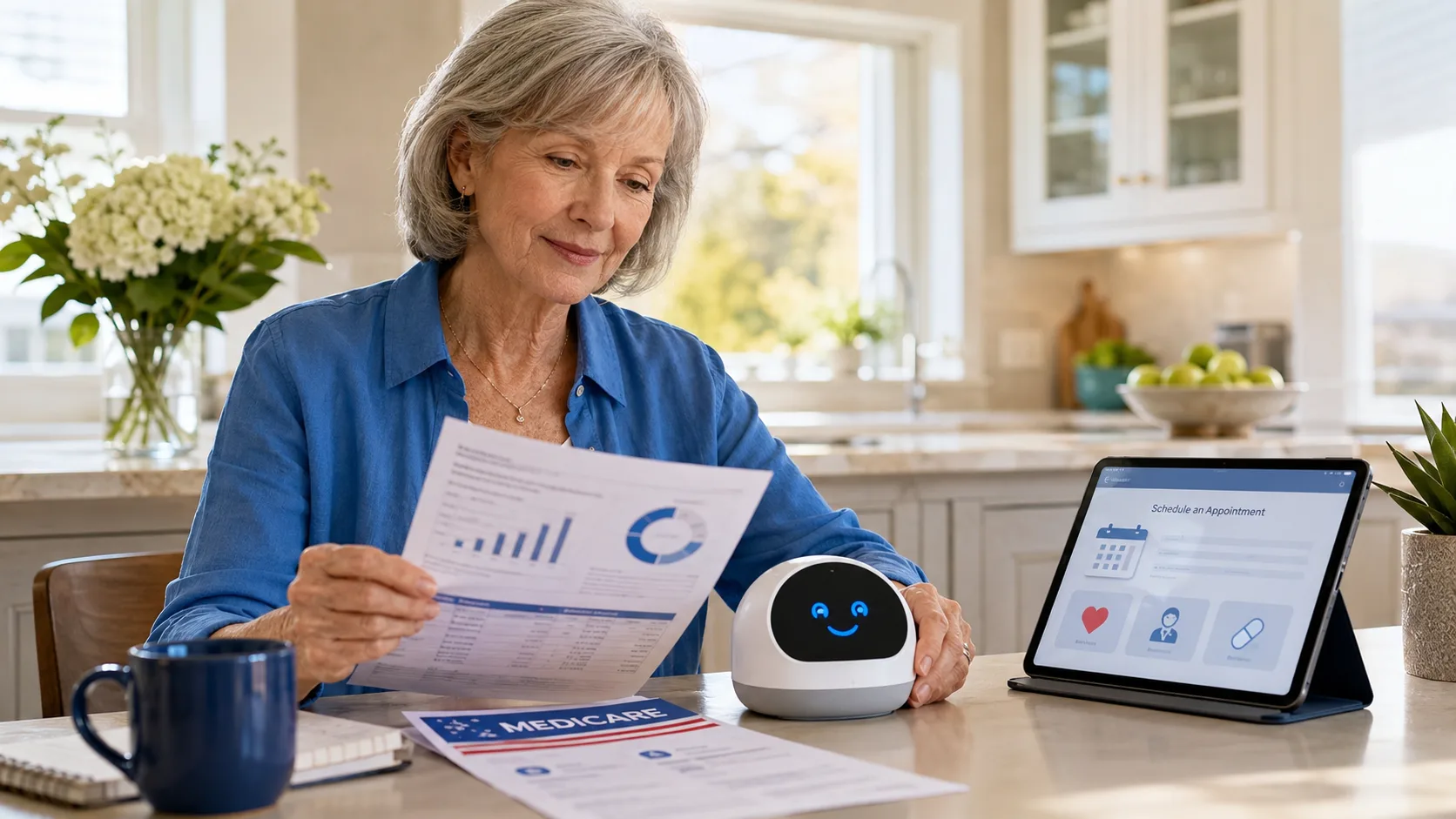
Artificial intelligence is rapidly moving into healthcare, insurance, caregiving and investment management. For retirees, the technology could extend independence and simplify complex decisions, but it also creates new threats to medical coverage, privacy and retirement portfolios.
AI is usually presented as a technology story. For older Americans, it is becoming something much more personal.
Algorithms may help determine whether Medicare covers a procedure. AI systems are monitoring hospital patients, detecting fall risks and providing companionship to people who live alone. Meanwhile, the companies funding the AI boom occupy an enormous share of the stock market, giving millions of retirement accounts substantial exposure whether investors actively sought it or not.
That creates a complicated tradeoff. Retirees may benefit from AI more directly than almost any other group, yet they have less time to recover from its financial or medical failures.
AI Has Already Entered the Retirement System
The clearest example may be healthcare.
Chatbots such as ChatGPT and Google Gemini can translate medical reports, explain unfamiliar terminology and help patients prepare questions before an appointment. For someone trying to understand a complicated diagnosis or prescription, that can make a rushed doctor’s visit far more productive.
AI is also operating behind the scenes. Some hospitals use predictive systems to identify patients at risk of deterioration, allowing medical teams to intervene before a patient requires intensive care. Other tools listen during appointments and prepare clinical notes, giving doctors more time to speak directly with patients.
Caregiving technology is advancing as well.
AI-enabled monitoring systems can identify changes in movement, sleep or balance that may signal a growing health problem. Assisted-living facilities are testing systems designed to recognize fall risks, while developers are working on smarter wheelchairs, robotic companions and connected-home technology.
The opportunity is substantial. Falls are the leading cause of injury among Americans 65 and older, according to the Centers for Disease Control and Prevention. More than 14 million older adults report falling each year.
Even a modest reduction in falls could lower medical costs, extend independence and delay the need for assisted living.
The Real Shift Is From Assistance to Authority
The most important distinction for retirees is the difference between an AI system that provides information and one that influences a consequential decision.
Asking a chatbot to explain a blood-test result is assistance. Allowing an algorithm to influence whether an insurer approves treatment is authority.
That line is already beginning to blur.
Medicare Advantage insurers have used automated systems in claims administration and prior authorization, drawing scrutiny over whether algorithms contribute to inappropriate delays or denials. The federal government is also introducing technology-assisted reviews within traditional Medicare.
The Centers for Medicare and Medicaid Services launched the Wasteful and Inappropriate Service Reduction Model, known as WISeR, on Jan. 1, 2026. The six-state pilot requires prior authorization for a limited set of services that CMS believes may be vulnerable to unnecessary or inappropriate use.
CMS says clinicians will make final coverage decisions and that the program includes human review. Even so, the initiative illustrates how deeply automated analysis is moving into healthcare administration.
This matters because many patients do not appeal rejected claims, even when the decision may be reversible. Retirees and their families will increasingly need to understand when an algorithm influenced a decision, how to request human review and how to file an appeal.
An AI-generated denial may arrive faster than a traditional one. That does not make the decision more accurate.
Your Retirement Portfolio May Be an AI Portfolio Already
AI exposure is no longer confined to investors who bought Nvidia or a specialized technology fund.
The largest technology and communications companies carry tremendous weight in major indexes. That means an investor holding a standard S&P 500 fund may already have significant exposure to companies whose valuations depend partly on AI spending and expectations.
The exposure extends further.
Alphabet, Meta Platforms, Microsoft, Amazon and Oracle are spending heavily on data centers, chips, networking equipment and power infrastructure. Some are also borrowing billions of dollars through the corporate bond market to finance expansion.
Utilities are building generation and transmission capacity for data centers. Industrial companies are supplying cooling systems, electrical equipment and construction materials. Energy producers are positioning themselves to meet growing electricity demand.
AI has become a capital-spending cycle that reaches across stocks, bonds, utilities, real estate and commodities.
For retirees, this creates two separate risks.
Concentration Risk
Market-cap-weighted indexes give their largest allocations to the most valuable companies. When a small group of AI-linked stocks rises rapidly, those companies gain even more influence over index performance.
That works well while earnings and valuations continue climbing. If expectations weaken, the same concentration can accelerate losses.
A retiree drawing money from a portfolio during a broad selloff faces sequence-of-returns risk. Losses early in retirement can be especially damaging because withdrawals leave less capital available to participate in a recovery.
Interest-Rate Risk
AI development requires extraordinary amounts of capital. Data centers, power generation and chip infrastructure are expensive, and the payoff may take years to materialize.
If bond yields remain elevated, financing becomes more expensive and future earnings are discounted more heavily. High-growth companies are especially sensitive because a larger portion of their expected value lies years in the future.
Rising yields can therefore pressure both sides of a retirement portfolio. They can reduce technology-stock valuations while creating losses in longer-duration bonds.
This relationship makes Federal Reserve policy, Treasury yields and corporate borrowing costs increasingly important indicators for anyone with substantial AI exposure.
How Retirees Can Reduce the Risk Without Abandoning AI
Avoiding every AI-linked investment would be extremely difficult and could carry a significant opportunity cost. The technology may produce lasting gains in productivity, healthcare and infrastructure.
The more practical response is diversification.
An equal-weight S&P 500 fund, such as the Invesco S&P 500 Equal Weight ETF, assigns approximately the same weight to every company in the index. That reduces dependence on the largest technology stocks, although it creates greater exposure to smaller companies and different economic risks.
International funds can also spread exposure across countries, currencies and industries. The Vanguard Total International Stock ETF, for example, still holds important semiconductor and technology companies, but its portfolio extends across developed and emerging markets.
Retirees may also examine sectors whose performance depends less directly on AI valuations, including selected healthcare, consumer staples, real estate and income-producing businesses.
The appropriate allocation will depend on withdrawal needs, pensions, Social Security income, taxes and tolerance for volatility. The key is to measure total exposure rather than counting only the stocks carrying an obvious AI label.
A retiree who owns a broad index fund, a growth fund and shares of several large technology companies may have far more concentration than the number of holdings suggests.
Human Advice Could Become More Valuable
The assumption that AI will make financial and medical professionals obsolete may be premature.
AI can summarize, calculate and generate scenarios cheaply. Those capabilities should lower the cost of routine work and make basic guidance more accessible.
Accountability remains scarce.
A chatbot does not automatically understand a household’s full tax situation, long-term-care exposure, Medicare income-related surcharges, estate plan or emotional response to a market decline. It also has no fiduciary obligation to place a retiree’s interests first.
The most valuable professionals may increasingly use AI to analyze information faster while accepting responsibility for the final recommendation.
That could divide the advisory market. Generic guidance becomes cheaper, while verified judgment, coordination and accountability become more valuable.
About Author