
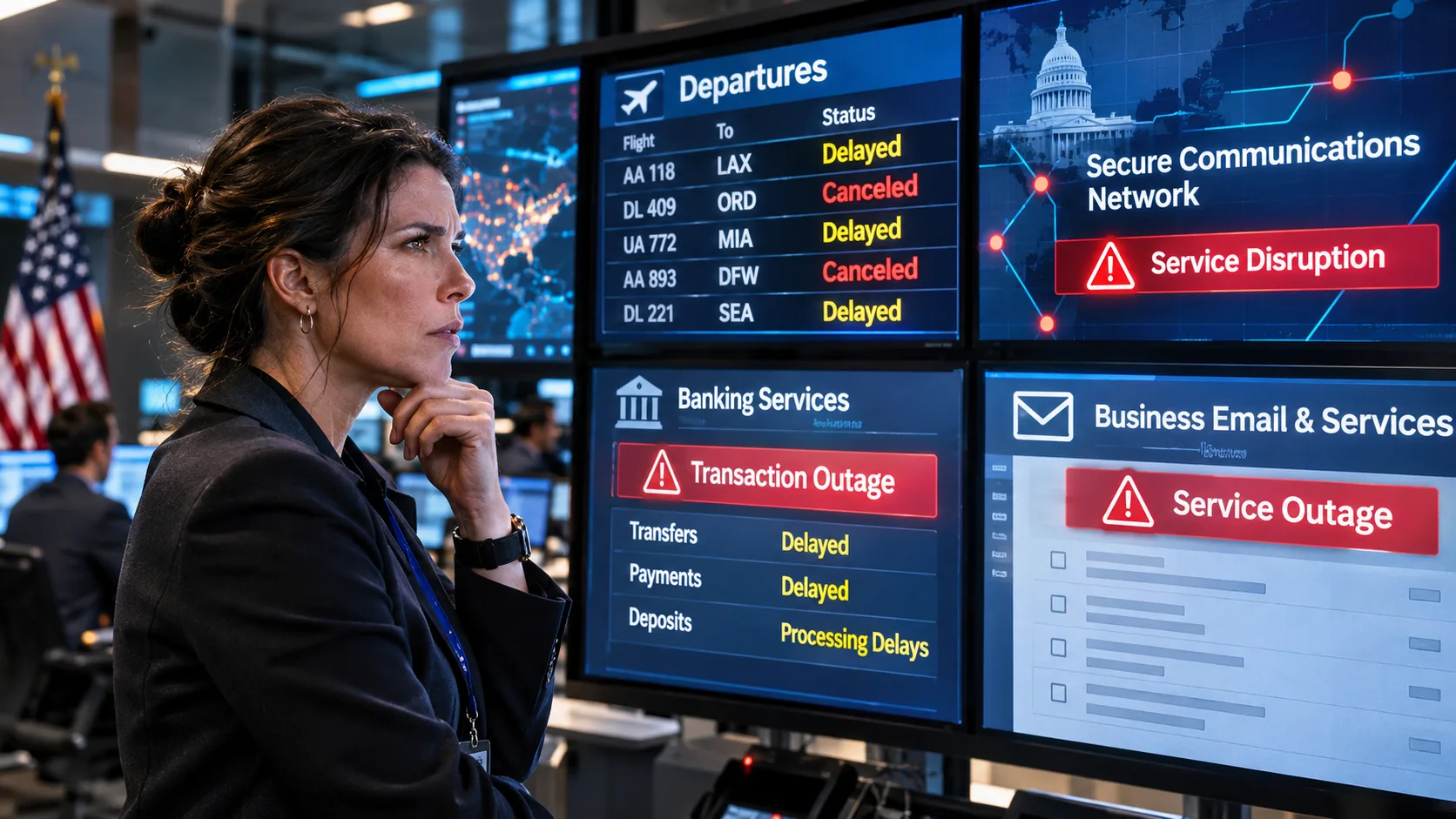
A highly classified National Security Agency communications network has reportedly gone offline, adding to an extraordinary series of technology failures that have disrupted American banking, air travel, businesses and government operations in less than a week.
The Trump administration insists there is no evidence of a coordinated cyberattack. But the growing number of failures is raising a much larger question: How vulnerable has America’s critical infrastructure become?
Classified NSA Network Becomes Latest System to Fail
CNN reported Tuesday that NSA Net, a classified communications network used internally by the National Security Agency, had gone down. The agency reportedly implemented staggered arrival times for employees while investigating the disruption. The cause remains unknown, and sources familiar with the situation said there was no immediate evidence of a cyberattack.
The report follows several major incidents that have disrupted essential services since November 12.
- November 12: A massive Microsoft 365 outage disrupted Outlook, email delivery and other workplace services worldwide.
- November 13: A failure involving the FAA’s telecommunications infrastructure triggered a nationwide ground stop, disrupting thousands of flights.
- November 13: Human resources software company Workday experienced a significant service interruption, affecting employee access to workplace systems.
- November 16: JPMorgan Chase experienced transaction delays, with problems also reported by customers of other major banks. United Airlines separately suffered a systems outage that delayed departures.
- November 17: Reports emerged that the NSA’s classified internal communications network was unavailable.
Authorities have not established a connection among these incidents. Several organizations have attributed their disruptions to technical failures rather than malicious activity. Nevertheless, the concentration of failures across banking, aviation, corporate technology and national security has exposed a troubling dependence on increasingly complex systems.
Trump Administration Moves to Calm Americans
Vice President JD Vance addressed mounting public anxiety in an interview with Fox News released Monday.
“We do not see some crisis coming down. But you have to be prepared for everything,” Vance said.
He acknowledged that friends had asked whether they should begin building bunkers or stockpiling emergency supplies. His answer was no, explaining that government efforts to prepare military installations and other critical operations for potential emergencies are part of responsible contingency planning.
Homeland Security Secretary Markwayne Mullin also rejected suggestions that the disruptions were part of a coordinated attack, saying federal cybersecurity officials had found no evidence connecting the incidents.
Mullin said the government was approximately 98% certain that the outages were unrelated to cyberattacks, adding that investigators had found no suspicious digital activity linking them.
But the administration’s reassurances come amid growing questions about the reliability of the infrastructure supporting the U.S. economy. Even failures caused by routine maintenance or software defects can create disruptions once associated primarily with major cyberattacks.
A Single Router Helped Shut Down America’s Airspace
The November 13 nationwide ground stop offers one of the clearest examples of the problem.
Transportation Secretary Sean Duffy said the failure occurred while contractor L3Harris was upgrading legacy FAA telecommunications infrastructure, replacing older copper connections with fiber-optic technology. During that process, a malfunctioning router apparently began overwhelming other network equipment with connection attempts, disrupting communications and radar information.
The FAA temporarily halted departures nationwide while technicians isolated the issue. Duffy said investigators were examining whether the problem resulted from faulty equipment or contractor error, with the precise root cause still under investigation.
The incident has become a political and financial flashpoint. Duffy is seeking as much as $50 billion for air traffic control modernization, even as lawmakers question how previously authorized funding has been used.
On November 17, Democratic members of the Senate Commerce Committee called for additional router installations to be paused until testing and reliability concerns are addressed. According to information cited by the senators, the FAA’s modernization effort involves replacing more than 3,600 routers, with only 69 of 400 installed devices operational at the time of their inquiry.
The confrontation could complicate efforts to modernize an air traffic control system that government officials have warned for years is becoming increasingly outdated.
Microsoft’s Outage Reveals an Even Bigger Problem
Microsoft’s preliminary investigation offers another warning about the fragility of modern technology infrastructure.
According to a post-incident report released after last week’s outage, a software defect introduced months earlier combined with shifting network traffic and reduced server capacity to trigger widespread failures. More than 80% of affected networking gateway servers reportedly became unresponsive, disrupting email and other cloud services used by businesses around the world.
The outage lasted nearly 24 hours, leaving companies unable to access essential communications and workplace applications.
Microsoft’s findings point to a significant vulnerability: a software problem can remain undetected for months before an ordinary change in operating conditions exposes it.
As more businesses move critical operations into cloud platforms, an isolated technical problem can rapidly spread across organizations that depend on the same provider. The immediate consequences include lost productivity, interrupted communications and delayed transactions, while longer disruptions could create more serious financial consequences for companies without adequate backup systems.
The Bigger Threat to America’s Economy
The recent incidents are drawing attention to a problem that extends far beyond individual technology companies.
Much of America’s essential infrastructure was built decades ago and has been updated through successive layers of hardware, software and communications equipment. Those systems now support an economy that depends on uninterrupted digital connectivity, creating enormous consequences when even a relatively small component fails.
Airlines need reliable communications to operate safely. Banks depend on continuously available transaction processing, while businesses rely on cloud software to communicate with employees, customers and suppliers.
As these systems become more interconnected, failures can have consequences far beyond the equipment or application where the original problem occurred.
The implications are particularly significant as artificial intelligence increases demand for computing capacity, electricity and sophisticated digital infrastructure. The country’s aging electrical grid, transportation networks and government computer systems face growing pressure to accommodate technologies that did not exist when much of that infrastructure was designed.
Modernization will require substantial investment, but the FAA failure demonstrates that upgrading old infrastructure can introduce new risks when changes are poorly tested or existing systems cannot handle unexpected behavior.
Why Wall Street Should Pay Attention
For investors, the biggest implications may emerge through infrastructure spending, corporate risk management and government technology contracts.
Cybersecurity and Network Resilience
Companies and government agencies could face mounting pressure to improve monitoring, backup systems and disaster recovery capabilities. That could support longer-term demand for cybersecurity and network management providers, including companies such as Palo Alto Networks, CrowdStrike and Fortinet.
However, the recent incidents demonstrate that organizations also need protection against ordinary operational failures. Cybersecurity spending alone cannot eliminate problems caused by defective software or aging hardware.
Infrastructure and Government Contractors
The FAA’s proposed $50 billion modernization effort highlights the scale of potential government investment. Companies specializing in telecommunications, networking equipment, aerospace systems and infrastructure modernization could benefit from additional federal spending.
The opportunity carries risks. Contractors involved in system failures could face greater scrutiny, contract reviews and stricter testing requirements, potentially increasing project costs and delaying implementation.
Cloud Computing and Enterprise Software
Microsoft’s outage raises questions about the concentration of critical business services among a relatively small number of technology providers.
Major outages could push corporate customers to invest more heavily in redundancy, backup communications and alternative service arrangements. Those investments may create opportunities for infrastructure providers while also increasing operating costs for businesses that must maintain multiple systems to ensure continuity.
The Risk Investors May Be Underestimating
The most important lesson from these incidents may be that a major economic disruption does not require a sophisticated foreign cyberattack.
A faulty router, an overlooked software defect or an improperly executed upgrade can produce consequences that extend across an entire industry. Technology companies generate substantial revenue by connecting businesses, automating operations and moving critical services into centralized platforms, but those same efficiencies can create concentrated points of failure.
As dependence on technology increases, reliability becomes an increasingly important financial consideration.
Investors may need to look beyond revenue growth and profit margins when evaluating infrastructure-dependent companies. Operational resilience, supplier concentration and contingency planning could become more important measures of long-term risk, especially for businesses whose customers cannot tolerate extended interruptions.
America’s Infrastructure Is Facing a Serious Test
The Trump administration says there is no evidence that the recent disruptions represent a coordinated attack. Based on currently available information, that assessment remains consistent with the reported technical causes of several incidents.
But the broader concern is difficult to dismiss.
Within days, Americans have experienced interruptions involving essential corporate software, banking transactions, commercial aviation and, reportedly, classified government communications. The incidents have highlighted how heavily the nation’s economy and national security depend on technology systems that can be disrupted by comparatively ordinary failures.
The question is no longer whether America’s increasingly interconnected technology systems can fail. They already have. The question is whether the country can strengthen them before the next disruption causes far greater damage.
For investors, the resulting push toward infrastructure modernization, cybersecurity and operational resilience could become an important spending theme for years to come.
About Author