
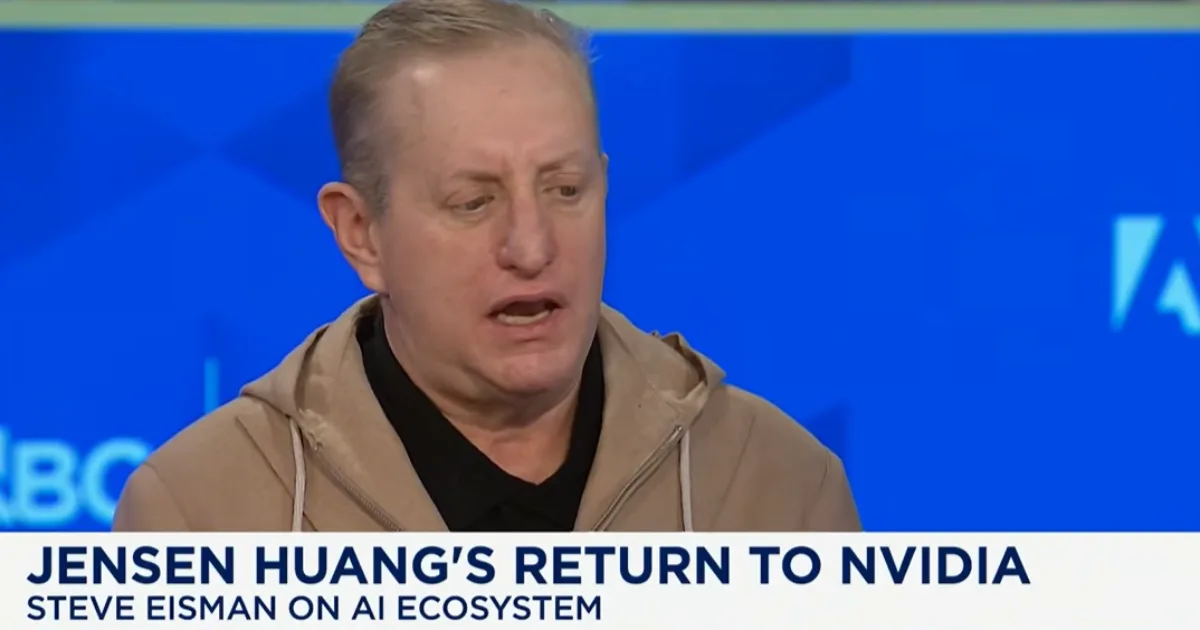
The investor who famously saw the 2008 financial crisis coming says Jensen Huang’s return has bought the artificial intelligence industry more time. But the financial risks underpinning America’s biggest investment boom remain.
Nvidia’s spectacular rally following the reinstatement of CEO Jensen Huang may have given Wall Street a false sense of security. Steve Eisman, the investor made famous by The Big Short, believes the AI industry remains dangerously dependent on an interconnected network of financing arrangements, speculative investments and enormous capital expenditures.
Appearing Tuesday morning on CNBC’s Squawk Box, Eisman suggested that Huang’s return may have prevented an immediate unraveling of the AI trade while doing little to address its underlying vulnerabilities.
Perhaps most tellingly, the veteran investor revealed that he has reduced the risk in his own portfolio despite the market’s dramatic recovery.
Nvidia’s Comeback Has Bought Wall Street Time
Nvidia shares surged more than 31% on Monday after the company announced Huang’s reinstatement as chief executive officer. The S&P 500 jumped 4.7%, illustrating just how dependent the broader stock market has become on confidence in artificial intelligence.
Nvidia’s board unanimously approved Huang’s return after receiving input from senior members of the U.S. government. President Donald Trump also acknowledged his involvement in persuading the company to bring back its founder.
Eisman, however, questioned whether Huang was truly indispensable and expressed concern about the circumstances surrounding his reinstatement.
“I find the whole thing disturbing,” Eisman said.
He pointed to Apple following the death of Steve Jobs in 2011. Despite widespread concerns at the time that Apple would struggle without its visionary founder, the company went on to generate extraordinary shareholder returns under Tim Cook.
Eisman believes Nvidia could similarly have survived a leadership transition. His greater concern was what Huang’s departure might have meant for the network of businesses whose growth depends, at least partially, on Nvidia’s financial support.
That distinction may be one of the most important overlooked aspects of the entire Nvidia saga.
Is Nvidia Financing Its Own AI Boom?
For years, investors have focused on Nvidia’s ability to sell increasingly powerful and expensive artificial intelligence chips. What deserves greater attention, according to Eisman, is how some of the companies purchasing those chips are financing their expansion.
Nvidia has evolved beyond its traditional role as a semiconductor supplier. Through strategic investments and other financial arrangements, it has helped develop an ecosystem of AI laboratories, emerging cloud computing providers and infrastructure companies.
Many of these businesses are also potential customers for Nvidia’s products.
The arrangement, commonly referred to as circular financing, can create a powerful cycle of growth:
- Nvidia provides capital or financial support to an AI company.
- That company expands its computing infrastructure.
- The expansion generates additional demand for Nvidia chips.
- Nvidia generates revenue and profits from those sales.
- Additional capital becomes available to support further expansion across the AI ecosystem.
When demand is growing and capital remains plentiful, the arrangement can benefit everyone involved. Nvidia gains customers, emerging technology companies gain access to computing power, and investors benefit from rapid revenue growth.
The vulnerability emerges when businesses within that ecosystem struggle to generate enough independent revenue to sustain their spending.
A billion-dollar purchase of AI infrastructure carries different financial implications when the buyer is funding it through established, profitable operations than when it relies heavily on outside investment and financing.
Both transactions can generate revenue for a chip supplier. Their long-term sustainability, however, may be considerably different.
Circular financing arrangements are not inherently improper, and their existence alone does not establish accounting misconduct. The investment question is whether the underlying demand can eventually sustain itself without continued financial assistance.
The AI Industry Has Three Problems Huang Cannot Solve Alone
Eisman identified several fundamental challenges that existed before Huang’s departure and remain after his return.
1. Artificial Intelligence Is Becoming Increasingly Expensive
Building advanced AI models requires enormous investments in semiconductors, data centers, electricity, cooling systems and engineering talent.
Companies must commit substantial amounts of capital before knowing whether their products will generate sufficient financial returns. In some cases, they may also need to replace expensive computing equipment as newer, more powerful technology becomes available.
For investors, rapid revenue growth can conceal a difficult economic reality if capital expenditures continue consuming much of the cash a business generates.
The AI industry ultimately needs to demonstrate that its infrastructure investments can produce attractive and sustainable returns.
2. The AI Price War Could Destroy Profit Margins
Competition among OpenAI, Anthropic and developers of Chinese open-weight AI models is intensifying.
As competing systems become more capable, customers gain additional choices and negotiating power. That makes it increasingly difficult for individual AI providers to maintain premium pricing.
The industry could find itself facing an uncomfortable combination of rising infrastructure costs and declining prices for its services.
Consumers and businesses could benefit enormously from cheaper artificial intelligence. Shareholders financing the infrastructure behind it may experience a very different outcome.
3. AI Companies May Have Weaker Competitive Advantages Than Investors Expect
Technology companies have historically commanded premium valuations because of their ability to build durable competitive advantages, often referred to as economic moats.
Eisman questioned whether developers of large language models possess sufficiently strong moats to protect their long-term profitability.
If competing AI systems deliver comparable results, customers may increasingly select providers based on price, convenience and integration with existing software.
Artificial intelligence could become one of the most transformative technologies in modern history while some of the companies developing it fail to deliver the investment returns shareholders currently anticipate.
The history of technological innovation is filled with examples of revolutionary products that transformed society while leaving early investors with disappointing returns.
The Warning That Should Concern Every Investor
Perhaps the most consequential statement Eisman made during the interview had little to do with Nvidia itself.
“The entire economy of the United States is dependent upon this period. It’s one trade,” he said.
While that characterization is arguably an exaggeration, it highlights a legitimate concern about the concentration of investment, economic growth and stock market performance around artificial intelligence.
Consider how far the AI investment cycle now extends beyond Silicon Valley:
- Semiconductor manufacturers supplying advanced chips.
- Utilities expanding electricity generation capacity.
- Industrial companies supplying data center equipment.
- Construction companies building computing facilities.
- Private credit firms financing AI infrastructure.
- Technology companies committing billions to future computing capacity.
A significant slowdown in AI spending could affect corporate earnings, employment, business investment and retirement portfolios across multiple sectors.
Even investors who have never directly purchased Nvidia stock could have considerable exposure through S&P 500 index funds, mutual funds and retirement accounts.
Is Wall Street Betting on an AI Safety Net?
Trump’s involvement in Huang’s return raises another interesting possibility: Investors may begin to believe that the AI industry has become too economically and strategically important for Washington to allow a major disruption.
Wall Street has historically referred to the expectation that the Federal Reserve will intervene during periods of severe financial distress as the “Fed put.”
The Nvidia episode raises the possibility of something different: an informal AI put, where investors increasingly anticipate government intervention when the artificial intelligence industry faces significant threats.
There is no guarantee such protection exists. Nevertheless, the perception alone could encourage greater risk-taking, higher valuations and more aggressive financing arrangements.
The danger is that government intervention may delay a financial reckoning while allowing underlying risks to accumulate.
Washington can influence corporate leadership, technology exports and industrial policy. It cannot guarantee that AI companies will generate sufficient profits to justify their enormous investments.
The Man Who Saw the Housing Bubble Coming Is Lowering His Risk
Eisman became one of Wall Street’s most recognizable investors after identifying weaknesses in the mortgage market before the 2008 financial crisis.
Although today’s AI investment boom is fundamentally different from the housing bubble, both raise an important question about financial interdependence: How many seemingly independent businesses are ultimately relying on the same assumptions?
During Tuesday’s interview, Eisman revealed that he has become more defensive with his personal investments.
“My risk is lower than than it usually is,” he said.
He acknowledged that the AI rally could continue for some time following Huang’s return, while expressing reluctance to make a major investment given the uncertainty surrounding the industry.
Eisman has neither declared that an imminent market crash is inevitable nor suggested that investors should abandon artificial intelligence entirely. His position reflects uncertainty about how long the current investment cycle can continue and what might eventually disrupt it.
For an investor who built his reputation questioning widely accepted Wall Street assumptions, that caution is particularly noteworthy.
Three Signals That Could Reveal Whether the AI Boom Is Sustainable
Rather than focusing exclusively on Nvidia’s daily stock price, investors may find greater value in monitoring three developments over the coming months.
Independent customer demand: Watch whether AI companies generate sufficient cash from paying customers to finance an increasing portion of their infrastructure spending. Reduced dependence on strategic investments and external financing would strengthen the industry’s financial foundation.
Capital spending versus profitability: Monitor whether major technology companies begin moderating their AI expenditures and whether businesses providing AI services can improve profit margins as competition intensifies.
Financial and political scrutiny: Pay attention to new disclosures surrounding Nvidia’s investments, financing commitments and relationships with customers. Congressional scrutiny of Huang’s reinstatement could also introduce additional uncertainty for the company and its shareholders.
Huang is reportedly scheduled to testify before the Senate Banking Committee on December 3, creating another potential catalyst for Nvidia and the broader technology sector.
Nvidia Has Recovered. The Bigger Questions Remain.
Jensen Huang’s return has restored a significant degree of confidence to an industry that appeared increasingly vulnerable just days earlier.
The strongest argument against Eisman’s concerns is that AI demand could grow rapidly enough to justify today’s enormous investments. Strategic financing may ultimately prove to have been an effective way to accelerate the development of a profitable global industry.
That outcome remains possible.
For now, however, investors are still confronting many of the same questions about profitability, competition, financing and valuations that existed before Nvidia’s leadership crisis began.
Huang’s return has given the industry more time to answer them.
Whether it can deliver those answers may ultimately determine the direction of the stock market in 2027.
About Author