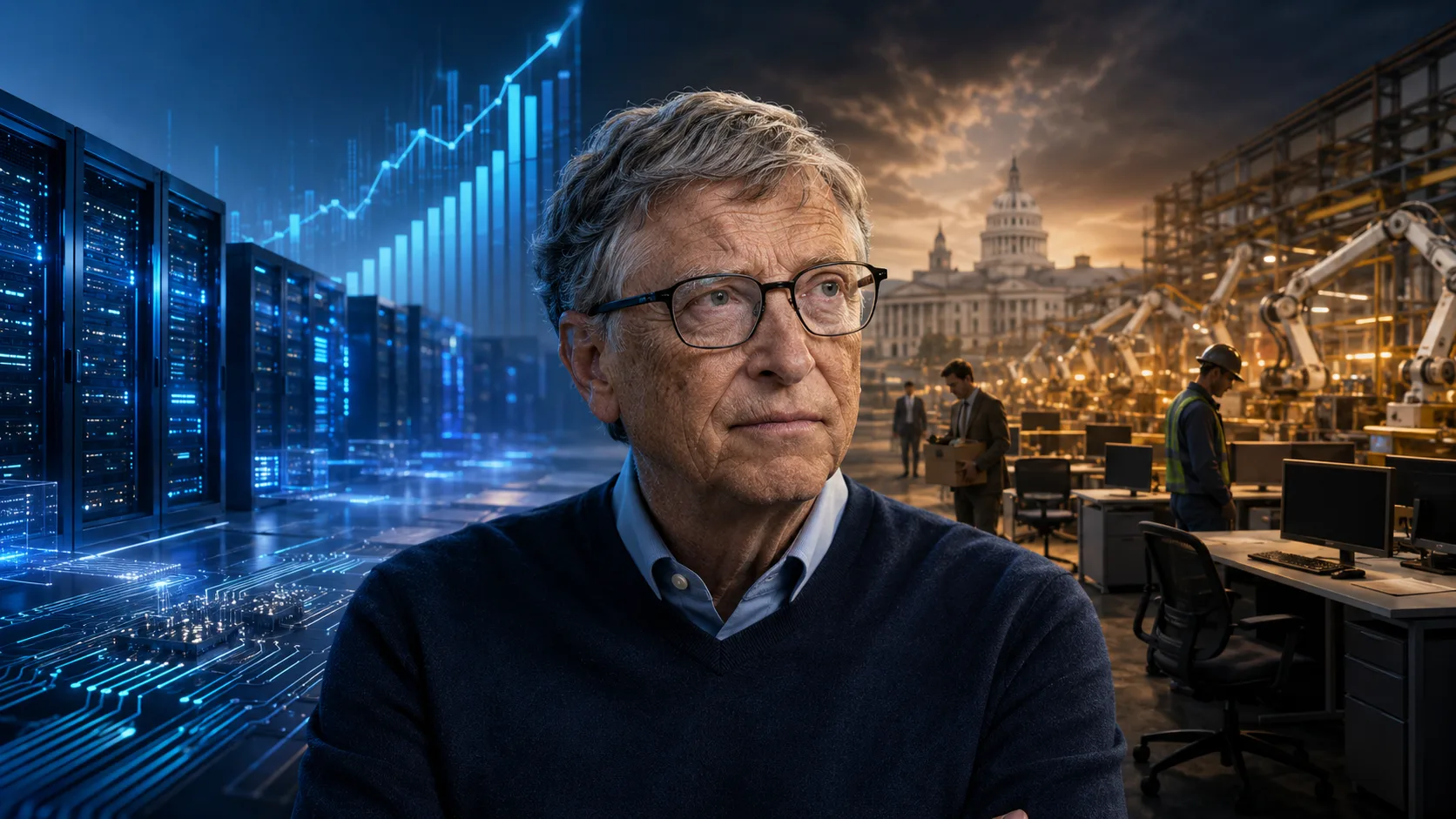
Bill Gates believes artificial intelligence could transform medicine, agriculture and productivity. He is equally convinced that governments and businesses are dangerously unprepared for the economic disruption arriving with it.
In a sweeping 5,784-word essay, the Microsoft co-founder warns that the transition to an AI-driven economy could become one of the most turbulent periods in human history.
“There is no plan to ease the entry into the AI era,” Gates wrote.
For investors, the warning carries implications far beyond the technology sector. If AI replaces workers faster than economies can create new roles, the effects will spread through consumer spending, corporate profits, tax revenue and political policy. The companies building AI could generate extraordinary wealth while governments scramble to manage the consequences.
That collision between technological progress and economic stability may become one of the defining market forces of the next decade.
Gates Is Sounding a More Urgent Alarm
Gates has consistently described AI as a breakthrough comparable to the personal computer and the internet. His latest message retains that optimism, particularly around healthcare, energy, education and agriculture.
The tone, however, has grown much more cautious.
“Even under the best circumstances, the transition to this new AI era will be one of the most turbulent times in human history,” Gates wrote. “Right now, we are not preparing for it. I don’t see evidence that leaders, experts and communities are confronting the challenges adequately.”
His warning centers on three risks.
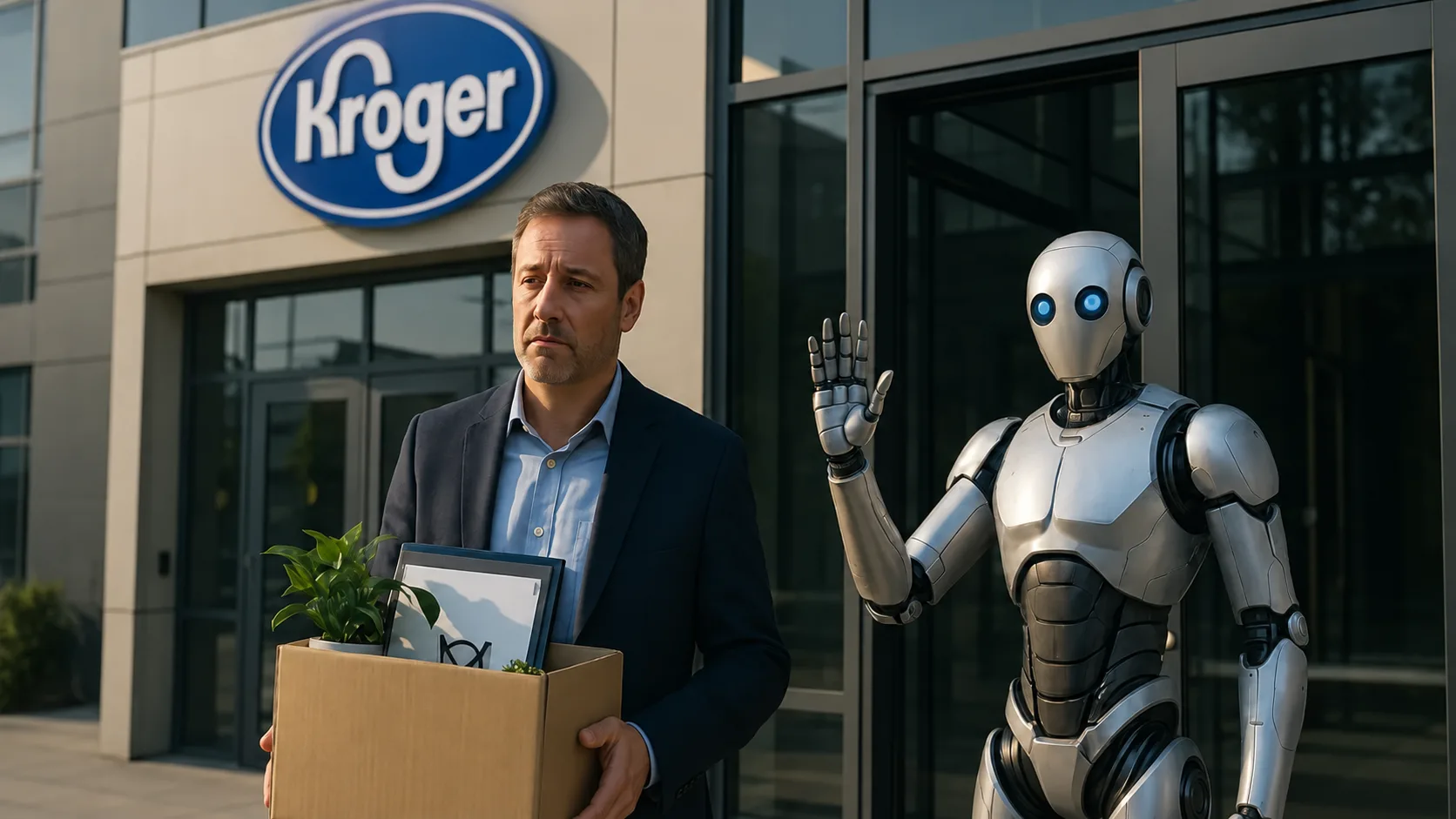
First, AI could eliminate both white-collar and blue-collar jobs at a pace that existing labor markets cannot absorb.
Second, increasingly capable systems could weaken critical thinking while expanding the reach of fraud, surveillance, misinformation and cyberattacks.
Third, governments may need entirely new tax structures to replace lost income-tax revenue and support workers displaced by automation.
Each concern has direct consequences for investors.
Takeaway No. 1: The Labor Shock Could Arrive Faster Than Expected
Previous technological revolutions displaced workers, but the adjustment often unfolded across generations. Agricultural employment declined over many decades. Manufacturing automation spread gradually across industries and regions.
AI can move much faster because software can be deployed across thousands of businesses almost instantly.
Entry-level and midlevel positions in customer service, law, finance, marketing and software development appear particularly exposed. Gates also expects the pressure to spread into manufacturing and other blue-collar industries as AI combines with robotics.
The critical threshold will arrive when AI systems can reliably complete tasks without human supervision.
When AI can produce error-free work, Gates argued, “it will be able to function on its own without a human checking in on it, and companies will have every economic incentive to let it.”
That incentive is easy to understand. A company that can replace recurring labor costs with scalable software may improve margins, accelerate output and operate around the clock. Competitors will feel pressure to follow, even if executives have concerns about the broader social consequences.
The Productivity Trade Becomes More Complicated
Investors have largely treated AI as a productivity and earnings story. Companies spend heavily on chips, data centers and software today in anticipation of lower costs and higher profits tomorrow.
That thesis may prove correct at the company level while creating problems across the wider economy.
Workers are also consumers. If automation reduces employment or wages across multiple industries, household spending could weaken. Consumer-facing companies would then encounter softer demand even as their own AI investments reduce operating expenses.
The result could be a widening gap between highly profitable AI owners and an economy struggling to distribute the gains.
This creates a central question for markets: Will AI generate new forms of work quickly enough to replace the income it eliminates?
If the answer is delayed, investors could face stronger corporate margins alongside weaker consumer demand, rising political pressure and larger government deficits.
The Entry-Level Pipeline Is Especially Vulnerable
The elimination of junior roles creates another long-term problem. Entry-level employees do more than handle routine work. Those positions train the managers, specialists and executives of the future.
A law firm may use AI to reduce the need for junior associates. A technology company may hire fewer beginning programmers. A financial institution may automate research and administrative functions.
Those decisions can produce immediate savings. They can also weaken the pipeline of experienced human talent several years later.
Companies that automate too aggressively may eventually discover that they lack employees capable of supervising advanced systems, managing clients and exercising judgment when the technology fails.
Takeaway No. 2: Trust Could Become an Economic Asset
Gates’s second warning concerns the effect of AI on security, relationships and critical thinking.
AI systems can help criminals produce convincing scams, personalize disinformation and automate cyberattacks. Deepfakes may make it increasingly difficult to determine whether a video, voice recording or message is authentic.
“This would be the worst possible time for humans to lose their critical thinking skills,” Gates wrote. “In an era of deepfakes and misinformation that can be tailored to you individually, the ability to tell what is true from what is not becomes an essential life skill.”
This is often discussed as a social problem. It is also a financial one.
Banks, hospitals, utilities and government agencies will need stronger systems for verifying identities, protecting infrastructure and detecting manipulated content. Spending on cybersecurity, authentication, fraud prevention and data protection could become a permanent cost of operating in the AI economy.
Companies able to verify that a person, transaction or piece of content is genuine may gain strategic value.
Cybersecurity Spending Could Become Less Discretionary
AI can strengthen cyber defenses, but it also gives attackers faster and cheaper tools.
Electric grids, financial systems and healthcare networks represent particularly sensitive targets. A successful attack on one of these systems could produce economic damage far beyond the organization initially breached.
That raises the likelihood of tighter cybersecurity requirements, larger compliance budgets and greater demand for automated threat detection.
The beneficiaries may extend beyond traditional cybersecurity companies. Identity-verification platforms, secure cloud providers, network-monitoring firms and specialized insurers could all play larger roles.
Investors should also account for the other side of the equation. Companies with aging systems, sensitive customer information or weak security controls could face higher costs, regulatory penalties and liability.
Human Interaction May Gain a Premium
Gates also raises concerns about AI companions, particularly for children. Chatbots offer personalized and friction-free interaction, but they can reinforce users’ existing beliefs and weaken their willingness to engage with uncomfortable ideas.
As artificial interactions become common, genuine human judgment may become more valuable.
Professions built around trust, empathy and responsibility may retain a human premium. Healthcare, education, wealth management and certain customer relationships could adopt AI heavily while keeping people at the center of the final decision.
The winning model in these industries may involve AI expanding what a skilled professional can accomplish while preserving human accountability.
Takeaway No. 3: AI Taxes Could Rewrite the Economics of Automation
Gates’s most financially significant proposal may be his call for governments to tax AI tokens and bots.
The logic is straightforward. Governments currently collect large amounts of revenue from workers and employers. If AI replaces a meaningful share of human labor, income-tax and payroll-tax collections could decline.
At the same time, governments may need to spend more on unemployment support, retraining and social programs.
That creates a fiscal imbalance. The tax base shrinks precisely as the demand for assistance rises.
Taxes on AI usage could help close the gap. They could also reduce the immediate financial incentive for businesses to replace workers.
For investors, this possibility challenges the assumption that every dollar saved through automation will flow to corporate earnings. Governments will have powerful incentives to claim a portion of those savings.
AI Usage Could Become the Next Major Tax Base
Taxing AI tokens would effectively place a cost on computational output. Taxing bots could resemble a levy on automated labor.
Either approach would be difficult to design. Governments would need to define taxable AI activity, distinguish productive tools from worker replacements and prevent companies from shifting operations to lower-tax jurisdictions.
Even an imperfect system could materially change business models.
AI companies currently compete partly on declining usage costs. A token tax would raise the marginal cost of deploying AI at scale. That could slow adoption in low-margin industries while having less effect on companies using AI for high-value tasks.
Large technology platforms may be better positioned to absorb compliance costs than smaller competitors. Regulation intended to control AI’s social impact could therefore strengthen the largest incumbents.
Regulation Could Strengthen the Companies It Targets
The obvious assumption is that AI regulation would hurt the largest technology companies.
The outcome could be more complicated.
Major platforms have the capital, legal teams, computing infrastructure and government relationships required to comply with complex rules. Smaller developers may struggle with licensing, testing and reporting requirements.
A heavily regulated AI market could create wider competitive moats for established companies. Compliance becomes another fixed cost that favors scale.
Taxes on tokens or automated systems could have a similar effect. The largest companies may negotiate favorable treatment, spread expenses across huge customer bases or build proprietary infrastructure. Smaller firms could face higher costs relative to their revenue.
Investors should therefore distinguish between regulation that restricts AI adoption and regulation that concentrates the industry. The second outcome could reduce competition while strengthening the dominant providers.
The Investment Reality
Gates is not arguing that AI development should stop. His warning is that the technology is advancing much faster than society’s ability to manage its consequences.
That distinction matters.
AI could still create extraordinary value for chipmakers, software companies, data-center operators, power providers and businesses capable of turning automation into higher productivity. It could also increase spending on cybersecurity, identity verification and workforce retraining.
The largest risk may emerge outside the technology itself.
If AI displaces workers faster than governments can adapt tax systems, education and social protections, the resulting economic pressure could trigger regulation, higher corporate taxes and political instability. Those forces would eventually influence valuations across the market.
Investors have spent years asking which companies will win the AI race. Gates is raising a harder question: What happens to the economy when the winners begin moving faster than everyone else can adjust?
About Author