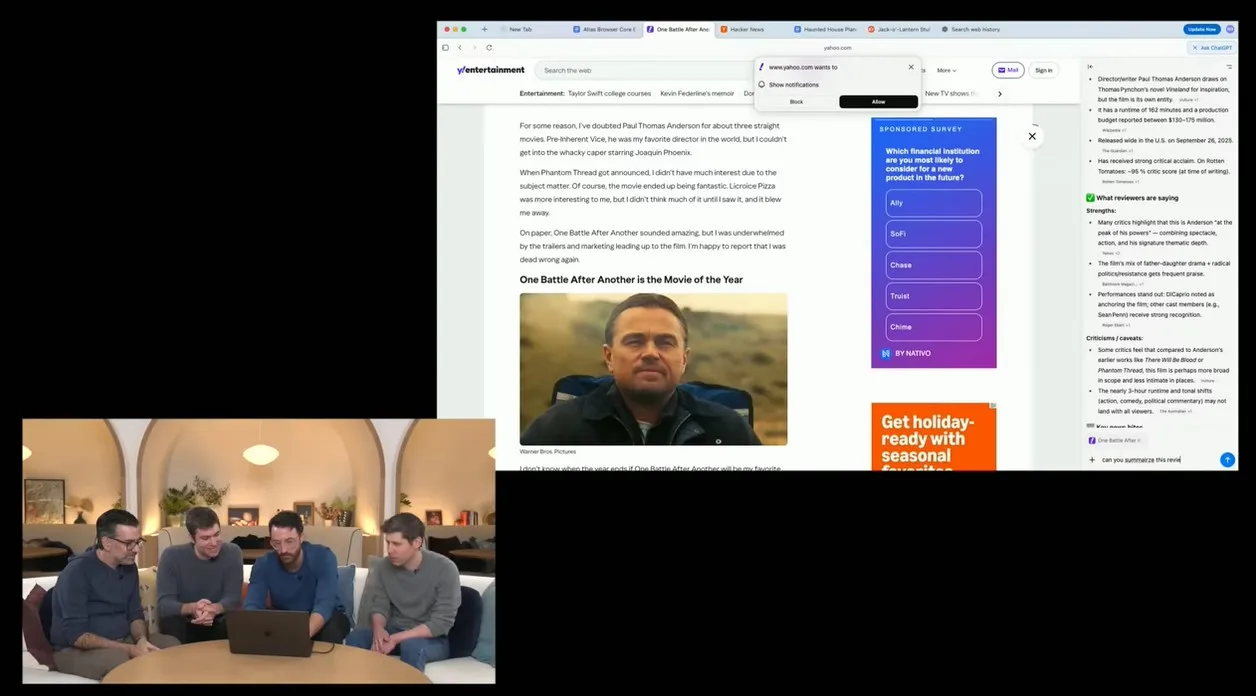
OpenAI has officially unveiled ChatGPT Atlas, a new web browser that places artificial intelligence at the center of the online experience. The browser is designed to make ChatGPT an active participant in how users search, navigate, and interact with the web.
The launch of ChatGPT Atlas marks OpenAI’s most aggressive step yet toward embedding AI into everyday tools. For investors and technologists, this could be one of the most significant moves in the evolution of web software since Google first introduced Chrome.
What ChatGPT Atlas Does
ChatGPT Atlas combines a traditional web interface with the conversational power of ChatGPT. Users can open a sidebar window to ask ChatGPT questions about the page they are viewing or request summaries of complex information. The browser also introduces an “agent” capability that can click links, complete tasks, and perform actions on behalf of the user.
“We think that AI represents a rare, once-a-decade opportunity to rethink what a browser can be about,” OpenAI CEO Sam Altman said during the livestream announcement. “Tabs were great, but we haven’t seen a lot of browser innovation since then.”
Atlas integrates search, conversation, and automation within a single interface. Instead of typing queries into a search bar and sifting through results, users can ask ChatGPT questions directly inside the browser. The AI then delivers answers and supporting web links, creating a more guided and contextual search experience.
How ChatGPT Atlas Differs from Chrome and Other Browsers
While Google Chrome remains the world’s most popular browser, it has been criticized for limited innovation in recent years. Chrome’s integration with Google’s Gemini chatbot is a first step toward AI-driven browsing, but OpenAI’s Atlas takes the concept further.
With ChatGPT Atlas, the AI chatbot sits at the center of the experience rather than being added as an optional tool. Traditional search results still appear, but they are secondary to the conversational answer generated by ChatGPT. This inversion changes the way users find and process information online. Instead of the AI sitting on top of the web, the web becomes an extension of the AI.
Ryan O’Rouke, OpenAI’s lead designer for Atlas, explained during the announcement that “we’ve made some major upgrades to search on ChatGPT when accessed via Atlas.” He described a system that presents direct, conversational responses in the search bar before showing conventional web links, images, and videos.
That approach may help users complete tasks faster, but it also signals a larger shift in how companies compete for user attention. Search engines and browsers are beginning to merge, blurring the lines between the two.
Availability and Pricing
OpenAI says ChatGPT Atlas is now available globally for macOS users. Versions for Windows and mobile devices are in active development. The browser is free to use, but its agent capabilities and advanced automation tools are reserved for subscribers to OpenAI’s ChatGPT Plus or ChatGPT Pro plans.
Early users report that Atlas feels more like an AI-powered workspace than a conventional browser. It allows users to automate simple web routines, recall information from previous sessions, and pick up where they left off on ongoing projects.
Introducing Browser Memories
One of the most talked-about features is the new “browser memories” option. This builds on ChatGPT’s existing memory system, allowing the browser to remember prior searches, preferences, and browsing habits. If a user frequently researches specific topics or industries, Atlas can automatically suggest related content or return to previously useful websites.
The memory feature is optional and can be turned off for privacy reasons. Still, its inclusion reflects a larger trend in AI design. As systems like ChatGPT Atlas learn from user behavior, they can personalize experiences at a level that static browsers cannot match.
For professionals and investors, this personalization could have practical applications. Market researchers could use it to track specific sectors, while analysts could automate repetitive online research tasks.
The AI Browser Race Heats Up
OpenAI is not the only company racing to bring AI into the browser. Microsoft embedded its Bing chatbot into the Edge browser early on, and smaller companies like Brave and Opera have released AI features as well. Perplexity’s Comet browser also launched this year, using a similar conversational approach.
Still, ChatGPT Atlas is the first time OpenAI has fully entered the browser market on its own terms. Earlier efforts, such as integrating ChatGPT’s “agent” tool with web browsing, were experimental. Those features allowed users to send the chatbot off to complete online tasks, like product comparisons or research projects. While the results were occasionally slow or inaccurate, they provided the foundation for Atlas’s new automation system.
What This Means for the Future of Browsing
OpenAI’s move into the browser market could reshape how people interact with information online. For consumers, it promises convenience. For companies that depend on search visibility, advertising, or user analytics, it could introduce new challenges.
If ChatGPT Atlas gains traction, fewer people may rely on traditional search engines. Instead of browsing through multiple pages of search results, users may trust AI summaries to provide what they need. That could reduce traffic for certain websites while rewarding those optimized for conversational AI systems.
Investors in the tech and advertising sectors should pay attention to this shift. A widespread move toward AI-centric browsing could change how ad impressions, click-throughs, and user behavior are measured.
Privacy and Ethical Considerations
The introduction of browser memories and agent automation raises important privacy questions. Atlas stores certain details to improve the user experience, but how that data is handled remains under scrutiny. OpenAI says users will have control over memory features, but privacy advocates are already urging transparency in how browsing data is retained and processed.
The company insists that privacy controls will be clear and user-friendly, allowing individuals to opt out of data retention at any time. Still, the balance between convenience and privacy will likely determine whether ChatGPT Atlas achieves mainstream adoption.
Ambitious?
ChatGPT Atlas is OpenAI’s most ambitious product since ChatGPT itself. It aims to reinvent the web browser by turning it into a conversational, intelligent assistant that can act, remember, and respond in real time.
Whether it succeeds depends on adoption. Chrome users are deeply loyal, and Microsoft, Apple, and Google are all adding AI layers to their existing platforms. But if Atlas proves faster, more capable, and genuinely useful, it could push the browser industry into a new era of competition and innovation.
For now, ChatGPT Atlas represents the clearest glimpse yet of what the future of the internet might look like: an experience where AI is not a tool we use, but a partner that helps us think, search, and act online.
About Author