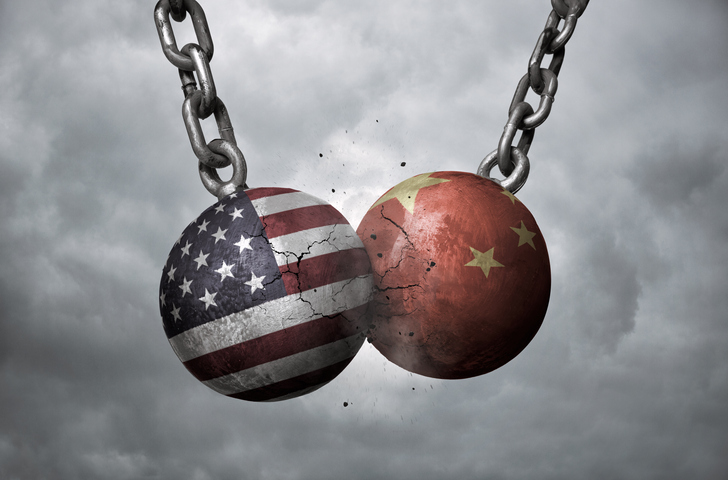
In a development adding fresh urgency to the escalating U.S.-China trade standoff, Beijing has imposed exit bans on two U.S. citizens—a government official and a top banking executive. These incidents, involving a U.S. Department of Commerce employee and a Wells Fargo managing director, come just weeks ahead of a critical trade deadline set by President Trump. For investors navigating geopolitical risk, this signals a dramatic turn: economic conflict between the world’s two largest economies is no longer limited to tariffs—it now includes travel restrictions on U.S. personnel.
What Happened?
According to the U.S. State Department, a U.S. Patent and Trademark Office employee traveling to China in a personal capacity has been barred from leaving the country since mid-April. The Chinese authorities reportedly seized the individual’s passport, credit cards, and electronic devices upon arrival in Chengdu on April 14, and though those items were later returned, the exit ban remains in place.
In a separate but equally concerning case, Chinese officials confirmed that Mao Chenyue, a managing director at Wells Fargo based in Atlanta, has also been subjected to an exit ban while facing criminal charges. Mao, a U.S. citizen born in Shanghai, leads Wells Fargo’s international factoring business. The charges against her remain vague, but she is required to remain in China to cooperate with ongoing investigations.
U.S. Government Responds
The U.S. State Department confirmed both cases and emphasized that “there is no higher priority than the safety and security of American citizens.” It also reiterated warnings for Americans traveling to China, citing Beijing’s increasing use of arbitrary exit bans without due legal process or transparency.
The State Department has specifically highlighted risks for U.S. citizens of Chinese descent, noting that the Chinese government does not recognize dual nationality. This can subject Americans of Chinese heritage to heightened scrutiny and harassment during visits.
China’s Strategic Playbook: Exit Bans as Leverage?
These moves appear far from isolated. They align with a growing trend in China’s handling of foreign nationals amid worsening diplomatic ties. Beijing has long used exit bans as a strategic tool, but the targeting of a U.S. official and a senior banker—both citizens—signals a potentially coordinated response to intensifying economic pressure from Washington.
Just last month, China raided several foreign firms operating within its borders, including consultancies and due diligence outfits. As James Zimmerman, a business attorney based in Beijing, told CBS News during those crackdowns, “It looks as if anything you do could be considered spying,” highlighting how national security has become an elastic pretext for a wide range of enforcement actions.
Why Now? The Looming August 12 Trade Deadline
The exit bans come at a delicate moment in U.S.-China relations. President Trump has set an August 12 deadline for the two countries to finalize a new trade agreement. If no deal is reached, the U.S. plans to increase tariffs on Chinese goods to as much as 145%. Currently, 30% duties are already in effect.
Beijing has responded with its own tariffs and economic measures, but these new exit bans suggest a broader strategy that includes leveraging legal and personal restrictions on U.S. individuals as a form of pressure.
Investor Implications: Beyond Tariffs
For investors, the implications are stark. This escalation transforms what was once a narrowly scoped tariff conflict into a multidimensional geopolitical risk environment. Several investment-critical takeaways emerge:
1. Operational Risk for U.S. Firms in China
Multinational corporations with American executives operating in China may now face significantly higher personal and legal risk. The uncertainty around travel restrictions or criminal accusations—often not clearly defined—makes it difficult for firms to maintain stable leadership or oversight on the ground.
2. Supply Chain Recalibration
The increased legal volatility for U.S. personnel could accelerate the trend of “China Plus One” strategies, where companies move manufacturing or operations to alternative locations like Vietnam, Mexico, or India. Investors should be watching companies with heavy China exposure for early signs of divestment or reallocation.
3. Tech and Finance Sector Volatility
The fact that one of the exit ban targets is a high-ranking Wells Fargo executive raises alarms across the financial sector. Global banking institutions operating in China may need to reassess their personnel risk management strategies. Similarly, tech companies involved in sensitive sectors like semiconductors, AI, and cybersecurity could be next.
4. Increased Risk Premiums for China-Based Assets
Emerging market funds, China-focused ETFs, and other investment vehicles tied to the region may face heightened volatility. Investors should expect increased risk premiums as political tensions ratchet up and exit bans expand to new sectors.
5. Policy Unpredictability Becomes a Core Risk Metric
Traditional market analysis tends to downplay political maneuvering as noise, but this episode reinforces the fact that autocratic legal environments can change the rules of engagement overnight. Investors must now factor in not just regulatory risk, but political retaliation risk.
A Pattern Emerging
This is not the first time China has used exit bans in high-profile international disputes. In recent years, it has restricted the movement of foreign business leaders, diplomats, and NGO workers, often as bargaining chips in unrelated geopolitical issues. But this latest chapter—targeting a U.S. government employee and a senior banking executive—suggests a new level of boldness.
It reflects China’s evolving posture as it attempts to balance economic diplomacy with domestic security concerns. The decision to reveal the charges against Mao Chenyue publicly while remaining vague about the Department of Commerce official may be a calibrated message: Beijing wants leverage but is cautious about provoking total diplomatic rupture.
The Bigger Picture: Geoeconomics vs. Geopolitics
As the August 12 deadline looms, the focus may appear to be on tariffs and trade imbalances. But these latest developments remind investors that the real story is geoeconomic warfare: legal tools, individual freedoms, and state power are being deployed alongside interest rates and import duties.
This isn’t just about shipping containers and customs paperwork anymore. It’s about control, deterrence, and unpredictability—a triad that poses real risks to capital flows, corporate governance, and foreign investment strategies.
What Investors Should Do Now
- Review China Exposure in Your Portfolio:
Look at which holdings are heavily exposed to China’s legal environment—especially in finance, tech, healthcare, and industrials. - Monitor Corporate Disclosures:
Pay close attention to earnings calls, 10-Ks, and risk factor sections. Public companies will likely begin flagging geopolitical personnel risks more explicitly. - Reevaluate Emerging Market Allocations:
Consider reducing overweight positions in China in favor of Southeast Asian economies with similar manufacturing capacity but fewer political entanglements. - Stay Ahead of U.S. Trade Policy:
Watch for signals from President Trump’s administration. A breakdown in talks or an extension of the deadline could each create volatile conditions across currency, bond, and equity markets. - Keep an Eye on the Dollar-Yuan Dynamic:
Currency fluctuations could offer both a hedge and a warning sign. A rapid depreciation in the yuan may indicate that China is bracing for deeper economic pain—and planning retaliatory moves.
Final Thoughts
The recent exit bans are not just isolated legal issues—they are part of a larger and more dangerous game unfolding between the U.S. and China. Investors would be wise to treat this not as a footnote, but as a bellwether.
As political risk continues to intersect with economic performance, portfolios exposed to the Chinese market—either directly through equities or indirectly through global indices—face a new layer of uncertainty. This is a chess match that is no longer just about trade deals. It’s about leverage, and right now, both sides are grabbing every piece they can.
Sources:
About Author