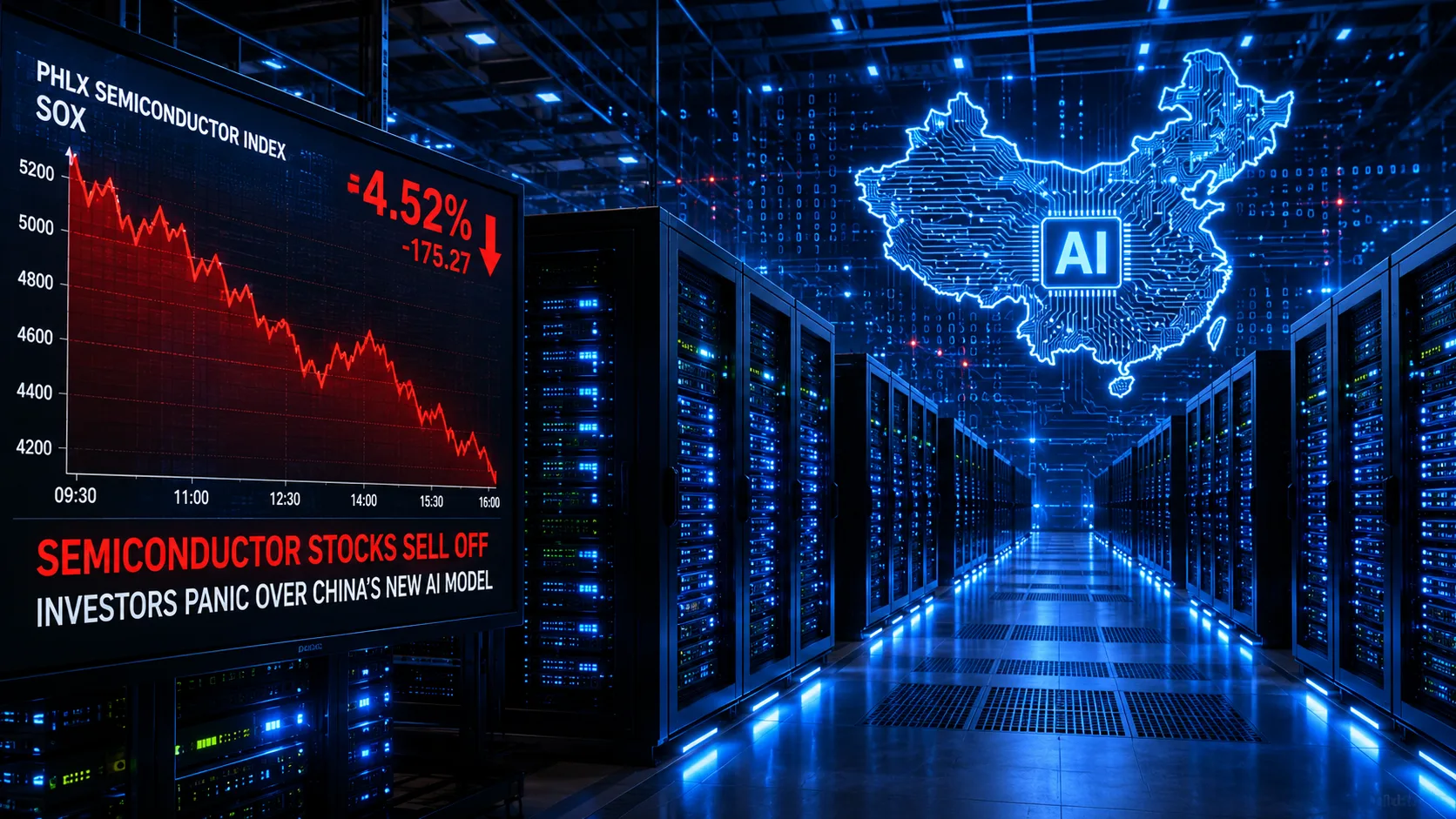
Chinese AI startup Moonshot AI has shaken the semiconductor sector after unveiling Kimi K3, a powerful low-cost artificial intelligence model that rivals leading U.S. systems. While the announcement sparked a sharp selloff in chip stocks, several Wall Street analysts believe investors may be looking at the story the wrong way. Instead of reducing demand for AI hardware, cheaper AI models could ultimately drive even greater demand for Nvidia GPUs, Micron memory chips and the infrastructure powering the next generation of AI.
Chip Stocks Sell Off After Kimi K3 Debut
Moonshot AI’s release of Kimi K3 surprised the market by demonstrating that a Chinese developer could produce an AI model capable of competing with many leading Western systems despite facing export restrictions on Nvidia’s most advanced chips.
The announcement helped accelerate a broad semiconductor selloff, pushing the PHLX Semiconductor Index (SOX) into bear-market territory as investors questioned whether AI hardware spending could slow if powerful models become dramatically cheaper.
The initial concern was straightforward: if AI becomes less expensive to build and operate, companies may need fewer chips.
However, many analysts argue the opposite is more likely.
Why Lower AI Costs Could Increase Chip Demand
The key concept driving the bullish thesis is Jevons Paradox, the economic principle that greater efficiency often leads to higher overall consumption rather than less.
Instead of replacing expensive AI infrastructure, lower-cost models may encourage businesses to deploy AI across far more applications.
As AI becomes more affordable, companies can:
- Expand AI into additional business functions
- Build more AI-powered products
- Increase inference workloads
- Process significantly larger volumes of data
Each of those activities requires substantial computing power.
Rather than shrinking demand for chips, analysts believe cheaper AI could dramatically expand the total addressable market.
Kimi K3 Is Already Running Into Capacity Limits
One of the strongest arguments supporting this view came almost immediately after launch.
Moonshot AI announced that demand for Kimi K3 surged so rapidly that it temporarily paused new user registrations because available computing capacity had been exhausted.
For many semiconductor analysts, that was an important signal.
Instead of reducing infrastructure requirements, the cheaper model immediately encountered the same scaling challenges affecting many frontier AI systems.
That suggests demand for computing resources remains the primary bottleneck.
Why Memory Chip Companies Could Be Major Winners
Several analysts believe memory manufacturers may benefit the most.
Although Kimi K3 activates only a relatively small portion of its total parameters during inference, the model still contains roughly 2.8 trillion parameters that must be stored in memory.
Large-scale enterprise deployments therefore require enormous amounts of high-performance memory.
That directly benefits companies supplying High Bandwidth Memory (HBM), including:
- Micron Technology (NASDAQ: MU)
- SK Hynix
- Samsung Electronics
HBM has become one of the most constrained components in AI infrastructure, allowing manufacturers to maintain strong pricing power amid persistent shortages.
As AI models continue growing in size and complexity, memory requirements are expected to increase alongside them.
Nvidia Could Still See Strong GPU Demand
While some investors worry that cheaper AI models reduce the need for expensive GPUs, analysts say enterprise adoption points toward continued hardware growth.
Businesses are increasingly expected to use different AI models for different workloads.
Less demanding tasks may shift to inexpensive open-weight models like Kimi K3, while complex reasoning, autonomous agents and mission-critical applications continue relying on premium frontier models.
Even lower-cost inference workloads still require significant GPU capacity when deployed at enterprise scale.
That could continue supporting demand for:
- Nvidia’s AI accelerators
- Broadcom’s custom AI chips
- High-speed networking infrastructure
- Advanced chip packaging technologies
Large cloud providers also continue expanding AI infrastructure to meet rapidly rising enterprise demand.
Open-Weight AI Could Accelerate Enterprise Adoption
Unlike many leading U.S. AI systems, Kimi K3 will be released as an open-weight model, allowing developers greater flexibility to customize it for enterprise applications.
Analysts believe that lower licensing costs combined with greater customization could accelerate AI adoption across industries.
Businesses that previously found AI deployment too expensive may now begin implementing AI-powered workflows, creating additional long-term demand for computing infrastructure.
In other words, lower software costs may ultimately increase hardware consumption.
What Investors Should Watch
The semiconductor selloff following Kimi K3’s release reflects investor concerns that cheaper AI models could weaken the industry’s extraordinary growth story.
However, many industry analysts see a very different picture emerging.
If affordable AI dramatically expands enterprise adoption, demand for memory, GPUs, networking equipment and advanced packaging could continue climbing for years.
The fact that Kimi K3 reached capacity limits almost immediately after launch reinforces the idea that the biggest challenge facing AI is no longer model development, but delivering enough computing power to satisfy growing demand.
For long-term investors, that may prove more important than the model’s lower price.
The Bottom Line
While China’s Kimi K3 initially rattled semiconductor investors, the broader implications may ultimately favor the industry’s largest players.
Cheaper AI models have the potential to unlock significantly more enterprise adoption, creating additional demand for Nvidia GPUs, Micron’s high-bandwidth memory and the broader AI infrastructure ecosystem.
If AI follows the same pattern seen throughout computing history, lower costs may not reduce hardware demand. Instead, they could dramatically expand it, strengthening the long-term investment case for many of the semiconductor companies that power artificial intelligence.
About Author