

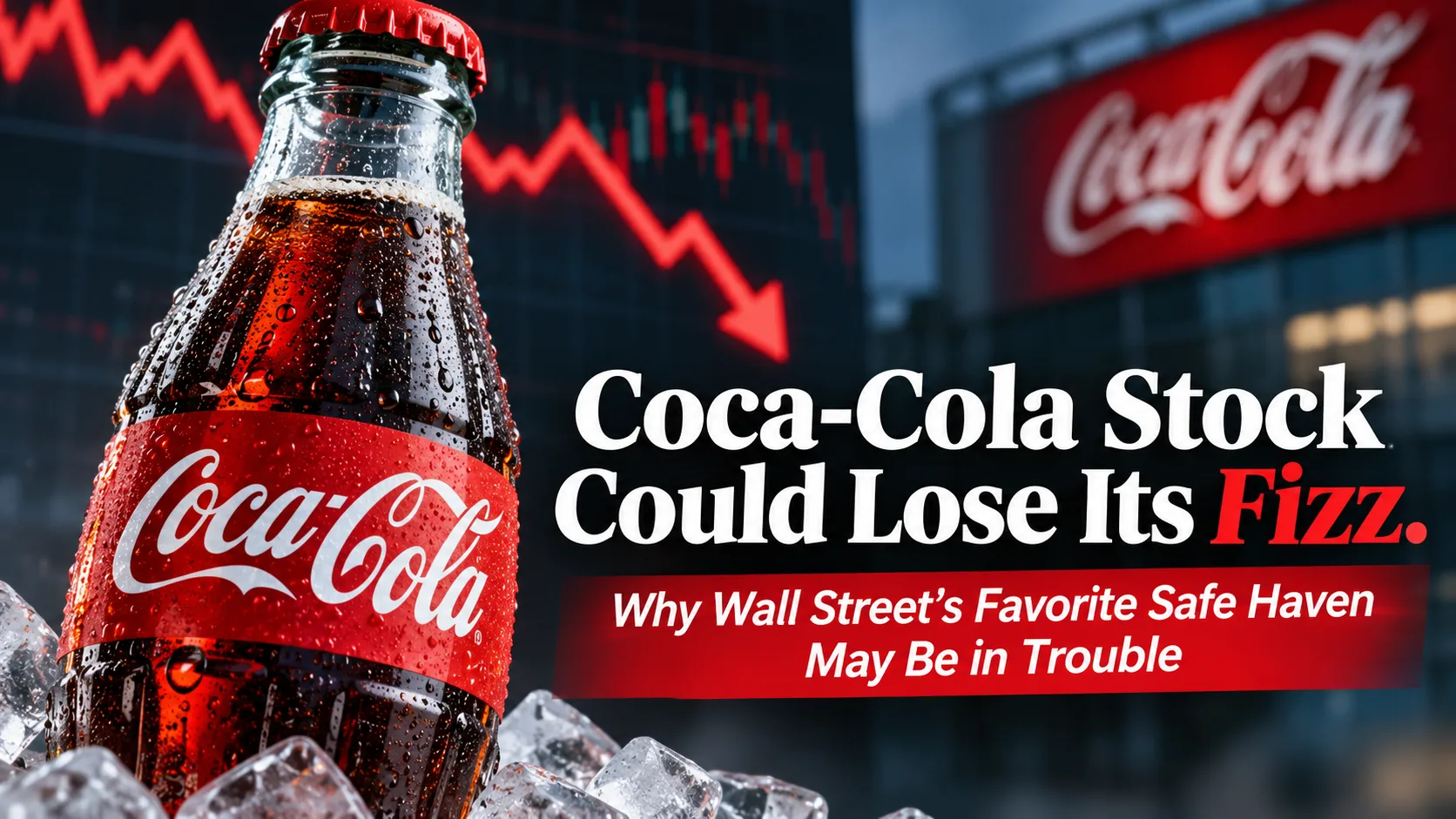
Coca-Cola has emerged as one of Wall Street’s favorite defensive investments in 2026. But with its valuation near a 25-year high, earnings growth expected to slow, and shares retreating from a recent peak, investors may be overlooking a potentially expensive risk.
For decades, Coca-Cola (NYSE: KO) has represented the kind of investment that helps shareholders sleep at night. Its products are sold around the world, its dividend has increased for more than six decades, and its brand recognition is almost unmatched. Yet the qualities that have made Coca-Cola so attractive are also helping push its valuation to unusually expensive levels.
Shares closed at $95.88 on November 23, down from a 52-week high of $100.56 reached earlier this month. The stock remains a strong performer in 2026, but the recent pullback has brought renewed attention to a troubling question: How much should investors pay for a dependable company whose earnings growth may be approaching a slowdown?
The answer could have significant implications for Coca-Cola shareholders and for the growing number of investors who have been moving money out of volatile technology stocks and into supposedly safer investments.
Coca-Cola’s Rally Has Created a Valuation Problem
While artificial intelligence stocks have dominated financial headlines, some of the market’s most attractive investments this year have come from less glamorous industries.
Consumer staples companies, which sell everyday necessities such as food, beverages, and household products, have attracted investors seeking protection from economic uncertainty and stock market volatility. Coca-Cola has been a major beneficiary of that shift, with investors drawn to its predictable revenue, global reach, and reliable dividends.
But that enthusiasm comes at a price.
Coca-Cola currently trades at approximately 28 times earnings, with its forward valuation considerably above historical norms. Over the past five years, the company’s average price-to-earnings ratio has been closer to 23. Its current valuation is approaching levels last seen roughly 25 years ago, when investors were similarly enthusiastic about the company’s growth prospects.
The premium becomes even more striking when Coca-Cola is compared with faster-growing technology companies. Several major technology stocks trade at comparable or lower forward earnings multiples despite expectations for substantially faster profit growth.
That creates an unusual situation in which investors are paying growth-stock prices for a mature beverage company.
Coca-Cola is undeniably a strong business, but its valuation now assumes that management can continue delivering impressive results despite growing competitive pressures, shifting consumer preferences, and a potentially difficult earnings environment in 2027.
Why Investors Are Willing to Pay So Much for Coca-Cola
The appeal of Coca-Cola is easy to understand. Its products are purchased during strong economic expansions and recessions alike, giving the company a level of stability that many businesses simply cannot match.
Consumers may delay purchasing a new vehicle or upgrading their smartphones when household budgets tighten, but relatively inexpensive beverages remain part of everyday spending. Coca-Cola also benefits from one of the world’s most extensive distribution networks, along with a business model that relies heavily on independently operated bottlers.
That structure allows the company to generate substantial cash without absorbing all the costs associated with manufacturing and distributing its products worldwide.
And despite concerns about its valuation, Coca-Cola’s recent financial performance has been impressive.
In its third-quarter earnings report, released October 27, the company reported a 7% increase in revenue and 5% growth in global unit case volume. Comparable earnings per share increased 11% to $0.91, while operating income rose 12%.
Management responded by raising its full-year outlook, forecasting at least 11% growth in comparable earnings per share for 2026 and at least $13 billion in free cash flow.
Those results stand out in a consumer staples industry where several major food and beverage companies have struggled to generate meaningful volume growth.
Coca-Cola has also benefited from market share gains in the United States, particularly as rival PepsiCo works to strengthen its own beverage business.
The company’s performance helps explain why Wall Street remains enthusiastic. But strong recent earnings do not necessarily mean its shares offer an attractive investment at any price, particularly if investors are paying a substantial premium for growth that may prove difficult to sustain.
The Bigger Concern: Coca-Cola’s Earnings Could Slow Sharply in 2027
Perhaps the most significant risk facing Coca-Cola investors is the growing disconnect between the stock’s premium valuation and its expected earnings growth.
After a strong 2026, the analyst projections cited in recent valuation commentary suggest Coca-Cola’s earnings per share could increase by less than 5% in 2027. That would represent a meaningful slowdown from the double-digit comparable earnings growth management expects this year.
Several factors could contribute to that moderation.
A Stronger Dollar Could Hurt International Profits
Coca-Cola generates a substantial portion of its revenue and profits outside North America, making currency movements an important factor in its reported financial results.
When the U.S. dollar strengthens, revenue earned in foreign currencies translates into fewer dollars when consolidated into the company’s financial statements. That can reduce reported earnings even when overseas operations continue performing well.
In its latest earnings report, Coca-Cola warned that currency movements could create a slight headwind for 2027. Management also identified an approximately 2% potential earnings headwind from acquisitions and divestitures, including the planned sale of its African bottling operations.
The combined impact could make earnings comparisons more challenging next year.
Tougher Comparisons After a Strong 2026
Coca-Cola has benefited from strong international demand, successful marketing campaigns, and major global events during 2026, including the FIFA World Cup.
Those tailwinds have helped support volume growth and profitability, but repeating that performance may become increasingly difficult as the company moves into 2027.
Even respectable revenue and earnings growth could disappoint investors if results fall short of the optimistic expectations reflected in the stock’s current valuation.
Higher Expectations Leave Less Room for Mistakes
At nearly 28 times expected earnings, Coca-Cola is priced for consistent execution.
A disappointing quarter, weaker-than-expected beverage demand, or a downward revision to earnings estimates could quickly change investor sentiment. Even if Coca-Cola remains profitable and financially healthy, a reassessment of its valuation could push shares materially lower.
This is one of the biggest risks associated with buying stocks after an extended period of investor enthusiasm.
A company does not need to experience a serious business downturn for its share price to fall. Sometimes, slowing growth is enough.
Could Coca-Cola Stock Fall Another 15%?
Recent analysis has suggested Coca-Cola’s fair value could be closer to $80 to $85 per share, considerably below its recent trading range.
From the November 23 closing price of $95.88, that would imply potential downside of approximately 11% to 17%.
Importantly, such a decline would not necessarily require a recession or a collapse in Coca-Cola’s business.
Consider a simplified example.
If a company earns $3.50 per share and investors assign it a price-to-earnings ratio of 28, the stock would be worth $98.
Reduce that valuation multiple to 24, while keeping earnings unchanged, and the theoretical stock price falls to $84.
That represents a decline of more than 14%, even though the company’s profits have remained exactly the same.
This is the danger of valuation compression, a process in which investors become unwilling to pay as much for each dollar of a company’s earnings.
For Coca-Cola, that risk has become increasingly relevant as its stock trades at a premium to its historical valuation.
Wall Street’s views remain divided on how much the stock is worth. TD Cowen recently reiterated a $112 price target, reflecting confidence in the company’s competitive position and long-term earnings potential. Meanwhile, RBC Capital maintained a $96 target on November 24, while Morgan Stanley maintained a $103 target.
The differences demonstrate how sensitive Coca-Cola’s valuation has become to assumptions about future growth.
A Changing Consumer Market Presents Another Challenge
Coca-Cola’s premium valuation is attracting attention, but the company’s long-term business model faces challenges of its own.
Carbonated beverages account for approximately 70% of Coca-Cola’s global beverage volume, leaving the company heavily exposed to a category facing increasing scrutiny from health-conscious consumers and governments.
Regular Coca-Cola contains approximately 140 calories in a 12-ounce can, primarily from added sugar. As consumers become more concerned about obesity, diabetes, and overall health, traditional sugary drinks could face greater pressure.
Governments are also taking action.
Mexico has increased taxes on sugary beverages as part of efforts to discourage consumption, while Brazil is preparing additional taxation measures that could affect beverage producers in 2027.
These policies create potential headwinds in important international markets where Coca-Cola has historically generated meaningful sales and profits.
The company has responded by expanding its portfolio of zero-sugar beverages, bottled water, sports drinks, coffee, and other products. Its brands include Sprite, Fanta, Powerade, BODYARMOR, Costa Coffee, and fairlife.
Those investments have helped Coca-Cola remain competitive as consumer preferences evolve, but the company still depends heavily on its traditional carbonated beverage business.
Affordability presents another challenge.
A 12-pack of Coca-Cola cans can cost approximately $8 to $11 at U.S. retailers, depending on the location and promotional pricing. For consumers already dealing with higher grocery bills, those prices could encourage purchasing fewer beverages, switching to smaller packages, or choosing less expensive alternatives.
Coca-Cola’s third-quarter results showed no unit case volume growth in North America, even as worldwide volume increased 5%.
That contrast deserves attention because it suggests the company’s strongest growth opportunities may increasingly depend on international markets rather than its mature domestic business.
Even Coca-Cola’s Dividend May Not Justify the Price
Income-oriented investors have long considered Coca-Cola a core portfolio holding, and for good reason.
The company has raised its dividend for 64 consecutive years, making it one of the stock market’s best-known dividend growth investments. Warren Buffett’s Berkshire Hathaway famously accumulated 400 million Coca-Cola shares, primarily during the late 1980s, and has held that position for decades.
But there is an enormous difference between buying Coca-Cola at an attractive valuation and purchasing shares after investors have already bid the stock to historically expensive levels.
At its recent price, Coca-Cola offers a dividend yield of approximately 2.2%.
That provides dependable income, but it offers limited protection against a meaningful share-price decline.
For perspective, a 15% drop in Coca-Cola’s stock would be equivalent to nearly seven years of dividend income at today’s yield, excluding future dividend increases and reinvestment.
Coca-Cola’s ability to generate cash remains impressive, with management forecasting at least $13 billion in free cash flow for 2026. However, against a market capitalization exceeding $400 billion, that translates into a free cash flow yield of roughly 3%.
Investors are effectively paying a significant premium for the company’s stability, dividend history, and global competitive position.
Those qualities have undeniable value, but they do not eliminate the risks associated with purchasing shares at an elevated price.
The Unexpected Risk Hiding in Defensive Stocks
There is a broader lesson in Coca-Cola’s rally that extends well beyond the beverage industry.
Investors typically associate risk with technology companies, speculative growth stocks, and businesses whose earnings depend heavily on uncertain future developments.
Consumer staples companies, by comparison, are generally considered defensive because demand for their products tends to remain relatively stable during economic downturns.
But defensive stocks can become risky investments when investors pay too much for them.
During periods of market uncertainty, money often moves away from volatile sectors and into businesses offering stable revenue, recognizable brands, and reliable dividends.
That increased demand can drive valuations progressively higher until the stock price reflects an unusually optimistic outlook.
Coca-Cola illustrates the potential danger of this process.
Its products are unlikely to disappear from store shelves, and its global distribution advantages remain formidable. However, those strengths are already reflected in the company’s market value.
Investors seeking refuge from expensive technology stocks could discover that some traditional safe havens have developed valuation risks of their own.
There is also an important distinction between Coca-Cola and high-growth technology companies.
A fast-growing business may eventually justify an elevated valuation by expanding earnings dramatically over several years. A mature beverage company has fewer opportunities to generate that kind of acceleration, making its valuation more dependent on steady execution and investor willingness to maintain a premium earnings multiple.
Warren Buffett’s Coca-Cola History Offers a Warning
Coca-Cola’s current situation has an interesting historical parallel.
During the late 1990s, Coca-Cola was one of the world’s most admired businesses. Its global brand recognition, powerful distribution network, and consistent profitability made it appear almost unstoppable.
Warren Buffett was among its most enthusiastic supporters, describing the company’s competitive advantages in extraordinarily favorable terms.
Investors shared that optimism, pushing Coca-Cola’s valuation to levels that proved difficult to sustain.
The stock peaked in 1998, and shareholders subsequently experienced an extended period of disappointing price performance. On a split-adjusted price basis, Coca-Cola took nearly two decades to regain those late-1990s levels, although dividends improved investors’ total returns.
The underlying company continued operating profitably during much of that period. The central problem was that investors had paid too much for its expected growth.
That history does not mean Coca-Cola is destined to repeat the experience.
However, it demonstrates that even a globally dominant business can produce disappointing stock market returns when investor expectations become excessive.
Buffett’s long-term success with Coca-Cola also reflects the price Berkshire paid for its original investment, which was dramatically lower than today’s valuation.
For investors considering the stock now, that distinction is especially important.
Three Signals Coca-Cola Investors Should Watch Next
Investors evaluating Coca-Cola should focus on three developments that could determine whether the stock can maintain its premium valuation.
First, 2027 earnings guidance. Coca-Cola plans to provide its formal full-year outlook when it reports fourth-quarter results. That guidance will offer a clearer picture of whether the expected earnings slowdown is temporary or reflects a more persistent moderation in growth.
Second, beverage volume growth. The company’s 5% global unit case volume increase in the third quarter was encouraging, but stagnant North American volume raises questions about domestic demand. Continued weakness could suggest that higher prices and changing consumer preferences are affecting purchasing behavior.
Third, the valuation premium. Investors should watch whether Coca-Cola maintains its elevated earnings multiple relative to its own history and other consumer staples companies. A sustained rotation back toward technology and other growth sectors could reduce demand for expensive defensive stocks.
These developments will be particularly important because Coca-Cola is entering a period when strong operational performance may already be reflected in its share price.
If the company continues producing healthy volume growth and resilient earnings, its valuation could remain elevated. But slower earnings growth combined with a declining price-to-earnings multiple would create a much more challenging environment for shareholders.
The Bottom Line: A Great Company Can Still Be an Expensive Stock
Coca-Cola remains one of the world’s most recognizable and financially durable businesses.
Its global distribution advantages, pricing power, consistent cash generation, and impressive dividend history make it attractive to long-term investors. The company’s latest earnings results also demonstrate that management continues executing effectively despite challenges across the consumer staples industry.
But Coca-Cola’s premium valuation leaves less room for disappointment, particularly with earnings growth potentially slowing in 2027.
The stock’s recent retreat from its November high illustrates how quickly investor enthusiasm can change when valuation concerns begin competing with an otherwise positive business outlook.
The greatest risk may be the assumption that Coca-Cola is automatically a safe investment simply because its underlying business is stable.
History suggests that investors should be more cautious.
Coca-Cola does not need to become a weaker company for its stock to become a disappointing investment. At today’s valuation, even respectable earnings growth may struggle to justify the price investors are paying.
About Author