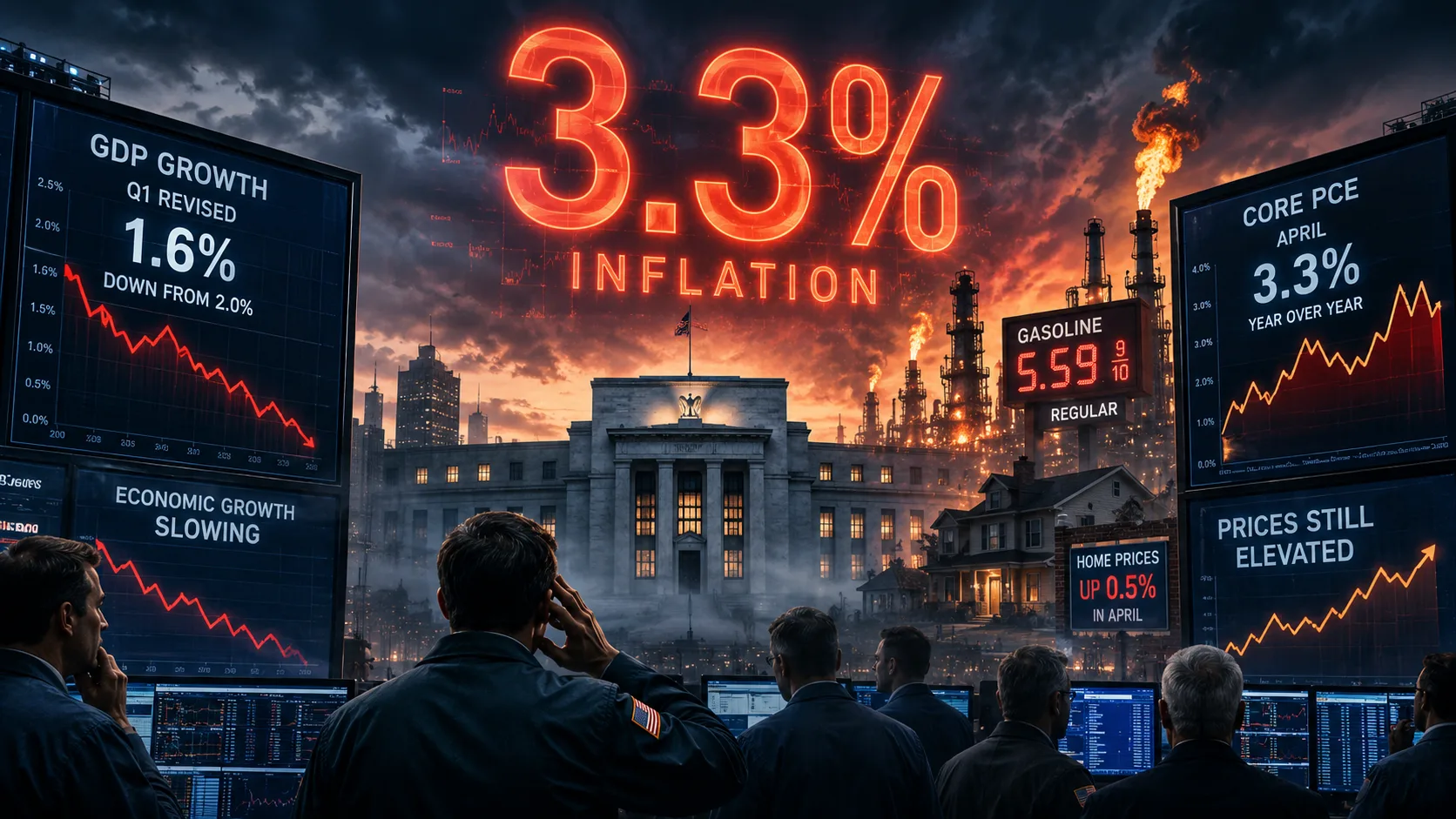
The Federal Reserve’s preferred inflation gauge delivered a mixed message Thursday. On the surface, inflation pressures showed signs of easing. Underneath, however, the data reinforced a growing reality investors may not want to hear: interest rates could stay higher for longer as geopolitical tensions, tariffs, and stubborn housing costs keep inflation elevated well above the Fed’s 2% target.
According to new Commerce Department data, core Personal Consumption Expenditures (PCE) inflation rose 0.2% in April and 3.3% from a year earlier. That matched Wall Street expectations on an annual basis while coming in slightly softer than expected month-over-month.
Markets initially welcomed the softer monthly reading, seeing it as evidence that the inflation spike from March may be beginning to cool. But the broader economic picture remains complicated.
At the same time inflation remains elevated, economic growth is slowing sharply. First-quarter GDP growth was revised down to just 1.6%, well below the prior 2% estimate, while consumer incomes unexpectedly stagnated.
For investors, that combination creates an increasingly dangerous setup: slower growth paired with sticky inflation. In other words, the U.S. economy is drifting closer toward a stagflation-style environment that could complicate everything from stock valuations to bond yields and Federal Reserve policy.
Why This Inflation Report Matters More Than Usual
The PCE index is not just another inflation report.
This is the metric the Federal Reserve watches most closely when deciding whether to cut, hold, or raise interest rates. While Wall Street often focuses heavily on the Consumer Price Index (CPI), Fed policymakers repeatedly emphasize PCE because it captures a broader range of consumer behavior and spending patterns.
More importantly, the Fed pays special attention to “core” PCE inflation.
That strips out volatile food and energy prices to give policymakers a clearer view of underlying inflation trends.
April’s report showed:
- Headline PCE inflation rose 0.4% monthly and 3.8% annually
- Core PCE rose 0.2% monthly and 3.3% annually
- Consumer spending increased 0.5%
- Personal income was flat
- GDP growth slowed to 1.6%
That last figure may be the most important.
The economy is slowing faster than many economists expected, yet inflation is still running far above the Fed’s target. That creates a difficult balancing act for the central bank.
The Hidden Story: Inflation Is Becoming More Structural Again
Many investors spent much of the past year expecting inflation to steadily fade back toward 2%.
That narrative is now breaking down.
The biggest issue is that inflation is no longer being driven solely by temporary post-pandemic distortions. Instead, several deeper structural forces are beginning to emerge simultaneously.
1. Energy Risks Are Back
Gasoline prices surged 5.5% in April alone.
The ongoing Iran conflict and disruptions tied to the Strait of Hormuz have created renewed fears about global oil supply stability. Investors are increasingly realizing that geopolitical instability can rapidly reverse disinflation trends.
Energy costs matter because they spread throughout the economy.
Higher fuel prices increase transportation costs, shipping costs, airline expenses, manufacturing input prices, and food distribution costs.
That eventually works its way into nearly every consumer category.
President Donald Trump’s administration has aggressively pushed tariffs and trade restructuring measures as well, adding another inflationary layer.
2. Housing Inflation Is Reaccelerating
Housing prices increased 0.5% in April, marking the biggest monthly gain since at least early 2025.
That is particularly problematic for the Fed because housing inflation tends to move slowly and remain sticky for long periods.
Shelter costs are among the largest components of inflation calculations. Once housing inflation begins accelerating again, it becomes far harder for the Fed to quickly bring inflation back down.
The rise in housing and utility costs suggests consumers are still absorbing elevated living expenses despite slowing economic momentum.
3. Services Inflation Remains Elevated
Services inflation rose another 0.3% in April.
That matters because services inflation is closely tied to wage growth and labor market conditions. Unlike goods inflation, which can sometimes cool quickly as supply chains normalize, services inflation tends to persist.
Restaurants, travel, healthcare, housing services, and entertainment categories all remain under upward pricing pressure.
The Economy Is Slowing Faster Than Expected
While inflation remains sticky, the economy itself is clearly losing momentum.
GDP growth slowing to 1.6% represents a meaningful deceleration from prior quarters.
Consumer income was unexpectedly flat.
Jobless claims also ticked slightly higher.
Taken individually, none of these figures signal immediate recession danger. But together they reinforce the idea that the economy is becoming increasingly fragile.
The revised GDP data showed weaker consumer spending and lower investment activity than previously estimated.
That is critical because consumer spending has been the backbone of the U.S. economy throughout the post-pandemic expansion.
If consumers begin pulling back while inflation stays elevated, corporate earnings could come under increasing pressure.
Why The Fed May Stay Hawkish Anyway
Despite the softer inflation reading, markets still expect the Federal Reserve to remain cautious.
Traders are now increasingly pricing in the possibility that the Fed’s next move could actually be another rate hike rather than a cut.
That represents a dramatic shift from expectations earlier in the year when investors believed multiple cuts were likely.
The reason is simple: inflation is proving far harder to eliminate than policymakers expected.
New Fed Chair Kevin Warsh has indicated openness to lowering rates eventually, but he may face resistance from other Federal Open Market Committee members who remain concerned about inflation risks.
The Fed’s credibility is now on the line.
If policymakers cut rates too early and inflation reignites, they risk repeating the mistakes of the 1970s, when premature easing helped fuel years of persistent inflation.
That historical memory still heavily influences central bank thinking today.
The Bond Market Is Starting To See The Problem
Treasury yields moved slightly lower after the report, but the broader trend remains concerning.
Long-duration bond yields have stayed elevated because investors increasingly doubt the Fed will return rates to ultra-low levels anytime soon.
This has major implications for markets.
Higher bond yields pressure:
- Growth stock valuations
- Commercial real estate
- Private equity
- Highly leveraged companies
- Consumer borrowing
- Government financing costs
At the same time, elevated yields can create opportunities in income-producing assets.
For older investors and retirees, the return of meaningful Treasury and money market yields has fundamentally changed portfolio construction strategies.
Markets May Be Underestimating Inflation Persistence
Wall Street still appears heavily conditioned to expect eventual Fed rescue cuts whenever growth slows.
But this cycle may be different.
The combination of:
- Geopolitical instability
- Energy shocks
- Tariffs
- Housing inflation
- Rising deficits
- Deglobalization trends
- AI-driven power demand
could create a structurally higher inflation environment for years rather than months.
That does not necessarily mean runaway inflation returns.
But it may mean the era of near-zero interest rates is over.
Investors who continue building portfolios around the assumption of permanently cheap money may face serious problems.
Winners And Losers In A Higher-For-Longer Environment
Potential Winners
Energy Stocks
If oil prices remain volatile because of Middle East tensions, energy producers and infrastructure firms could continue benefiting.
Financials
Banks and insurers often benefit from elevated interest rates and higher net interest margins.
Defense Stocks
Geopolitical instability has already boosted spending expectations across the defense sector.
Income Investments
Treasuries, money markets, preferred shares, and dividend-focused investments become more attractive when rates stay elevated.
Potential Losers
High-Growth Tech
Companies priced heavily on future earnings remain vulnerable to elevated discount rates.
Commercial Real Estate
Higher financing costs continue pressuring office and retail property valuations.
Consumer Discretionary Stocks
Consumers are increasingly strained by higher living costs and slowing income growth.
Small Caps
Smaller companies often face higher borrowing costs and weaker pricing power during inflationary periods.
What Investors Should Watch Next
Several major developments could shape the next phase of the inflation story:
Oil Prices
The Iran conflict remains one of the biggest inflation wildcards in global markets.
Wage Growth
If labor costs remain elevated, services inflation may stay sticky.
Housing Data
Any continued acceleration in housing inflation would likely concern the Fed.
Consumer Spending
Consumers have remained resilient so far, but weakening incomes could eventually slow spending activity.
Federal Reserve Messaging
Markets will closely watch whether Fed officials begin discussing renewed rate hike risks more openly.
The Bottom Line
Thursday’s inflation report provided some relief, but not enough to fundamentally change the broader economic picture.
Inflation is cooling slowly, but it remains far above the Federal Reserve’s target. At the same time, economic growth is weakening.
That creates an increasingly uncomfortable environment for investors who had been expecting aggressive rate cuts and a smooth economic landing.
The bigger story may not be whether inflation falls slightly month-to-month.
The bigger story is whether America is entering a prolonged period of structurally higher inflation, elevated interest rates, and slower growth.
If that happens, many of the investment strategies that worked during the ultra-low-rate era of the 2010s may no longer work nearly as well in the years ahead.
About Author