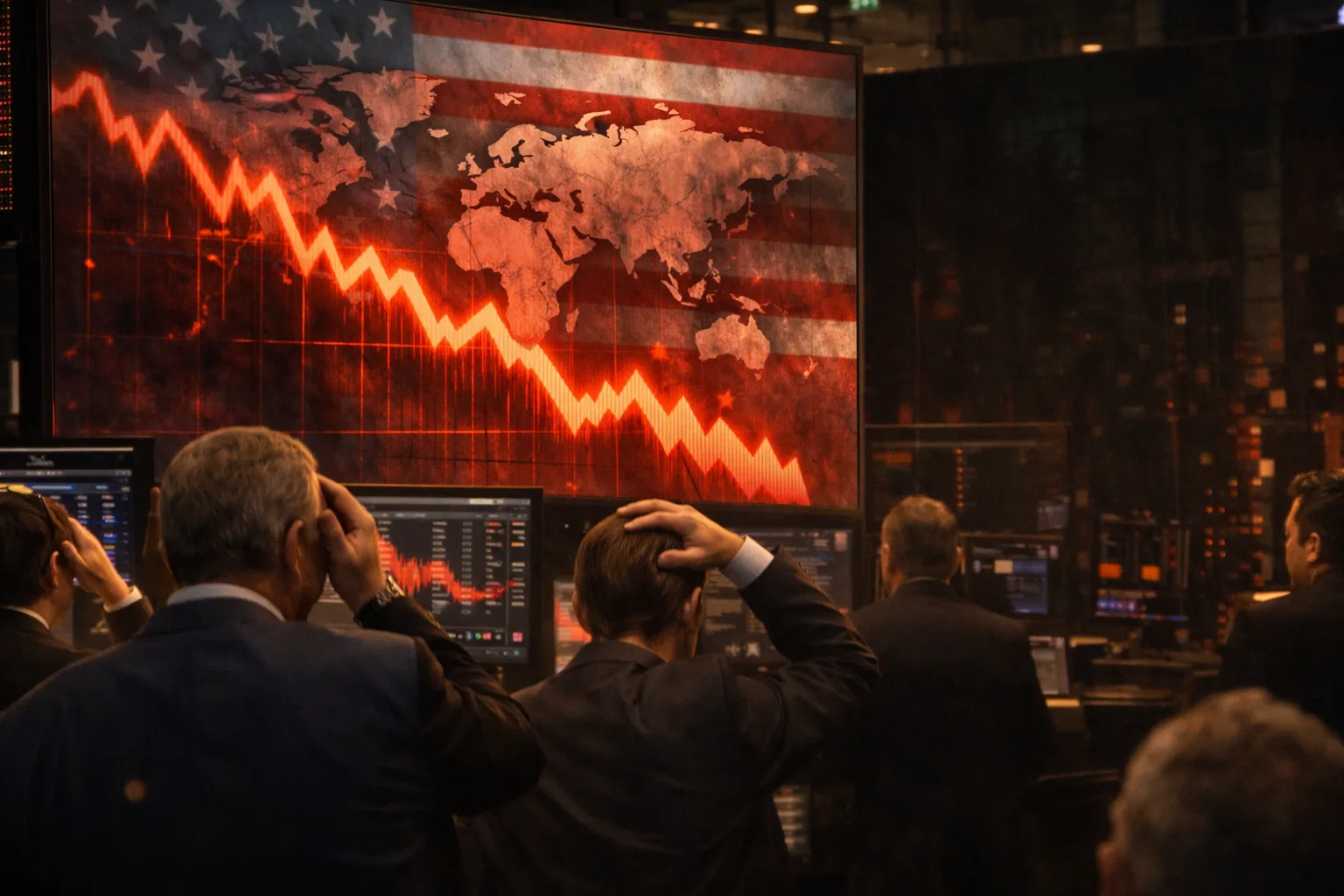
Wall Street suffered a sharp selloff Thursday as rising oil prices and escalating tensions in the Middle East rattled investors and triggered a broad market retreat.
The Dow Jones Industrial Average fell nearly 900 points, while the S&P 500 and Nasdaq also moved lower as traders digested geopolitical risk, surging crude prices, and fresh uncertainty around U.S. military involvement in the Persian Gulf.
Energy markets reacted quickly after Iran reportedly struck an oil tanker with a missile, renewing fears that the conflict could disrupt one of the most critical shipping routes in the global energy system.
For investors, the sudden surge in oil prices is a reminder that geopolitical events can move markets faster than economic fundamentals.
Oil Prices Surge on Tanker Attack
U.S. crude oil prices jumped to their highest levels since mid-2025 after reports emerged that Iran launched a missile strike against an oil tanker.
West Texas Intermediate crude surged roughly 6 percent to trade above $79 per barrel, while global benchmark Brent crude climbed more than 3 percent to trade above $84 per barrel.
These moves followed a brief period of stabilization in oil markets earlier in the week.
Energy analysts say the real concern is not the attack itself but the possibility that the conflict could escalate further and threaten shipping traffic through the Strait of Hormuz, one of the most important energy chokepoints in the world.
Roughly 20 percent of global oil supply moves through the Strait of Hormuz, making it one of the most strategically important waterways in global commerce.
Any disruption there could send energy prices sharply higher.
Stocks Drop as Investors Move to Reduce Risk
The spike in oil prices and rising geopolitical uncertainty pushed investors toward defensive positioning.
The Dow Jones Industrial Average fell 867 points, or about 1.8 percent, weighed down by losses in industrial and financial stocks including Caterpillar and Goldman Sachs.
The S&P 500 dropped 0.9 percent, while the Nasdaq Composite declined 0.6 percent.
Industrial companies are particularly sensitive to rising fuel costs and geopolitical uncertainty, which explains why stocks tied to global growth were among the hardest hit.
Energy stocks, however, saw relative strength as higher crude prices typically boost profits for oil producers.
Market strategists say the reaction reflects growing concern that the situation could escalate into a wider regional conflict.
Investor Concerns About U.S. Military Involvement
Sam Stovall, chief investment strategist at CFRA Research, said markets are reacting not just to rising oil prices but also to the potential for deeper U.S. involvement in the conflict.
“Can [President Donald] Trump really escort all of the vessels through the [Strait of Hormuz]?” he remarked. “What kind of liability are we going to be putting on ourselves, and how would that affect our debt levels? Investors are basically saying that whatever is happening now is not good.”
Investors are now trying to assess how much risk the United States may assume if it commits naval forces to protect oil tankers moving through the Persian Gulf.
Such operations can be extremely expensive and politically complicated.
Trump Administration Moves to Protect Shipping
President Trump said earlier this week that the United States is preparing to provide risk insurance and naval escorts for ships traveling through the Persian Gulf.
The move is designed to ensure that oil shipments can continue flowing despite rising regional tensions.
However, administration officials have not yet provided a timeline for when the Strait of Hormuz can be considered fully secure.
Markets typically react strongly when uncertainty surrounds a critical global trade route.
Even a temporary disruption could send oil prices soaring and ripple through financial markets worldwide.
Pentagon Says U.S. Is “Winning Decisively”
Defense Secretary Pete Hegseth said during a press briefing that the United States is currently “winning decisively” in its confrontation with Iran.
He added that additional U.S. military forces are being deployed to the region to strengthen deterrence and protect international shipping lanes.
Military buildups often raise investor concerns about the possibility of broader conflict.
Historically, markets have reacted negatively during the early stages of geopolitical escalations but often stabilize once the situation becomes clearer.
Tariffs Add Another Layer of Market Uncertainty
Complicating matters further, Treasury Secretary Scott Bessent indicated that the Trump administration’s new 15 percent global tariff policy could go into effect as soon as this week.
The tariff policy is part of the administration’s broader strategy to rebalance global trade relationships.
But investors worry that tariffs introduced during an already fragile geopolitical environment could increase volatility in global markets.
Trade tensions combined with rising oil prices create a difficult environment for global growth.
Both factors increase costs for businesses and consumers.
Berkshire Hathaway Stands Out as a Rare Winner
While most stocks fell sharply during the session, Berkshire Hathaway was one of the few bright spots.
Both Class A and Class B shares rose more than 1 percent after the company disclosed that it had resumed repurchasing its own stock for the first time since 2024.
Share buybacks are often viewed by investors as a signal that management believes the stock is undervalued.
Adding to the positive sentiment, Berkshire CEO Greg Abel personally purchased $15 million worth of shares, a move that investors often interpret as a strong vote of confidence in the company’s future.
Berkshire Hathaway has historically performed well during periods of market uncertainty due to its diversified portfolio and strong balance sheet.
Why Oil Prices Matter for Investors
Oil prices have historically played a major role in shaping financial markets.
When crude prices rise sharply, several things tend to happen:
• Transportation costs increase
• Inflation pressures rise
• Consumer spending weakens
• Corporate profit margins shrink
These factors can weigh on equities, particularly in industries such as airlines, manufacturing, logistics, and consumer goods.
However, energy companies often benefit during periods of rising oil prices.
Investors frequently rotate into oil and gas stocks during geopolitical crises for that reason.
Could Oil Prices Go Even Higher?
Energy analysts say the key variable to watch is whether tanker traffic through the Strait of Hormuz becomes disrupted.
If oil shipments begin slowing or stopping, crude prices could spike quickly.
Some analysts warn that oil could climb back above $90 or even $100 per barrel if shipping risks increase significantly.
That would likely put additional pressure on global stock markets.
Higher oil prices also complicate the Federal Reserve’s fight against inflation.
If energy costs surge, it could delay interest rate cuts and tighten financial conditions.
Market History Shows Geopolitical Selloffs Often Reverse
While geopolitical shocks often trigger sharp market declines, history suggests they rarely cause long lasting bear markets.
Research from CFRA shows that since World War II, most geopolitical driven selloffs have recovered within weeks or months once uncertainty begins to fade.
However, the duration of the current volatility will depend heavily on whether tensions between the United States and Iran escalate further.
Investors are closely watching the situation for signs of disruption to global energy supplies.
What Investors Should Watch Next
Several key developments could determine how markets move in the coming weeks:
• Security conditions in the Strait of Hormuz
• U.S. military deployments in the region
• Iran’s response to U.S. actions
• Oil price movements above $80 per barrel
• The rollout of the Trump administration’s new tariffs
If oil prices stabilize, markets may quickly recover.
But if tensions escalate and energy prices continue climbing, volatility could remain elevated.
For now, investors are once again being reminded that geopolitical risk can return to markets at any moment.
About Author