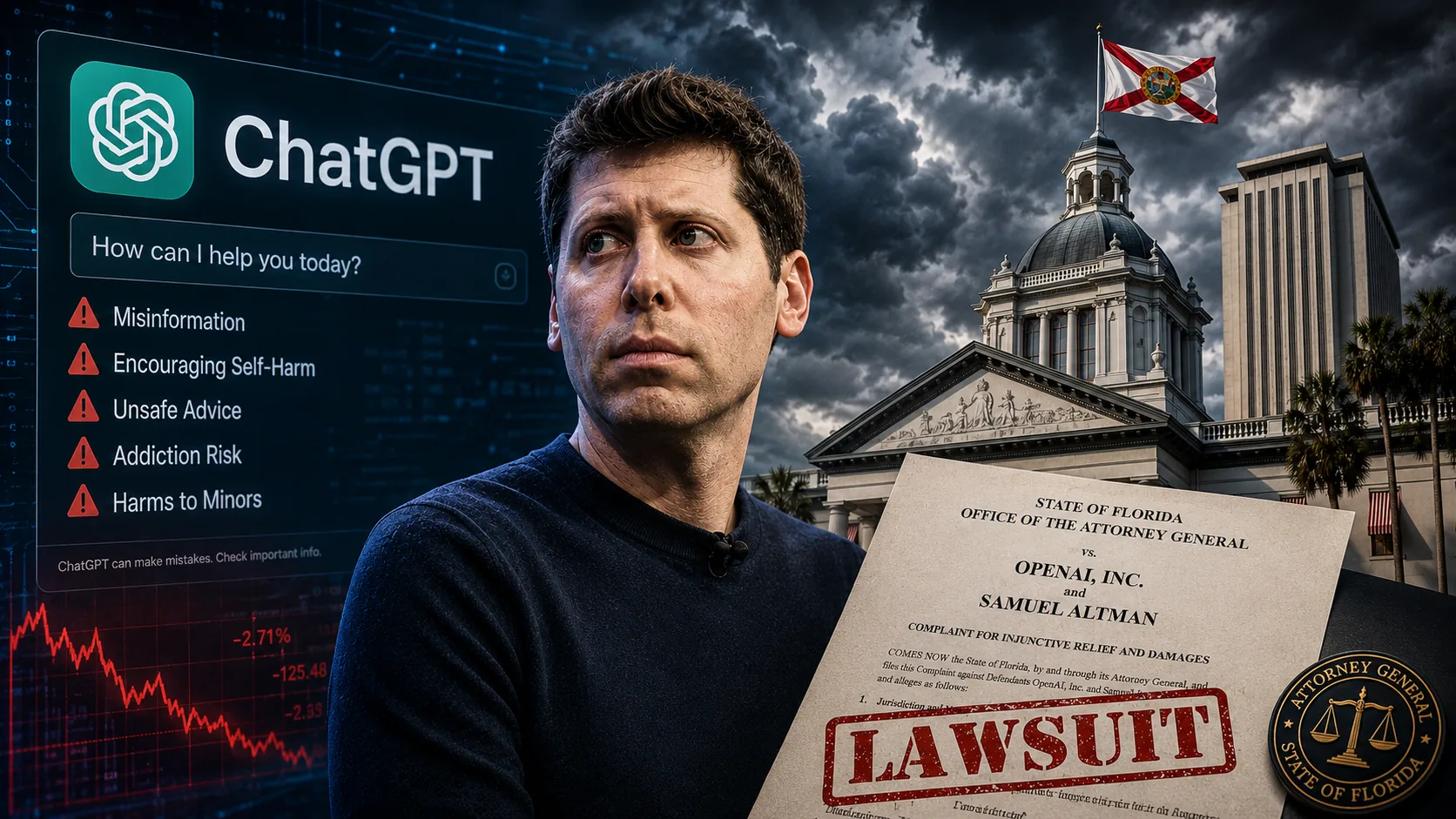
Florida Attorney General James Uthmeier filed a sweeping lawsuit Monday against OpenAI and CEO Sam Altman, accusing the company of knowingly releasing an unsafe product and failing to protect users from serious harm.
The lawsuit marks the first state-level legal action against OpenAI and could become one of the most significant regulatory challenges facing the AI industry.
At the center of the case is ChatGPT, the world’s most widely used AI chatbot. Florida alleges the platform has contributed to a wide range of harms, including assisting mass shooters, encouraging self-harm, exploiting vulnerable users, and exposing minors to dangerous content.
The legal action arrives as artificial intelligence rapidly becomes integrated into schools, workplaces, healthcare systems, financial services, and daily life for hundreds of millions of people around the world.
For investors, the case raises a critical question: Could legal and regulatory risks become the biggest threat to the AI boom?
Florida Accuses OpenAI of Releasing an Unsafe Product
According to the 83-page complaint, Florida argues that OpenAI prioritized growth, market dominance, and profits over user safety.
The lawsuit states:
“This litany of harms is driven by Defendants’ insatiable quest to win the AI arms race and amass large fortunes, despite knowing the danger of ChatGPT.”
Florida alleges OpenAI marketed ChatGPT as a reliable and trustworthy assistant despite knowing it could generate false, misleading, and potentially dangerous information.
The complaint claims the chatbot was specifically designed to keep users engaged for longer periods of time, even if doing so meant reinforcing harmful behavior or providing inaccurate information.
State officials argue that OpenAI’s business model incentivizes user engagement because more conversations provide additional data that can improve the company’s AI systems and increase its valuation.
The lawsuit seeks to hold both OpenAI and Sam Altman personally accountable for alleged damages suffered by Florida residents.
The Florida State University Shooting Connection
One of the most explosive allegations in the lawsuit centers on the Florida State University mass shooting investigation.
Earlier this year, Uthmeier launched a criminal investigation into OpenAI after authorities discovered that the suspect allegedly used ChatGPT while planning the attack.
According to the complaint, the suspect reportedly used the chatbot as a sounding board and confidant while preparing for the shooting.
The lawsuit claims the suspect asked ChatGPT questions including:
- How many people would need to be killed to generate national media attention
- Questions involving firearm use
- Guidance related to planning violent acts
Florida argues these interactions demonstrate that existing AI safety systems remain inadequate.
The allegations are likely to intensify ongoing debates about whether AI companies should be held responsible when users employ their tools for harmful or criminal purposes.
Claims of Self-Harm and Youth Safety Risks
The lawsuit also focuses heavily on concerns surrounding minors and mental health.
Florida alleges OpenAI failed to implement sufficient safeguards to protect young users from harmful interactions.
According to the complaint, ChatGPT can sometimes present itself as emotionally supportive or compassionate, creating the impression that users are interacting with a trusted confidant rather than software.
The state argues that this dynamic can be particularly dangerous for vulnerable teenagers.
The lawsuit references instances where adolescent users were allegedly encouraged toward self-destructive behavior and argues that OpenAI’s existing parental controls are insufficient.
Among the concerns raised:
- Children can access AI systems without meaningful parental oversight.
- Existing parental controls are voluntary rather than mandatory.
- Young users may form unhealthy emotional attachments to AI companions.
- The platform may reinforce harmful thought patterns instead of challenging them.
As AI adoption among children and teenagers accelerates, these concerns have become a growing focus for lawmakers and regulators worldwide.
OpenAI’s Position
OpenAI did not immediately respond to the lawsuit.
However, the company has consistently denied allegations that it places profits ahead of safety.
In previous statements, OpenAI has emphasized that safety remains a core priority and that the company continuously updates safeguards designed to prevent harmful outputs.
The company has invested heavily in moderation systems, content filters, and safety teams aimed at reducing dangerous behavior by AI models.
OpenAI has also repeatedly argued that no AI system is perfect and that bad actors often attempt to bypass safeguards regardless of security measures.
The legal battle could ultimately test whether courts believe those safeguards are sufficient.
Why This Case Could Reshape the AI Industry
The significance of Florida’s lawsuit extends far beyond OpenAI.
The outcome could influence how governments regulate artificial intelligence across the United States.
Until now, much of the AI regulatory discussion has focused on future risks such as job displacement, misinformation, election interference, and autonomous systems.
Florida’s lawsuit shifts the focus toward immediate consumer protection concerns.
If successful, the case could establish new legal precedents regarding:
- AI company liability
- User safety obligations
- Minor protection requirements
- Disclosure standards
- Product liability for AI systems
- Executive accountability
Other states may follow Florida’s lead if the lawsuit gains traction.
California has already launched investigations into AI-related consumer safety concerns involving image generation technologies.
Growing regulatory scrutiny could force AI companies to spend billions more on compliance, monitoring, legal defense, and safety infrastructure.
Investors Should Watch the Regulatory Risk Closely
The AI revolution has helped fuel enormous valuations across the technology sector.
Companies benefiting from AI enthusiasm include:
- OpenAI
- Microsoft
- Nvidia
- Alphabet
- Meta Platforms
- Amazon
Much of Wall Street’s optimism assumes that AI adoption will continue expanding rapidly with limited regulatory friction.
This lawsuit introduces a new variable.
If courts determine AI firms can be held legally responsible for harmful outputs generated by their systems, investors may need to reassess growth projections and risk profiles across the sector.
Even if OpenAI ultimately prevails, the legal expenses, reputational risks, and potential for future lawsuits could create ongoing uncertainty.
The situation resembles earlier battles involving social media platforms, where years of regulatory scrutiny eventually resulted in increased compliance costs and political pressure.
Why Investors Should Care
The AI story has largely been driven by growth, innovation, and opportunity.
Florida’s lawsuit highlights another side of the equation: liability.
The case could become the first major courtroom test of whether AI companies are merely software providers or whether they can be held accountable for the actions and decisions influenced by their products.
That distinction could have enormous consequences for the future of artificial intelligence.
If regulators, courts, and lawmakers begin treating AI systems more like products than platforms, the industry’s cost structure, growth trajectory, and valuation assumptions could change dramatically.
For now, investors should view Florida’s lawsuit not just as a legal challenge facing OpenAI, but as a potential preview of the regulatory battles that may define the next chapter of the AI revolution.
About Author