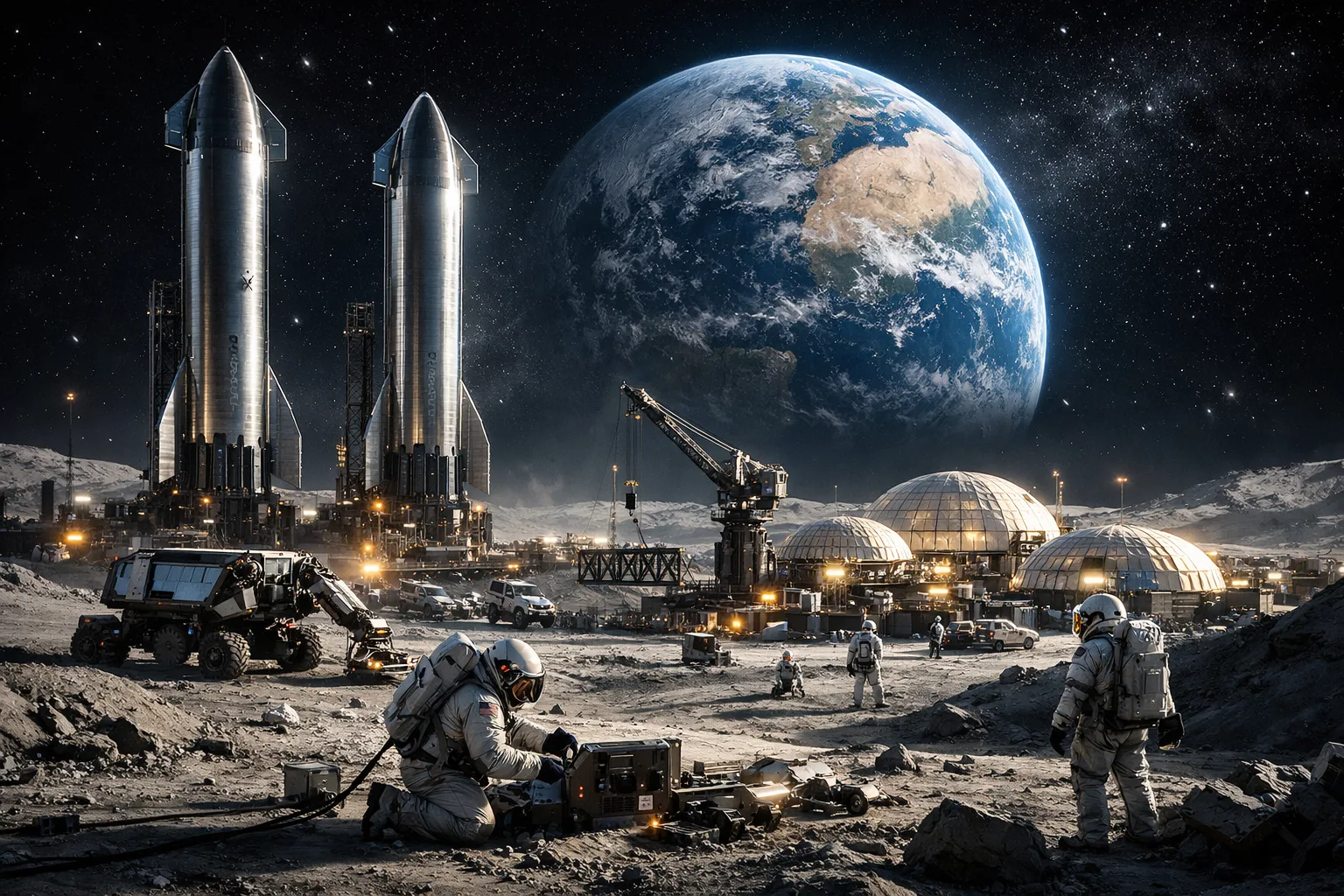
Elon Musk has spent more than two decades promising humanity a future on Mars. Now, in a notable strategic shift, the SpaceX founder says the company is prioritizing building a “self-growing city” on the Moon first, signaling a change that could reshape the trajectory of private space development, government partnerships, and the long-term economics of space exploration.
The decision does not mean Musk has abandoned Mars. Instead, it reflects a more practical roadmap aimed at achieving near-term progress, generating revenue, and proving technology before attempting the far more difficult challenge of establishing a permanent human settlement on the Red Planet.
For investors, the shift matters. SpaceX sits at the center of the global commercial space race, and its evolving strategy has implications for government contracts, satellite markets, lunar infrastructure, and the broader space economy projected to reach trillions of dollars over the coming decades.
Why Musk Is Pivoting Toward the Moon
In a statement posted on X, Musk explained that the Moon offers a far faster and more achievable path toward establishing an off-world human presence.
“The overriding priority is securing the future of civilization and the Moon is faster,” he said. “It is only possible to travel to Mars when the planets align every 26 months (six month trip time), whereas we can launch to the Moon every 10 days (2 day trip time).”
The logistical differences between the Moon and Mars are enormous. A round-trip mission to Mars requires years of preparation and perfect orbital alignment. In contrast, the Moon is only about three days away and offers frequent launch opportunities, significantly lowering risk and cost.
Musk described the new focus as building a “self-growing city on the Moon,” though he has not provided detailed technical plans. Analysts believe this concept refers to a scalable lunar base capable of expanding through automated construction, robotics, and in-situ resource utilization such as extracting oxygen and fuel from lunar soil.
Mars Remains the Ultimate Goal
Despite the shift, Musk reiterated that SpaceX remains committed to creating a city on Mars within five to seven years. Previously, he had suggested that the company could attempt its first uncrewed Starship landing on Mars as early as 2026, though timelines in the space industry often evolve.
For more than a decade, Mars colonization has been SpaceX’s defining mission. Musk has repeatedly argued that becoming a multi-planetary species is essential for the survival of human civilization in the face of existential risks.
However, the technological and financial barriers to Mars remain staggering. The cost of transporting cargo, building infrastructure, and sustaining human life on Mars is far higher than comparable efforts on the Moon. Establishing lunar operations first may serve as both a testing ground and a stepping stone.
Financial Reality and Investor Pressure
The strategy shift comes at a time when SpaceX is widely expected to pursue a public listing in the future, increasing pressure to demonstrate measurable progress and revenue generation.
Justus Parmar, CEO of Fortuna Investments, which is invested in SpaceX, explained the financial logic behind the move:
“Musk’s ultimate goal is to get civilization to Mars. It’s going to be very expensive, and as a soon-to-be public company, SpaceX needs to appease shareholders.”
“Setting up operations on the lunar surface will provide a quicker return on revenue, so it’s a natural step on the way to a more expensive and heavier R&D project to get to Mars.”
A lunar base could open multiple near-term revenue streams, including:
- Government contracts for lunar infrastructure
- Scientific research partnerships
- Resource extraction development
- Deep space logistics and refueling
- Satellite and communications expansion
This makes the Moon a commercially viable milestone rather than purely an aspirational one.
NASA’s Lunar Ambitions and the Artemis Program
While Musk long dismissed lunar missions as a distraction, NASA has prioritized the Moon for years through its Artemis program. The agency plans to return astronauts to the lunar surface for the first time since 1972.
NASA currently targets a human landing around 2028, following earlier delays. The upcoming Artemis II mission will send astronauts around the Moon without landing, serving as a critical step toward the eventual Artemis III landing mission.
SpaceX plays a central role in these efforts. The company holds a contract worth nearly $3 billion to develop the Human Landing System that will transport astronauts from lunar orbit to the Moon’s surface using a modified version of Starship.
This makes SpaceX indispensable to NASA’s timeline.
The Starship Challenge
Starship is the largest and most ambitious rocket ever built and is designed to eventually transport humans to both the Moon and Mars. However, the spacecraft remains in early development.
Multiple Starship test launches have ended in explosions or failures, and the vehicle has yet to complete a fully operational orbital mission. SpaceX is expected to introduce new Starship prototypes soon as it continues refining the design.
Delays in Starship readiness have raised concerns within the U.S. government. Transportation Secretary Sean Duffy, who previously served briefly as acting NASA administrator, warned that SpaceX might struggle to meet the timeline for the Artemis III lunar landing.
Duffy even suggested NASA could consider relying more heavily on Blue Origin, the space company founded by Jeff Bezos, if SpaceX fell behind.
The Growing SpaceX vs Blue Origin Rivalry
Blue Origin is also developing a lunar lander under a separate multibillion-dollar NASA contract. The company recently paused flights of its suborbital tourism rocket to focus resources on lunar development.
The rivalry between SpaceX and Blue Origin is intensifying as both companies compete for government funding, technological leadership, and influence over the future of space infrastructure.
Meanwhile, NASA’s new administrator, Jared Isaacman, a private astronaut and SpaceX ally, has not publicly revisited the Artemis III lander contract, suggesting SpaceX remains central to the mission.
Geopolitical Stakes: The U.S. vs China Lunar Race
The urgency behind lunar exploration is not purely scientific or commercial. It is also geopolitical.
The United States is racing to establish a sustained presence on the Moon before China, which has rapidly expanded its lunar exploration program and plans to build a joint lunar base with Russia in the 2030s.
Control of lunar infrastructure could determine leadership in future space resource extraction, communications networks, and deep-space logistics. For governments and investors alike, the Moon is increasingly seen as a strategic frontier.
The xAI Merger and Musk’s Expanding Vision
Musk’s shift in priorities comes shortly after SpaceX acquired xAI, merging two of his most ambitious ventures. The move aims to integrate advanced artificial intelligence into space operations, robotics, autonomous construction, and off-world resource management.
AI could play a critical role in building a “self-growing” lunar settlement by enabling autonomous construction, infrastructure maintenance, and resource extraction without continuous human intervention.
The combined entity is now one of the most valuable private companies in the world, strengthening Musk’s position in both the AI and space sectors.
Political Context and Government Contracts
Musk’s companies rely heavily on government partnerships, particularly with NASA and the U.S. Department of Defense. His increasing involvement in politics and fluctuating relationship with President Donald Trump have drawn attention.
SpaceX remains one of the largest recipients of U.S. space and defense contracts, and continued alignment with government priorities such as lunar exploration could help secure long-term funding and influence.
What This Means for the Space Economy
The global space economy is projected to exceed $1 trillion in value within the next two decades, driven by satellite communications, launch services, space infrastructure, and resource development.
A permanent lunar presence could accelerate multiple industries:
- Space manufacturing and robotics
- Satellite mega-constellations
- Space-based solar power
- Lunar mining and fuel production
- Deep space logistics and exploration
SpaceX’s pivot toward the Moon may signal that commercialization of space is entering a new phase, moving from experimental missions to infrastructure building.
Investor Takeaways
For investors tracking the space sector, Musk’s strategic shift carries several implications:
1. Faster Revenue Potential
Lunar infrastructure offers earlier commercialization opportunities than Mars, supporting SpaceX’s long-term valuation.
2. Strengthened NASA Partnership
SpaceX’s central role in Artemis keeps government funding flowing and reinforces its position as a leader in space transportation.
3. Rising Competition
Blue Origin and international space programs are intensifying the race for lunar dominance.
4. Long-Term Mars Vision Intact
The Moon is likely a stepping stone rather than a replacement for Mars colonization.
5. Expansion of the Space Economy
The development of lunar infrastructure could unlock new markets worth hundreds of billions over time.
About Author