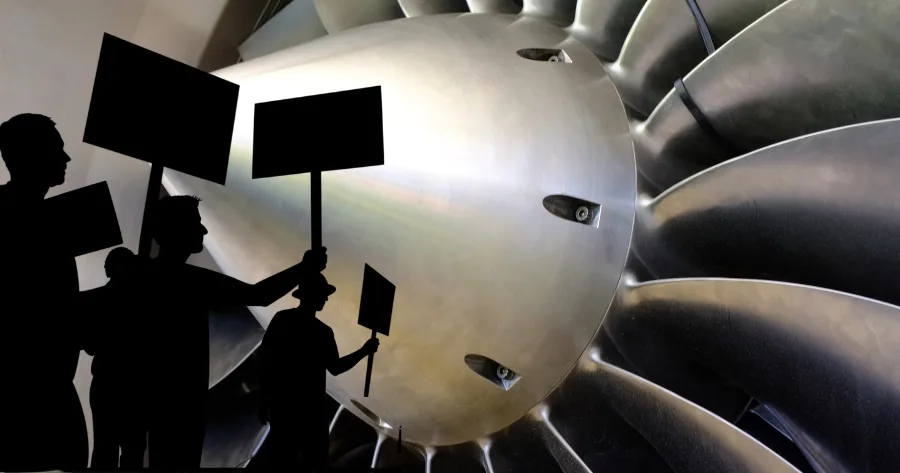
The United Auto Workers (UAW) strike at GE Aerospace facilities in Evendale, Ohio, and Erlanger, Kentucky, is now stretching into its second week. More than 600 employees walked out on August 28, 2025, after contract talks collapsed, leaving one of America’s largest aerospace companies facing a labor standoff with ripple effects that extend well beyond the shop floor.
For investors, the GE Aerospace strike is more than a local dispute—it’s a test of how far workers can push back against rising healthcare costs, stagnant wages, and job insecurity at a time when the company is reporting record profits. The outcome could affect GE’s production schedules, supply chains, and future labor negotiations across the industrial sector.
What Sparked the Strike
The dispute centers on the union’s demand for fair compensation, job security, and healthcare protections.
UAW’s Core Demands
- Healthcare: Workers are rejecting GE’s push for a high-deductible health plan that would shift more out-of-pocket costs onto employees.
- Job Security: The union wants assurances against layoffs and outsourcing—particularly relevant as aerospace firms increasingly look to automation and overseas labor.
- Time Off: Striking employees argue they need more personal and vacation days to avoid being forced to choose between family and work.
- Fair Pay: The demand is not just for incremental raises, but for pay increases that reflect GE’s booming financial performance.
“When it’s hurting for money, we gave. Now they’ve reneged,” said longtime GE worker Donald Luknis, highlighting what many see as a betrayal after years of concessions during leaner times.
GE’s Counteroffer
GE Aerospace says it has already put a “record” offer on the table, including:
- A 12% wage increase over three years (5% in 2025, 4% in 2026, 3% in 2027).
- More vacation days for most employees and expanded paid personal time (from 24 to 32 hours).
- A $750 accelerated cash payment in January 2026.
- Scheduled cost-of-living adjustments through mid-2028.
The catch: the deal would only go into effect if union members ratify it by September 5.
The union remains unconvinced, pointing to GE Aerospace’s record profits and the CEO’s nearly $89 million pay package in 2024.
Why It Matters for GE and the Aerospace Industry
This labor battle comes at a sensitive time. GE Aerospace is a critical supplier of engines for both commercial aircraft and U.S. military programs. Even short disruptions could echo through aviation and defense supply chains.
Investor Angle
- Operational Risk: A prolonged strike threatens to slow deliveries, disrupt schedules, and force GE to rely on management or non-union workers—less efficient and more costly.
- Financial Risk: If the strike drags on, overtime and contingency costs will eat into margins. Investors should expect a potential earnings hit in upcoming quarters.
- Precedent Risk: If the UAW secures significant gains, other GE divisions—and even rival manufacturers—may face similar demands in upcoming negotiations.
Markets have already shown sensitivity to labor disruptions, as seen in last year’s auto strikes at Ford, GM, and Stellantis. Aerospace investors should watch GE closely: any dip in production capacity could ripple into airlines, defense contractors, and suppliers.
A Tale of Two Economies: Workers vs. Executives
The strike also underscores a broader tension in corporate America—soaring executive compensation versus stagnant wage growth. GE Aerospace’s CEO pocketed nearly $89 million in 2024 compensation, while front-line workers argue they are struggling with healthcare costs and limited time off.
That mismatch has become a rallying cry not just for GE workers, but for labor movements nationwide. The symbolism here is hard to miss: one of America’s oldest industrial powerhouses is facing a battle over whether the people who build its engines deserve more than a token share of its success.
For investors, this matters because worker unrest is no longer a background risk—it’s a front-page one. Companies that fail to balance profitability with workforce satisfaction could face repeated disruptions.
Politics and Public Opinion
This strike has also become political theater. Lawmakers have joined picket lines, framing the dispute as part of a larger fight over working-class rights and corporate responsibility.
The timing matters: with a heated election season under way, politicians are keen to highlight worker grievances. Investors should note that any government involvement—whether supportive statements or potential intervention—could affect negotiations.
What’s Next
Right now, there’s no clear timeline for talks to resume. Union members receive about $500 a week in strike pay, but reduced healthcare and benefit coverage means the pressure is mounting. GE, for its part, is holding firm that its offer is the best available.
If the contract is not ratified, GE faces:
- Longer production delays.
- Potential reputational damage as “anti-worker” sentiment grows.
- Escalation of labor actions that could inspire similar walkouts at other industrial giants.
Investor Takeaways
- Short-Term Volatility: Expect potential turbulence in GE Aerospace’s share price if the strike extends beyond mid-September. Markets dislike uncertainty, and supply chain disruptions will quickly get priced in.
- Labor Risk Premium: The UAW strike shows that investors must factor labor relations into valuations. A generous settlement could raise costs but also stabilize long-term operations.
- Sector Watch: If GE Aerospace yields major concessions, watch Boeing, Lockheed Martin, and Raytheon. Their workers may see this as precedent.
- Macro Angle: Rising labor activism is part of a wider trend—workers across industries are pushing harder amid inflation, corporate profits, and executive pay disparities. Investors need to account for wage pressures as part of cost structures going forward.
Bottom Line
The GE Aerospace strike is more than a workplace dispute—it’s a test case for the balance of power between labor and management in a profitable, strategically critical industry. For workers, it’s about healthcare, time, and fair pay. For GE, it’s about controlling costs while maintaining production. For investors, it’s about gauging risk in a world where labor unrest is increasingly common.
In blunt terms: GE Aerospace can afford to settle. The question is whether it chooses stability or continues down a path of confrontation. Investors need to be watching closely—because this fight will set the tone for future labor negotiations across the sector.
Sources:
- Reuters – Over 600 UAW workers at two GE Aerospace facilities go on strike
- Local12 – GE Aerospace strike enters second week with no end in sight
- WLWT – GE Aerospace offer summary
- Dayton Daily News – GE says it has made best offer
- WCPO – Contract talks stalled out
- WSWS – GE Aerospace strike expands
About Author