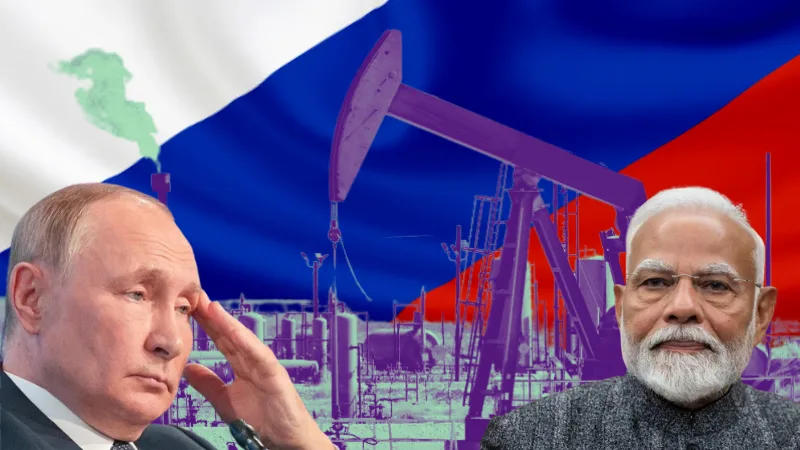
India has just 20 days to sidestep a major economic shock. President Donald Trump has moved to double tariffs on Indian goods, setting off a geopolitical firestorm with serious consequences for global trade and investment flows.
On August 27, the U.S. will raise tariffs on Indian exports from 25% to 50%, targeting India’s continued purchases of Russian oil. The decision marks a sharp escalation in Trump’s broader strategy to cut off Russia’s energy revenues amid the Ukraine conflict—but it also risks derailing the U.S.–India relationship just as it was gaining strategic depth.
Why Investors Need to Pay Attention
- India is the U.S.’s largest trading partner in Asia by goods volume.
- $86.5 billion worth of Indian exports to the U.S. are now under threat.
- India’s GDP could shrink by up to 0.4% if the tariffs stick—dragging growth below 6%.
- Companies like Apple and global investors looking at India as a China alternative may pause expansion.
Markets now have 20 days to brace for impact—or hope for diplomacy to work.
Why India Was Targeted
Unlike China or Turkey—also large buyers of Russian crude—India is being singled out. The Trump administration is using trade pressure to force a realignment, linking economic incentives directly to foreign policy.
India calls the move “unfair” and “unjustified.” Officials argue that its Russian oil imports are based on commercial terms and energy security needs, not politics.
Yet Washington’s calculus appears simpler: force Delhi to pick a side. By making Indian exports economically unviable under the new tariff load, the U.S. hopes to compel Prime Minister Narendra Modi’s government to cut Russian ties—or face economic pain.
The Fallout: What’s at Risk?
- Textiles, gems, and jewelry—labor-intensive sectors that dominate Indian exports—will take the first hit.
- Most Indian exporters can’t absorb a 50% tariff. Anything above a 15% hike risks killing off competitiveness.
- Nomura likens the policy to a trade embargo—a sudden stop in export flows.
- GDP impact: The U.S. accounts for 18% of Indian exports and 2.2% of GDP. A 25% tariff already risked shaving off 0.2–0.4% growth. A 50% rate is potentially catastrophic.
Although electronics and pharmaceutical exports are currently exempt, the signal is clear: no sector is safe if the trade war escalates.
Will This Backfire on the U.S.?
This is no minor squabble. The U.S. risks alienating a democratic counterweight to China—a key part of its Indo-Pacific strategy.
India is not a fringe player anymore. It’s the world’s fifth-largest economy, a growing tech hub, and a manufacturing destination courted by firms like Apple, which now makes a substantial share of iPhones locally.
But experts warn Trump’s tariff move could:
- Drive India closer to Russia and China, including a potential revival of the Russia-India-China trilateral bloc.
- Slow down India’s rise as a “China-plus-one” manufacturing destination, just as Vietnam and others are gaining traction with lower tariff environments.
“The U.S. action may push India to rethink its strategic alignment,” says Ajay Srivastava of the Global Trade Research Initiative (GTRI). “It sends a strong message that economic bullying can override partnership language.”
What Are India’s Options?
1. Concede Quietly
India could reduce Russian imports or issue signals that it’s looking to diversify oil sources. This would fit with its longer-term policy trends, which already show a slow shift away from Russian military hardware and energy dependence.
2. Retaliate
While unlikely, India has done it before. In 2019, it slapped tariffs on 28 U.S. goods in response to American steel and aluminum tariffs. Some were reversed in 2023, but the precedent exists.
3. Freeze the Trade Deal
India and the U.S. were close to finalizing a modest trade deal this month. Talks had stalled over agriculture and dairy access. Now, any concessions from India will look like submission—and could carry a steep political cost for Modi ahead of domestic elections.
4. Increase Export Subsidies
India has traditionally avoided direct subsidies, but with so much at stake, it may ramp up favorable trade financing and export promotion programs. Experts doubt these alone will be enough to offset a 50% U.S. tariff wall.
Is This the End of the “Mega Partnership”?
Trump’s aggressive move could mark the most serious rupture in U.S.–India relations in over a decade. The backlash within India is already fierce:
- Rahul Gandhi, leader of the opposition Congress party, called the tariffs “economic blackmail.”
- Economists like Urjit Patel, former central bank chief, are urging calm but warn that a “needless trade war” may now be inevitable.
Trump’s camp sees this as leverage. But the risk is that India doesn’t blink—and instead starts building alternative partnerships with less volatile conditions.
Meanwhile, markets are on edge. The next 20 days may determine not just trade flows, but the shape of global alliances.
U.S.–India Trade Exposure
| Category | 2024 Value (USD) | Tariff Risk |
|---|---|---|
| Textiles & Apparel | $18.7B | 🔴 High |
| Gems & Jewelry | $11.3B | 🔴 High |
| Electronics (e.g., iPhones) | $9.5B | 🟢 Exempt |
| Pharmaceuticals | $7.8B | 🟢 Exempt |
| Agriculture | $4.2B | 🟡 Medium |
Source: Nomura, Indian Ministry of Commerce
Watch for Diplomatic Maneuvers
A U.S. trade delegation is due in India this month. If both sides can pull back from the brink, this could still evolve into a “win-win” deal. But the clock is ticking.
For investors: watch the Indian rupee, U.S. importers with Indian exposure, and key Indian export stocks (especially textiles, jewelry, and mid-cap logistics). Any signal of de-escalation will trigger a bounce. Escalation could spell long-term realignment in global trade flows.
This isn’t just about tariffs—it’s about who sets the rules in the new global economy.
About Author