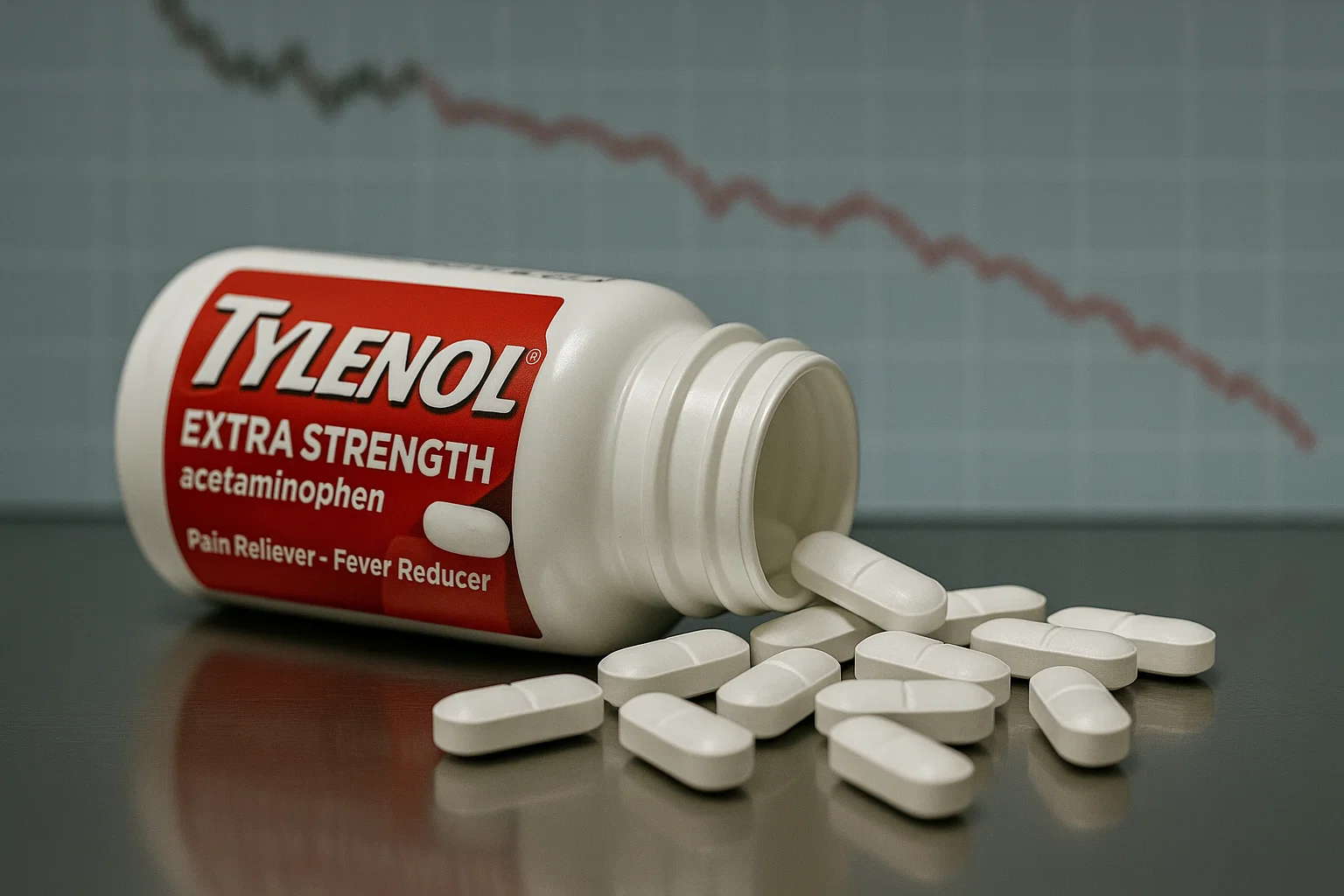
Shares of Tylenol maker Kenvue tumbled after reports suggested that Health and Human Services Secretary Robert F. Kennedy Jr. may soon release findings connecting the popular pain reliever to autism when taken during pregnancy. The development has rattled markets and renewed debate over both the safety of acetaminophen and the role of government health policy in shaping consumer behavior.
Market Reaction
Kenvue stock dropped more than 14 percent in early September trading, one of its steepest one-day losses since the company spun off from Johnson & Johnson in 2023. The decline erased billions in market value and highlighted just how sensitive consumer health brands can be to shifts in public perception and regulatory scrutiny.
The broader market shrugged off the news, but Kenvue’s fall underscores a key point for investors. Health narratives, especially those involving widely used drugs, can trigger sharp and unexpected swings in stock performance. Tylenol has been a staple in American households for decades, making any challenge to its reputation a serious financial threat.
The Report at the Center
According to reporting from The Wall Street Journal, Kennedy has directed HHS to release a study on the potential causes of autism before the end of September. People familiar with the matter suggest the review will point to prenatal Tylenol use and low folate levels as potential risk factors.
The Department of Health and Human Services has not confirmed those details. In a statement to FOX Business, an HHS spokesperson said that until the report is published, “any claims about its contents are nothing more than speculation.” The agency stressed that it is using “gold-standard science” to examine America’s rising autism rates.
What the Science Shows
The medical community remains divided.
- A large Swedish study published in 2024 tracked over 2.4 million children and found no association between prenatal acetaminophen use and autism, ADHD, or intellectual disability.
- A separate NIH-funded literature review of 46 epidemiological studies produced mixed results. More than half suggested some association between prenatal acetaminophen use and autism spectrum disorders, while others showed no link or even a possible protective effect.
- Major medical organizations, including the American College of Obstetricians and Gynecologists, continue to recommend acetaminophen as the safest option for pregnant women when used at the lowest effective dose for the shortest necessary time. They argue that untreated pain and fever pose greater risks to both mother and child.
In short, the scientific consensus does not support a proven causal link. Still, the conversation has gained momentum, and Kennedy’s involvement ensures it will remain in the headlines.
Legal and Reputational Risks
Kenvue is already facing lawsuits alleging that prenatal exposure to Tylenol caused autism or ADHD. In 2024, a federal judge dismissed mass tort cases, but appeals are ongoing. Any new government report suggesting even a potential association could reignite litigation and add pressure for costly settlements.
Consumer trust is another concern. Tylenol accounts for more than 15 percent of Kenvue’s U.S. retail sales, alongside major brands like Neutrogena. A sustained hit to Tylenol’s reputation would not only hurt sales but could damage confidence in the company’s entire product lineup.
Why This Matters for Investors
For investors, the key issue is not whether science ultimately confirms a link between Tylenol and autism. The real driver is perception. When health authorities, policymakers, or media outlets highlight potential risks, consumer behavior and investor sentiment can shift quickly, even without definitive proof.
Kenvue is learning this lesson in real time. The sharp sell-off reflects both immediate fears of regulatory fallout and longer-term concerns about litigation and brand damage. Investors should also note that if HHS changes guidance, competitors like Advil (ibuprofen) could see a boost in sales at Kenvue’s expense.
Investor Takeaways
- Monitor regulatory signals: The HHS report is expected later in September. Any change in guidance from NIH, FDA, or ACOG could materially affect Tylenol sales.
- Track litigation: Although mass tort cases were dismissed, appeals and new lawsuits remain a threat. A government report suggesting risk could give plaintiffs fresh momentum.
- Watch Kenvue’s messaging: The company insists acetaminophen is safe and continues to point to decades of scientific use. How effectively it communicates with consumers and doctors will shape the stock’s recovery.
- Consider portfolio diversification: Investors heavily exposed to Kenvue should evaluate other healthcare and consumer health companies with lower litigation risk.
- Look for rebound opportunities: If the HHS report ends up more balanced than feared, Kenvue stock could bounce back from current lows.
Science or Perception?
The Tylenol controversy is less about settled science and more about the power of narrative. A single pending government report, fueled by Robert F. Kennedy Jr.’s high-profile leadership at HHS, has already cost Kenvue billions in market value. For investors, the lesson is clear. Health stocks are not just about clinical outcomes. They are about perception, trust, and timing.
Until the report is released, investors should prepare for continued volatility. The science may not have changed, but the market’s perception of risk certainly has.
About Author