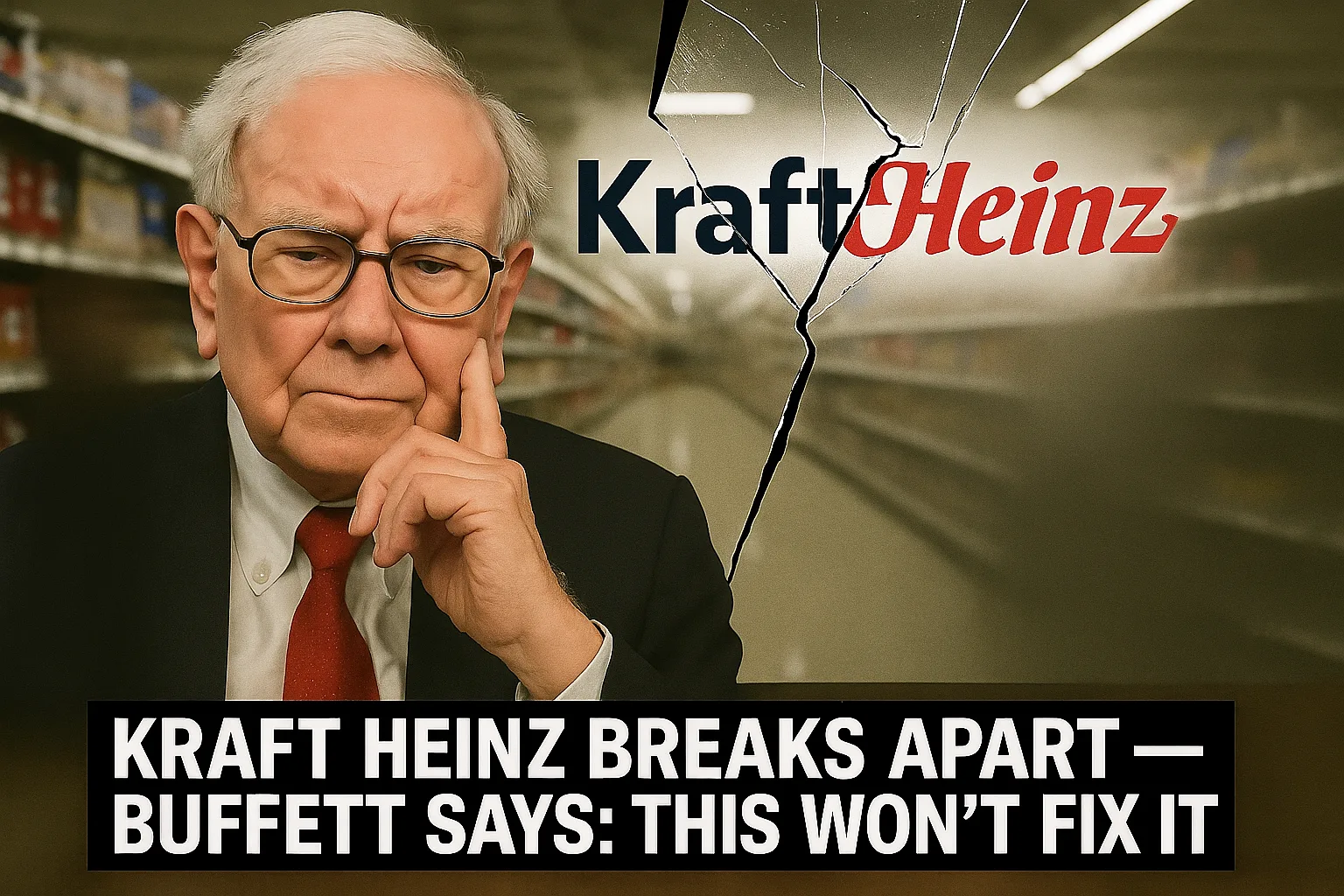
In 2015, the merger of Kraft Foods and H.J. Heinz created one of the largest food companies in the world, backed by Warren Buffett’s Berkshire Hathaway and Brazilian private equity firm 3G Capital. At the time, the $49 billion deal promised massive synergies, global scale, and the muscle to dominate the packaged food industry. A decade later, that grand experiment is being unwound.
On September 2, 2025, Kraft Heinz announced that it will split into two separate, publicly traded companies—Global Taste Elevation Co. and North American Grocery Co. The decision marks one of the most dramatic reversals in modern consumer goods history, and Buffett, once a key backer of the merger, is far from enthusiastic.
“It certainly didn’t turn out to be a brilliant idea to put them together, but I don’t think taking them apart will fix it,” Buffett told CNBC.
For investors, this isn’t just a corporate restructuring—it’s a signal of how consumer habits, capital allocation, and shareholder influence are shifting in today’s markets.
The Rise and Fall of the Kraft Heinz Merger
When Kraft and Heinz merged in 2015, the combined company instantly became the third-largest food and beverage firm in North America and the fifth-largest in the world. Warren Buffett’s Berkshire Hathaway and 3G Capital engineered the deal, each taking significant stakes.
The playbook was familiar: slash costs, centralize operations, and leverage a portfolio of iconic brands like Heinz ketchup, Kraft mac & cheese, Oscar Mayer, and Philadelphia cream cheese. Investors were promised billions in synergies and a more efficient giant that could compete with Nestlé, PepsiCo, and Unilever.
For a while, the model seemed to work. Earnings improved, dividends flowed, and Buffett hailed the brands as enduring consumer staples. But cracks soon appeared.
- Changing consumer tastes: Younger buyers gravitated toward fresh, organic, and less-processed foods.
- Private label competition: Grocery chains pushed cheaper, store-brand alternatives.
- Innovation lag: The company struggled to keep pace with food trends like plant-based protein, premium snacks, and health-conscious reformulations.
By 2019, Kraft Heinz was forced to take a $15 billion writedown on key brands, and its share price collapsed. The Buffett-3G “dream team” had created a company that was too big, too slow, and too tied to an outdated vision of the American grocery aisle.
The Split: Two Companies, Two Strategies
Kraft Heinz’s 2025 announcement will break the company into:
- Global Taste Elevation Co.
- Products: Heinz ketchup, Philadelphia cream cheese, Kraft mac & cheese, and other sauces, spreads, and seasonings.
- Financials: ~$15 billion in 2024 net sales; ~$4 billion in Adjusted EBITDA.
- Strategy: Focus on global brand power and growth through flavor categories.
- North American Grocery Co.
- Products: Oscar Mayer meats, Kraft Singles, Lunchables, Maxwell House coffee.
- Financials: ~$10.4 billion in 2024 net sales; ~$2.3 billion in Adjusted EBITDA.
- Strategy: Concentrated on staple grocery categories in the U.S. and Canada.
Current CEO Carlos Abrams-Rivera will lead the grocery-focused company, while Global Taste Elevation will get a new CEO. Headquarters will remain split between Pittsburgh and Chicago. The separation is expected to complete in the second half of 2026 and will cost up to $300 million (The Times).
Buffett’s Stake and Frustration
Buffett’s Berkshire Hathaway owns roughly 27.5% of Kraft Heinz, making it the single largest shareholder. When the merger was announced in 2015, Buffett’s endorsement gave the deal enormous credibility. His reputation as the “Oracle of Omaha” suggested that even if synergies didn’t materialize, the long-term stability of food brands would pay off.
But in 2025, Buffett’s comments reveal deep disappointment:
- On the merger itself: “It certainly didn’t turn out to be a brilliant idea to put them together.”
- On the split: “I don’t think taking them apart will fix it.”
- On governance: He criticized the fact that shareholders won’t get a vote on the breakup, despite Berkshire’s massive stake (Entrepreneur).
- On costs: Buffett flagged the $300 million “dys-synergy” expenses—the additional costs of running two separate companies instead of one—as wasteful (Barron’s).
Adding to the tension, Berkshire’s vice-chair and incoming CEO, Greg Abel, reportedly expressed opposition to the split just weeks before the announcement. Kraft Heinz management, however, pushed ahead anyway (ABC7 Chicago).
For Buffett, this represents more than a financial setback. It’s a public rebuke of Berkshire’s influence, showing how even a nearly 30% owner can be sidelined when management has other priorities.
Why Kraft Heinz Pulled the Trigger Anyway
Despite Buffett’s misgivings, Kraft Heinz executives argue the breakup is necessary to “unlock shareholder value” and give each company sharper focus. The logic:
- Simplified strategy: Each business can prioritize capital allocation to its core categories.
- Investor clarity: Shareholders can choose between a growth-oriented global brands company or a cash-generating North American grocery play.
- Operational agility: Separate companies can respond faster to changing consumer preferences.
The model echoes other recent food-industry breakups, such as Kellogg’s spinoff of its cereal business into WK Kellogg Co. Activist investors have also pressured companies like Nestlé and Constellation Brands to slim down portfolios.
Market Reaction and Investor Implications
Shares of Kraft Heinz dropped about 7% on the day of the announcement, reflecting investor uncertainty (Financial Express). Analysts are divided:
- Optimists argue the split will highlight the strengths of each business, attract new investor bases, and enable targeted innovation.
- Skeptics warn that both new companies will remain stuck in slow-growth categories, facing relentless competition from private labels and fresh-food challengers.
For dividend-focused investors, the big question is whether both companies will maintain payouts. For growth investors, the risk is whether Global Taste Elevation can reinvigorate legacy brands without burning cash on marketing.
The Buffett Factor: Lessons for Investors
Buffett’s disappointment carries weight beyond Kraft Heinz. It underscores several lessons:
- Even icons get it wrong: Buffett has long preached buying strong consumer brands, but the Kraft Heinz saga shows how tastes change faster than moats can hold.
- Governance matters: Even a 27.5% stake doesn’t guarantee influence if the board and management choose another path.
- Beware of financial engineering: The merger was fueled by debt, cost-cutting, and short-term synergy promises. Long-term growth requires more than spreadsheets.
- Splits aren’t magic bullets: Breaking up a struggling company doesn’t automatically create value—execution is everything.
What Comes Next
- Global Taste Elevation Co. will live or die on its ability to globalize Heinz, Philadelphia, and Kraft into high-margin categories and innovate around flavor trends.
- North American Grocery Co. will need to defend its turf against Walmart, Kroger, and Costco’s private labels while modernizing brands like Lunchables for health-conscious parents.
- Buffett and Berkshire may choose to hold their stake and wait for dividends—or, less likely, trim exposure. Given Buffett’s track record, a complete exit would send a powerful signal.
Conclusion
The Kraft Heinz breakup closes the book on one of Warren Buffett’s most high-profile deals of the last decade. For investors, it’s a case study in how scale, debt-fueled mergers, and iconic brands can still fall victim to changing consumer dynamics.
The split could create value if management executes brilliantly. But if Buffett is right—and “taking them apart won’t fix it”—then this may go down as one of the most costly corporate restructurings in recent history.
Either way, investors should watch closely. The lesson isn’t just about ketchup and cheese slices. It’s about whether old playbooks can still win in a world where consumer loyalty is fleeting, and adaptability—not scale—is king.
About Author