

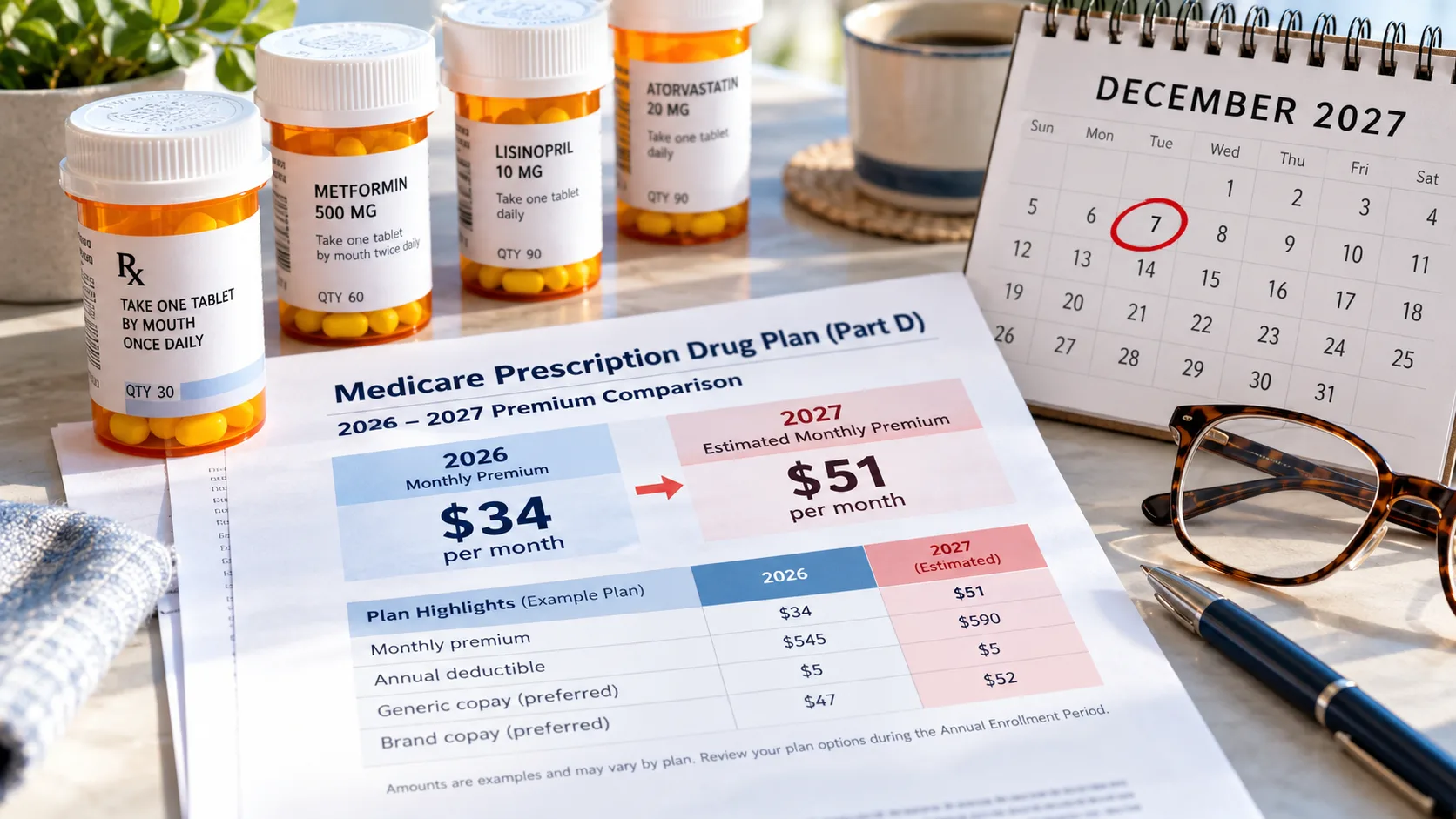
Millions of Americans on Medicare could face significantly higher prescription drug costs in 2027, with some seeing monthly premiums jump by more than $50. A new analysis released Friday warns that retirees who fail to review their coverage before December 7 could end up paying hundreds of dollars more next year.
The findings come from KFF, a nonprofit health policy research organization, which projects that average monthly premiums for stand-alone Medicare Part D prescription drug plans will rise from $34 in 2026 to $51 in 2027 if existing enrollees remain in their current plans.
That represents a 50% increase, although the impact will vary considerably depending on the insurance company, specific plan, medications, and location.
For retirees living on fixed incomes, the increases could create another financial burden at a time when healthcare, insurance, and everyday living expenses are already consuming substantial portions of household budgets.
The good news is that many beneficiaries still have an opportunity to reduce their costs. Medicare’s annual open enrollment period runs through December 7, giving participants several weeks to compare plans and make changes before the new coverage year begins.
More Than 10 Million Medicare Beneficiaries Could Face Higher Premiums
KFF’s analysis reveals that approximately 10.4 million people enrolled in stand-alone Medicare prescription drug plans without low-income subsidies, representing 76% of that group, will face higher monthly premiums in 2027 if they keep their current coverage.
For many retirees, the increases will be relatively modest. Others could experience dramatic changes that make their existing plans substantially more expensive.
Among those facing higher premiums, approximately 2.4 million beneficiaries could see their monthly costs increase by more than $50. That translates into at least $600 in additional annual premiums for each affected individual, before accounting for deductibles, copayments, or other prescription expenses.
The number of beneficiaries facing such large increases is particularly striking. KFF found that only about 38,000 people faced premium increases exceeding $50 per month heading into 2026.
Another major change involves retirees who currently pay nothing in monthly premiums for their stand-alone prescription coverage.
Approximately 4.1 million beneficiaries without low-income subsidies are enrolled in zero-premium Part D plans in 2026. According to KFF, no zero-premium stand-alone prescription drug plans will be available in 2027, meaning these individuals could begin paying monthly premiums for coverage that previously carried no premium.
The findings highlight how dramatically Medicare costs can change from one year to the next, even when beneficiaries stay with the same insurance company.
Some Medicare Drug Plans Will Cost More Than $200 Per Month
One of the most revealing findings is the widening difference between the least expensive and most expensive Medicare prescription drug plans.
Among eight national stand-alone Part D plans examined by KFF, average monthly premiums for 2027 range from approximately $6 to more than $200.
The Wellcare Value Script plan, offered by Centene, is projected to have an average monthly premium of $6.50. At the other end of the market, UnitedHealthcare’s AARP Medicare Rx Preferred plan is projected to average $204.50 per month, up from $126 in 2026.
Humana’s Premier Rx Plan is projected to average $137.40 per month, compared with $119.60 this year.
These figures are national averages. Individual premiums will vary by location and plan availability, while actual prescription expenses will depend on which medications a beneficiary needs.
A $200 monthly premium translates into $2,400 annually before considering any additional out-of-pocket prescription costs. For married couples who each maintain separate prescription drug coverage, those expenses can become a meaningful part of their retirement budgets.
However, the least expensive plan is not automatically the best financial choice. A plan with a low premium might charge considerably more for a particular medication, have a restrictive formulary, or place a beneficiary’s preferred pharmacy outside its most favorable pricing network.
That makes reviewing the total annual cost of coverage more important than comparing premiums alone.
Why Medicare Premiums Are Rising So Sharply
The projected increases follow a significant policy change affecting the Medicare prescription drug market.
The Trump administration decided to discontinue the Medicare Part D Premium Stabilization Demonstration after 2026. The temporary program had provided additional subsidies to participating insurers and placed limits on certain premium increases.
With those protections ending, some insurers are introducing considerably larger premium increases for 2027.
The change helps explain why beneficiaries could experience a sudden increase in costs, even as federal officials have emphasized broader stability in the Medicare marketplace.
In September, the Centers for Medicare & Medicaid Services projected that average stand-alone prescription drug premiums would rise by less than $1 per month in 2027.
At first glance, that appears to contradict KFF’s finding of a 50% increase.
The difference largely comes down to how the projections are calculated.
KFF examined what would happen if current beneficiaries simply remained enrolled in their existing plans. Its $51 estimate reflects those potentially higher premiums without assuming that retirees will switch to less expensive coverage.
CMS used a different estimate of average premiums across the market. KFF notes that the agency did not explain its calculation method in detail and that assumptions about beneficiaries moving to cheaper plans could help explain the difference.
Both projections can therefore describe different outcomes.
If many beneficiaries switch to lower-premium plans, the actual average premium paid across the market could be substantially lower than KFF’s $51 projection. Those who remain in particularly expensive plans, however, could still face large individual increases.
This distinction makes the upcoming enrollment deadline especially important.
Deductibles Are Also Increasing in 2027
Higher monthly premiums represent only one part of the cost changes coming to Medicare prescription drug coverage.
KFF found that average deductibles for stand-alone Part D plans are projected to rise from $540 in 2026 to $643 in 2027.
The maximum deductible that Part D plans can charge will also increase, from $615 to $700.
A deductible is the amount a beneficiary may have to pay toward covered prescriptions before certain plan benefits begin applying. Actual expenses depend on how a particular plan structures its coverage and which medications are prescribed.
This means a retiree could face higher premiums and a larger deductible in the same year.
For example, a beneficiary whose monthly premium increases by $30 would pay an additional $360 annually in premiums. If that person’s deductible also rises by $100 and they incur enough covered prescription costs to meet it, the combined increase could reach $460 before considering changes to copayments or coinsurance.
Drug pricing arrangements can create additional surprises.
Some plans charge fixed copayments for prescriptions, while others require beneficiaries to pay a percentage of the medication’s cost through coinsurance. For expensive brand-name medications, that percentage-based arrangement can make monthly spending less predictable.
The financial impact can be particularly significant for retirees managing chronic conditions that require several medications throughout the year.
Medicare Advantage May Look Cheaper, but There Are Tradeoffs
KFF’s report also identifies a substantial difference between premiums for stand-alone Part D plans and prescription coverage included within Medicare Advantage.
For 2027, average monthly premiums for prescription drug coverage in Medicare Advantage plans are projected at approximately $9, compared with $51 for stand-alone Part D coverage.
That difference could make Medicare Advantage appear especially attractive to retirees who are concerned about rising prescription expenses.
However, comparing the two options requires looking beyond drug premiums.
Medicare Advantage plans generally combine hospital, medical, and often prescription drug coverage into a single private insurance plan. Many have provider networks, referral requirements, or prior authorization rules that differ from Original Medicare.
Retirees who currently use Original Medicare with a Medigap supplemental policy and a stand-alone Part D plan should be particularly careful before switching.
Moving to Medicare Advantage could affect access to preferred doctors, hospitals, specialists, and other services. Returning to Original Medicare later may also create complications when attempting to purchase a Medigap policy, depending on the beneficiary’s circumstances and state protections.
For investors and affluent retirees who value flexibility in choosing healthcare providers, the cheapest monthly premium may come with tradeoffs they are unwilling to accept.
The better comparison involves evaluating total healthcare costs, provider access, prescription coverage, and potential out-of-pocket exposure together.
What the Changes Mean for Retirement Planning
For households approaching or already living in retirement, healthcare expenses are among the most difficult costs to forecast.
Unlike housing payments or many other recurring bills, medical expenses can change quickly because of insurance policy adjustments, new prescriptions, changes in health, and shifts in government programs.
The latest Medicare projections demonstrate how those changes can affect even retirees who have carefully planned their finances.
Higher Healthcare Expenses Reduce Retirement Income
Consider a retired couple whose combined prescription drug premiums increase by $75 per month in 2027.
That would represent an additional $900 in annual expenses, before any increase in deductibles or medication costs.
For retirees drawing money from investment portfolios, higher recurring expenses can mean larger withdrawals. Over time, those withdrawals can reduce the assets available to generate future income, particularly during periods of weak market performance.
While an additional $900 may seem manageable for a financially comfortable household, the larger concern is the accumulation of rising expenses across healthcare, insurance, property taxes, and other necessities.
Higher Costs Could Hit Those With Expensive Prescriptions Hardest
Retirees who require specialty medications should pay particularly close attention to changes in their drug coverage.
KFF found that many Medicare Part D plans use coinsurance for brand-name and specialty medications. Under such arrangements, patients pay a percentage of the covered drug’s cost rather than a predictable fixed copayment.
There is an important federal protection, however. In 2027, the annual out-of-pocket threshold for covered Part D drugs increases to $2,400, up from $2,100 in 2026. Once a beneficiary reaches that threshold, they generally owe no additional cost-sharing for covered Part D drugs during the remainder of the year.
The protection does not eliminate monthly premiums, and medications that are excluded from a plan’s formulary may present additional problems.
Consequently, someone taking several expensive prescriptions should examine both their anticipated annual expenses and whether each medication remains covered.
Insurance Companies Could See Changes in Customer Behavior
The sharp differences between plan premiums could also influence competition among health insurers.
Companies offering lower-cost prescription drug plans may have an opportunity to attract beneficiaries seeking relief from large premium increases. Higher-priced plans could experience greater enrollment pressure as retirees compare alternatives.
For investors following major healthcare insurers, including UnitedHealth Group, Humana, and Centene, the upcoming enrollment period offers another indication of how companies are balancing pricing, membership retention, and profitability.
Higher premiums do not automatically translate into higher earnings. Prescription spending, government payments, claims costs, and competitive pressures all influence the economics of Medicare drug coverage.
Enrollment trends and management commentary during upcoming earnings reports could provide a clearer picture of which companies are benefiting from the changes.
The Hidden Cost of Doing Nothing
Perhaps the most important finding in KFF’s report is how much retirees could end up paying simply because they keep their existing coverage.
Medicare beneficiaries often remain with the same insurance company for years, particularly when their plans have worked well and their medications have remained covered.
That loyalty can become expensive when insurers make substantial changes to premiums or benefits.
The Medicare marketplace also changes from year to year. Plans enter or exit particular markets, formularies are adjusted, and pharmacy pricing arrangements evolve.
For 2027, the average beneficiary will have access to nine stand-alone prescription drug plans, down from eleven in 2026. That reduction means some retirees will have fewer alternatives available.
Nevertheless, KFF’s findings indicate that less expensive options remain available in many markets.
The difference between paying $200 per month and $20 per month for prescription drug coverage amounts to $2,160 annually in premiums alone.
A higher-premium plan could still be preferable for someone taking expensive medications if its overall coverage produces lower total costs. The key is understanding what those costs will actually be.
For many retirees, spending a small amount of time comparing coverage could produce meaningful savings throughout 2027.
Five Things Medicare Beneficiaries Should Check Before December 7
Medicare’s annual open enrollment period began October 15 and ends December 7, 2026. Coverage changes made during this period generally take effect January 1, 2027.
Beneficiaries considering a switch should review several important details before making a decision.
1. Check your 2027 premium. Review the Annual Notice of Change from your current insurer. Compare next year’s monthly premium with what you are paying today and calculate the full-year difference.
2. Review every prescription you take. Confirm that your medications are included in the new plan’s formulary, understand which pricing tiers apply, and check whether prior authorization or other restrictions could affect coverage.
3. Compare total annual expenses. Look beyond monthly premiums to evaluate deductibles, copayments, coinsurance, and estimated out-of-pocket drug spending. Medicare’s Plan Finder can help estimate costs based on medications and pharmacies.
4. Check your pharmacy network. Prescription prices can vary substantially depending on whether a pharmacy is preferred, standard in-network, or out of network. Beneficiaries should also compare mail-order options when appropriate.
5. Review eligibility for financial assistance. Medicare’s Extra Help program can reduce prescription drug premiums and other expenses for eligible individuals with limited income and resources. Retirees should check eligibility before assuming assistance is unavailable.
Beneficiaries can compare available plans through Medicare’s official website at Medicare.gov or call 1-800-MEDICARE for assistance. Free counseling may also be available through State Health Insurance Assistance Programs.
Anyone receiving employer-sponsored or retiree drug benefits should consult their benefits administrator before changing coverage, since enrolling in another plan could affect existing benefits.
Why 2027 Could Be an Important Test for Medicare
The approaching enrollment deadline arrives as policymakers continue adjusting the structure of Medicare prescription drug benefits.
Some changes are designed to protect beneficiaries from exceptionally high medication expenses. Others are reshaping how insurers price their plans and compete for enrollment.
The result is a market in which consumers may receive stronger protection against certain catastrophic drug expenses while simultaneously confronting higher monthly premiums and deductibles.
For policymakers, the critical question is whether increased competition and beneficiary switching will keep actual costs manageable.
For insurance companies, the test will be whether pricing changes produce sustainable margins without driving away too many customers.
For retirees, the issue is more immediate: determining whether their current plan still delivers appropriate coverage at a reasonable cost.
The next several weeks will help determine how much of KFF’s projected 50% average premium increase ultimately materializes. Widespread switching to less expensive plans could reduce the increase in premiums actually paid across the market.
However, that outcome depends in part on beneficiaries actively reviewing their options.
The December 7 Deadline Could Make a Real Difference
The latest KFF analysis makes clear that millions of Medicare beneficiaries could face higher prescription drug premiums in 2027, with some experiencing particularly large increases.
The projected 50% average increase applies to stand-alone Part D plans under the assumption that existing beneficiaries remain in their current coverage. It does not mean every Medicare recipient will pay 50% more, and many people may be able to limit their increases by switching plans.
Still, the potential financial impact is significant. Higher premiums, larger deductibles, and changes in prescription coverage could increase healthcare expenses for retirees already managing tight budgets.
With Medicare open enrollment ending December 7, the most valuable step beneficiaries can take is to review their existing coverage, compare available alternatives, and understand what they could be paying in 2027.
For some retirees, that review could save hundreds or even thousands of dollars next year.
About Author