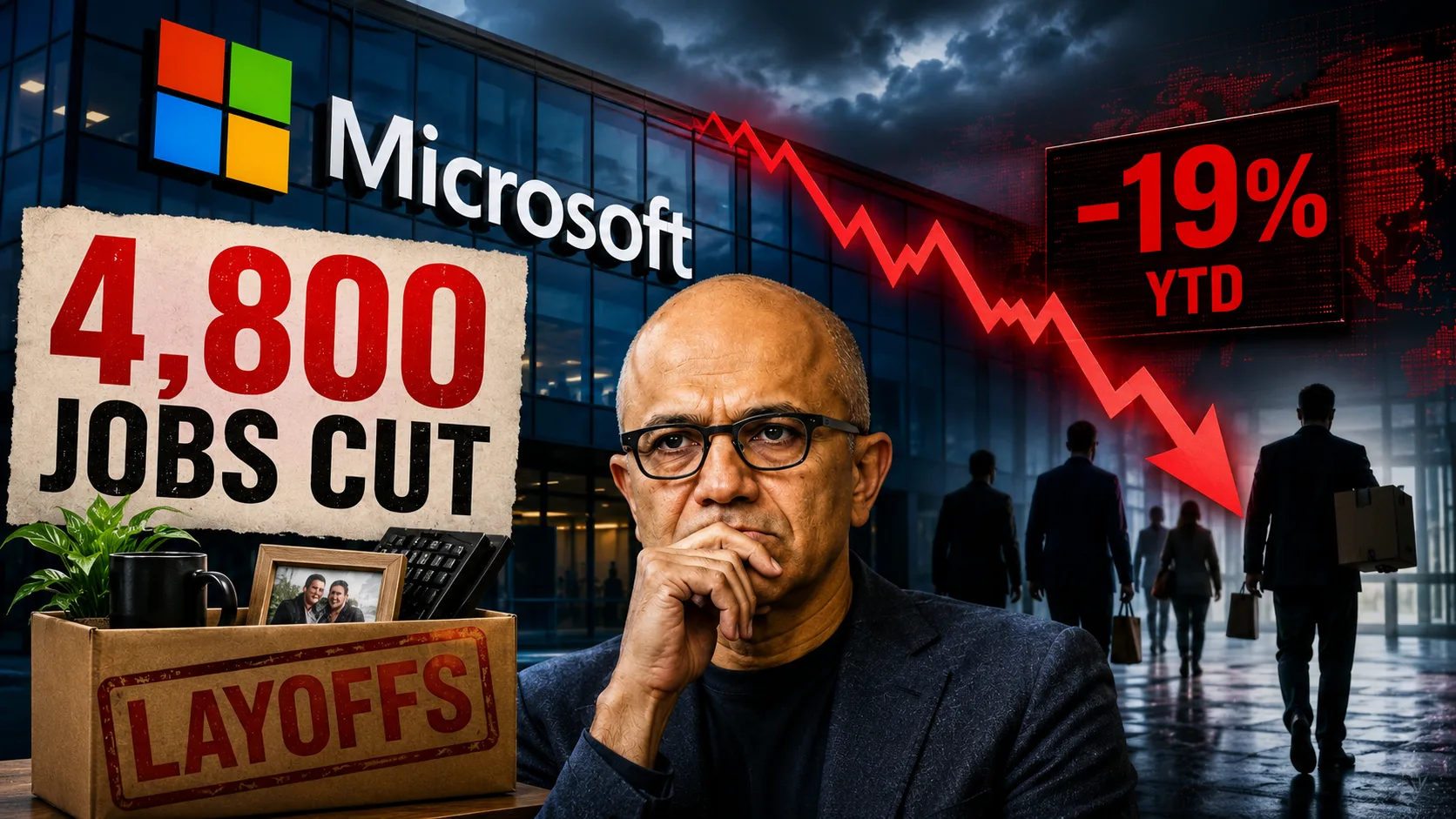
Microsoft is making one of its biggest workforce reductions in years, eliminating 4,800 jobs across the company while dramatically shrinking its Xbox gaming division and restructuring several of its game development studios.
The layoffs come as investors increasingly question whether Microsoft’s massive artificial intelligence investments will translate into meaningful long-term growth. Despite remaining one of the world’s most valuable companies, Microsoft shares have significantly underperformed many of their mega-cap technology peers in 2026.
For investors, the announcement is about far more than job cuts. It signals that Microsoft is reshaping its business around a future increasingly driven by AI while trimming slower-growing operations.
Why Microsoft Is Cutting Nearly 5,000 Jobs
Microsoft said it will eliminate approximately 4,800 positions, representing about 2.1% of its global workforce.
In a message to employees, Chief People Officer Amy Coleman said the technology industry is undergoing one of the fastest periods of transformation in the company’s history.
“The way technology is built, deployed, and used is transforming faster than at any point in my time here.”
The company emphasized that the layoffs are designed to streamline operations and better position Microsoft for long-term growth rather than serve as a short-term cost-cutting exercise.
Microsoft also revealed that a voluntary retirement program introduced earlier this year attracted more than one-third of eligible employees, and executives said similar programs could be explored in the future.
Xbox Takes the Biggest Hit
The largest reductions are occurring inside Microsoft’s Xbox gaming division.
The company plans to eliminate approximately 3,200 Xbox positions through fiscal 2027, including 1,600 immediate layoffs announced Monday.
According to people familiar with the restructuring, roughly one in every five Xbox employees will ultimately leave the company.
Xbox CEO Asha Sharma acknowledged that the restructuring will take place over an extended period.
Rather than making every reduction immediately, Microsoft will spread additional changes over the coming year as it reshapes the gaming business.
Despite the downsizing, Sharma told employees the company expects Xbox to return to growth by 2027.
Four Game Studios Will Leave Microsoft
As part of the overhaul, Microsoft is also reducing the size of its gaming portfolio.
Several well-known studios will no longer remain under Microsoft’s ownership:
- Compulsion Games will become an independent studio.
- Double Fine Productions will also regain its independence.
- Ninja Theory has entered an agreement to move under new ownership.
- Undead Labs is likewise transitioning to a new owner.
Meanwhile, France-based Arkane Studios is reportedly reviewing additional strategic alternatives as discussions continue with employee representatives.
The moves suggest Microsoft is becoming more selective about where it deploys capital within its gaming business after years of aggressive acquisitions.
AI Remains the Bigger Story
Although Microsoft said artificial intelligence is changing how employees work, the company pushed back against suggestions that AI directly caused these layoffs.
Coleman told employees that automation is replacing certain daily tasks but emphasized that workers must continue developing new skills as AI transforms workplaces.
She wrote that Microsoft’s customers are facing many of the same challenges, making it critical that Microsoft’s own workforce evolves alongside the technology.
The message reflects an increasingly common theme across corporate America: AI may not be eliminating entire jobs today, but it is fundamentally changing the types of work companies need employees to perform.
Investors Have Been Losing Confidence
The restructuring comes during an unusually difficult year for Microsoft’s stock.
Shares have fallen roughly 19% in 2026, making Microsoft one of the weakest performers among the largest technology companies.
Much of Wall Street’s concern centers on artificial intelligence.
Microsoft invested aggressively in AI infrastructure, software, and cloud services, but investors have questioned whether CEO Satya Nadella has clearly articulated how Microsoft’s AI products will generate sustainable competitive advantages and meaningful new revenue streams.
At the same time, several of Microsoft’s traditional businesses have shown mixed performance.
While Azure cloud services and LinkedIn have continued posting healthy growth, other segments have struggled:
- Windows licensing has softened.
- Surface hardware sales remain under pressure.
- Xbox gaming revenue has been declining.
That uneven performance has increased pressure on management to improve efficiency while focusing resources on higher-growth opportunities.
The Move That Could Define Microsoft’s Next Chapter
Microsoft’s latest restructuring highlights a broader trend sweeping through the technology sector.
Major technology companies are increasingly redirecting capital away from mature or slower-growing businesses and toward artificial intelligence, cloud computing, and automation.
For Microsoft investors, several questions will likely determine whether these moves improve sentiment:
- Can Microsoft’s AI investments begin producing stronger revenue growth?
- Will Azure continue outperforming competitors in cloud computing?
- Can Xbox return to sustainable growth after its restructuring?
- Will additional cost-cutting measures improve profit margins over the next several quarters?
The answers could play a significant role in determining whether Microsoft regains leadership among the market’s biggest technology companies.
For now, Monday’s announcement illustrates that even the world’s largest software companies are willing to make significant organizational changes as the AI era reshapes the technology landscape.
About Author