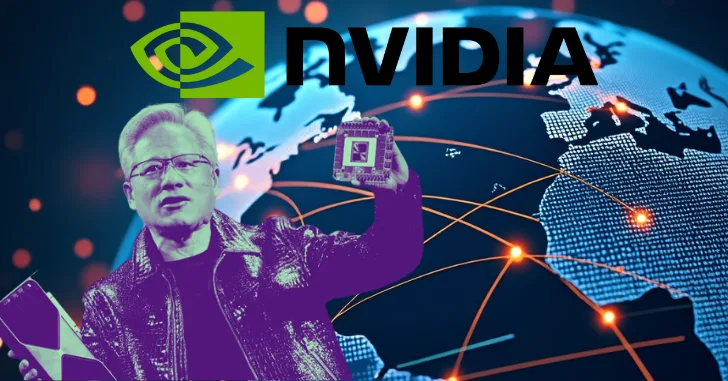
Nvidia stock rose early Thursday as CEO Jensen Huang sounded the alarm about China’s rapid progress in artificial intelligence chips. The comments add a new geopolitical twist to the AI investment boom and come as global competition in semiconductors intensifies.
Huang’s warning that China is “nanoseconds behind America” underscores the strategic importance of AI hardware to both national security and long-term corporate growth. For investors, it signals that Nvidia’s dominance in AI chips may face fresh pressure from Beijing-backed tech firms.
Nvidia Stock Rises After Volatile Week
Nvidia (NASDAQ: NVDA) shares gained roughly 0.5% in early trading Thursday after sliding nearly 2% the previous day. The mild rebound came during a turbulent week for AI-linked equities, as traders weighed whether the ongoing wave of corporate AI spending can sustain its pace through 2026.
The stock’s modest climb was enough to stabilize sentiment across the sector, though volatility remains elevated. Nvidia, still up more than 80% year-to-date, has been the poster child of the AI revolution. Yet its CEO’s latest comments serve as a reminder that the company’s lead is not guaranteed.
Huang’s Warning: “China Is Nanoseconds Behind America”
In an interview with the Financial Times, Huang warned that Chinese competitors are closing the gap on U.S. chipmakers and could soon overtake them if the United States slows its innovation.
He told the publication that China could “win the AI race,” echoing his concerns in a post on the social platform X later that evening.
“As I have long said, China is nanoseconds behind America in AI. It’s vital that America wins by racing ahead and winning developers worldwide,” Huang wrote.
His statement reflects a deep concern that U.S. export controls on AI chips may inadvertently accelerate China’s domestic semiconductor development. By limiting what American firms can sell overseas, Huang argues, the U.S. risks pushing China to build its own advanced alternatives faster.
The Growing Strain of Export Restrictions
Nvidia has been one of the most heavily impacted companies by Washington’s export restrictions on AI hardware. The U.S. government continues to limit sales of Nvidia’s most advanced GPUs to China and other regions deemed sensitive to national security.
These curbs have forced Nvidia to redesign chips to comply with export rules, reducing performance levels to stay within legal limits. While these modified versions still generate revenue, they capture only a fraction of what unrestricted high-performance chips would earn.
The policy also extends to certain Middle Eastern countries. Microsoft (NASDAQ: MSFT) recently received a license to ship Nvidia’s GB300 chips to the United Arab Emirates, but the amount of computing power permitted for export remains capped.
Industry leaders, including Huang, argue that such limits weaken U.S. competitiveness. If American firms cannot serve global demand, emerging competitors in China and beyond will fill the void.
The China Factor: A Rapidly Closing Gap
China’s semiconductor sector has accelerated under heavy government investment and state-backed funding. Companies like Huawei, Alibaba Cloud, and Biren Technology are racing to develop advanced AI processors capable of training large language models.
Huawei’s Ascend and Kirin chip families have shown major performance gains in the past year, while Alibaba has launched its own AI training chips to serve its cloud computing arm. Analysts estimate that China now produces AI chips that deliver roughly 70% to 80% of Nvidia’s top-tier performance, a gap that could narrow further by 2026.
If the trend continues, Chinese firms could dominate AI infrastructure across Asia and the developing world, effectively sidestepping U.S. technology in future deployments. That outcome would not only hit Nvidia’s export revenue but also shift the balance of technological power globally.
Nvidia’s Strength: Dominance in Ecosystem and Developers
Despite these competitive risks, Nvidia’s biggest advantage remains its software ecosystem. The company’s CUDA platform is the backbone of modern AI training and development. It allows developers to build, optimize, and deploy AI models on Nvidia’s GPUs with unmatched efficiency.
Huang’s emphasis on “winning developers worldwide” points to Nvidia’s long-term strategy: to make its platform indispensable, not just its chips. That strategy has turned Nvidia into the default standard for AI infrastructure across industries—from cloud computing and robotics to automotive and biotechnology.
Major partners such as Microsoft Azure, Amazon Web Services, and Google Cloud continue to rely heavily on Nvidia GPUs for AI workloads. The result is a deeply entrenched network effect that few rivals can replicate.
Even as Chinese firms ramp up production, they still face barriers in replicating Nvidia’s software stack, which took over a decade to refine. That ecosystem strength could help Nvidia defend its leadership, even in a more competitive market.
AMD and Broadcom Diverge
Nvidia’s warning about China’s progress comes as investors continue to rotate across semiconductor names. Advanced Micro Devices (NASDAQ: AMD) shares were down 1.9% on Thursday, while Broadcom (NASDAQ: AVGO) inched up 0.2%.
AMD is preparing to launch its MI350 accelerator chip, which it claims will outperform Nvidia’s H200 in certain AI workloads. However, analysts say Nvidia’s early lead and deeper integration with software partners keep it firmly ahead in the near term.
Broadcom, meanwhile, has benefited from its exposure to networking chips used in AI data centers, diversifying beyond its traditional infrastructure business. Together, these three companies represent the front lines of the AI hardware revolution, though Nvidia remains the undisputed leader for now.
Why Huang’s Comments Matter for Investors
Huang’s remarks carry weight far beyond headline value. For investors, they highlight a convergence of forces that will shape Nvidia’s future performance:
- Geopolitical Risk: The intersection of technology and national policy is becoming the defining risk factor for AI chipmakers. Any escalation in U.S.-China tensions could affect Nvidia’s sales pipeline.
- Valuation Pressure: Nvidia trades at a premium valuation relative to peers. Investors are paying for continued hypergrowth. If competition or regulation slows that trajectory, multiple compression could follow.
- Innovation Cycle: Nvidia’s ability to stay ahead depends on launching successive generations of chips that deliver exponential performance gains. Any delay could open room for rivals.
- Software Revenue Potential: Longer term, Nvidia’s opportunity lies not only in hardware but in monetizing its software ecosystem through enterprise AI platforms, recurring licenses, and cloud services.
- Global Expansion Strategy: Huang’s call to rally American support for AI development could foreshadow an international expansion campaign focused on partnerships in Europe, India, and Latin America.
America’s AI Leadership on the Line
Huang’s framing of the AI race as a matter of national urgency reflects a broader shift in tone among U.S. tech leaders. The AI boom has moved from being purely a business opportunity to a competition for technological dominance.
His warning that China is “nanoseconds behind” underscores how quickly the global balance can shift. With state funding, energy subsidies, and centralized coordination, Beijing can move with speed that private-sector players in the West often cannot match.
For Nvidia, this adds complexity. The company’s success now depends as much on global policy as it does on engineering. Investors must factor that into long-term forecasts.
Investor Takeaway
Nvidia’s success story remains unmatched in the AI era. Its chips power nearly every major artificial intelligence project in existence, from ChatGPT to autonomous driving systems. But the warning from its own CEO is a reality check: global competition is intensifying, and U.S. technology leadership is not guaranteed.
For long-term investors, Nvidia stock continues to represent exposure to the center of the AI revolution. However, those gains now come with geopolitical volatility and execution risk attached. The message is clear — the AI race is not a sprint but a marathon, and Nvidia must keep running faster than anyone else to stay ahead.
About Author