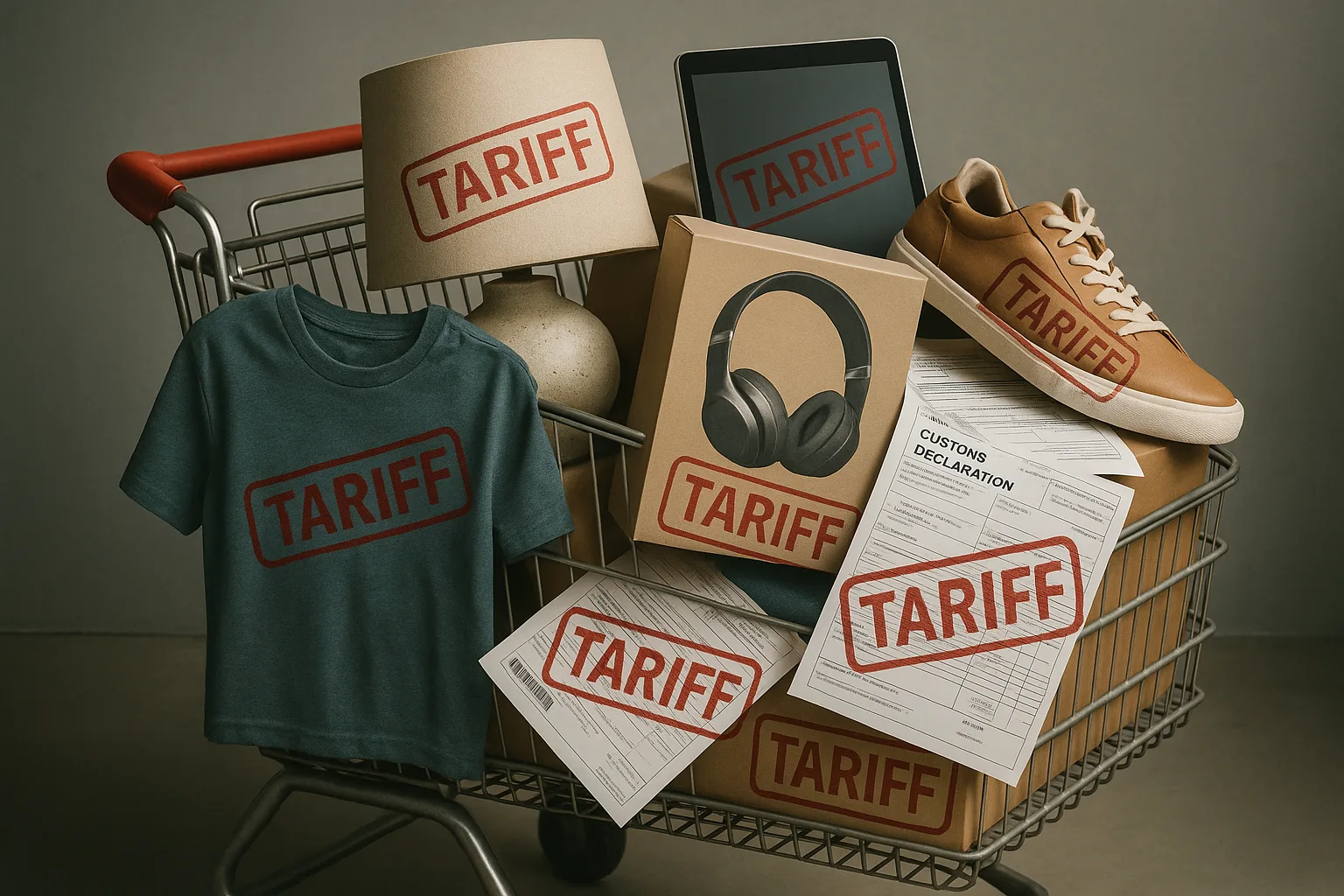
The U.S. retail and e-commerce sectors were shaken this week when President Donald Trump abruptly ended the long-standing de minimis exemption, a trade provision that allowed shipments under $800 to enter the country duty-free. For nearly a decade, this policy had been a quiet but powerful driver of global commerce, especially for online sellers and consumers who relied on inexpensive cross-border shipping.
Its removal is sending shockwaves through supply chains, small businesses, and consumers alike. The ripple effects are already visible in the form of suspended shipments, profit warnings, and plunging stock prices for major retailers. But for investors, the elimination of de minimis is more than just a trade story—it’s a turning point that will reshape e-commerce models, alter consumer spending patterns, and shift market share toward large-scale U.S. retailers with domestic infrastructure.
What Was the De Minimis Exemption?
The de minimis exemption, codified under U.S. law, allowed imports valued under $800 to enter duty-free and with minimal oversight. The threshold was raised from $200 to $800 in 2016 through the Trade Facilitation and Trade Enforcement Act, a move intended to streamline cross-border trade and reduce costs for businesses and consumers.
The results were dramatic:
- 2015: 134 million shipments entered under de minimis.
- 2024: More than 1.36 billion shipments came in duty-free.
- 2024 Daily Average: U.S. Customs processed over 4 million de minimis shipments each day.
Popularized by Chinese fast-fashion giants Shein and Temu, the provision became a linchpin of their U.S. growth strategies. But it wasn’t just Chinese e-tailers—luxury groups like Tapestry (Coach, Kate Spade) and athletic brands like Lululemon also quietly built parts of their supply chains around it.
Trump has called the policy a “catastrophic loophole” that enabled unsafe, counterfeit, and below-market goods into the country while hurting American jobs.
Why Did Trump End It Early?
The exemption was originally set to expire in July 2027 under legislation already passed by Congress. Instead, Trump issued an executive order accelerating the rollback, first targeting goods from China and Hong Kong in May 2025, then extending the ban globally on July 30, 2025.
The rationale was twofold:
- National Security & Safety – U.S. Customs reported that 90% of all seizures in fiscal 2024, including 98% of narcotics seizures and 97% of intellectual property seizures, came through de minimis shipments.
- Economic Protectionism – By making low-value imports subject to tariffs, the administration aims to bolster U.S. manufacturing and reduce reliance on Chinese goods.
Immediate Fallout
Supply Chain Disruptions
- Postal services in Europe and Asia have temporarily halted shipments to the U.S. while updating compliance systems.
- Small businesses reliant on Etsy, eBay, and Shopify are suddenly facing tariffs on every cross-border sale, threatening profitability.
- Even large retailers like Tapestry and Lululemon are bracing for significant earnings headwinds.
“The ending of that under-$800-per-person-per-day rule, from a global perspective, is about to probably cause a bit of pandemonium,” said Lynlee Brown, a partner in the global trade division at EY.
Consumer Price Shock
A study by economists Pablo Fajgelbaum and Amit Khandelwal (National Bureau of Economic Research, 2025) estimates the change could cost U.S. consumers $10.9 billion annually, or about $136 per family.
Low-income and minority households—who disproportionately rely on cheap imports—will feel the impact most acutely.
U.S. De Minimis Shipments Growth (2015–2024)
| Year | Shipments (millions) |
|---|---|
| 2015 | 134 |
| 2017 | 410 |
| 2019 | 720 |
| 2021 | 940 |
| 2023 | 1,200 |
| 2024 | 1,360+ |
Source: U.S. Customs and Border Protection (CBP)
The growth trend illustrates how deeply entrenched de minimis became in global e-commerce logistics. Its sudden removal is the equivalent of pulling out a structural beam in the supply chain.
Retail Sector Impact
1. Luxury and Apparel
- Tapestry (TPR): Estimated that 13–14% of its sales had been covered by de minimis. Barclays projects a $160 million profit hit in 2025, or a 2.3% margin headwind. Shares dropped nearly 16% after earnings.
- Lululemon (LULU): Wells Fargo slashed its price target from $225 to $205, citing a $0.90–$1.10 EPS headwind from lost exemptions.
2. Marketplaces (Etsy, eBay, Shopify)
- Etsy (ETSY): 25% of gross merchandise sales involve cross-border trade. Executives warned reforms could “disproportionately affect small American sellers”.
- Ebay (EBAY): Said guidance could be impacted, though CEO Jamie Iannone claimed the company is “well suited” to adapt.
3. Winners: Amazon & Walmart
Unlike niche marketplaces, Amazon (AMZN) and Walmart (WMT) have robust U.S. fulfillment centers. They can absorb overseas imports in bulk and handle domestic distribution, insulating them from the disruption.
Amazon has already proven resilient: sales rose 13% in Q2 2025, up from 10% in Q1, despite May’s China-specific rollback.
Why It Matters for Investors
Short-Term Risks
- Margin Compression: Retailers exposed to cross-border e-commerce will face sudden cost inflation. Expect near-term earnings downgrades.
- Consumer Demand: Higher prices could erode discretionary spending, adding pressure in an already inflationary environment.
- Volatility in Small-Cap Retail: Companies built entirely around online sales (independent Etsy stores, DTC brands) are at existential risk.
Long-Term Shifts
- Consolidation Advantage: Larger firms like Amazon and Walmart are positioned to capture market share as smaller players struggle.
- Tariff Inflation Hedge: Investors may want to monitor consumer staples and domestic manufacturing plays, which could see relative strength.
- Logistics Innovation: The shift may accelerate nearshoring strategies and investment in U.S. warehousing—potentially bullish for logistics REITs like Prologis (PLD).
Global Ripple Effects
The impact isn’t confined to U.S. shores:
- Canada & UK Sellers: Many small merchants have paused U.S. sales entirely while recalculating costs. Canadian bridal accessories designer Blair Nadeau said losing access to 70% of her U.S. customer base felt like “70% of your salary has been removed overnight”.
- European Artisans: UK artist Alexandra Birchmore said she would raise her Etsy prices by 10% just to cover duties.
- Asia: Singaporean and Japanese exporters of niche goods (like subscription ramen boxes) may see reduced demand due to higher U.S. tariffs.
Policy and Political Context
It’s notable that both Democratic and Republican administrations targeted de minimis.
- Biden’s Rationale: Focused on forced labor and compliance under the Uyghur Forced Labor Prevention Act.
- Trump’s Rationale: Framed as national security, citing fentanyl and counterfeit risks.
This bipartisan consensus suggests the rollback is here to stay, regardless of political swings. Investors should not expect a quick reversal.
Investor Takeaways
- Expect Earnings Volatility in Retail – Stocks like Tapestry, Lululemon, Etsy, and Shopify are exposed. Analysts are already cutting targets.
- Look for Defensive Winners – Amazon and Walmart could benefit as consumers shift toward reliable domestic supply chains.
- Logistics and REITs – Warehousing demand will likely rise as more companies adopt bulk U.S. fulfillment.
- Inflationary Pressure – With tariffs now applied across low-value imports, watch CPI data in late 2025 for upward surprises.
- Consumer Behavior Shift – U.S. shoppers may cut discretionary purchases, favor bundled shipments, or shift toward domestic substitutes.
Conclusion
The abrupt end of the de minimis exemption marks one of the most significant shake-ups in trade logistics in recent history. While consumers will feel the pinch through higher prices, the bigger story for investors is the reshuffling of winners and losers in retail and e-commerce.
In the short term, volatility will dominate as companies scramble to rework supply chains. In the long term, expect a more consolidated marketplace where scale and domestic infrastructure become decisive competitive advantages.
For investors, the playbook is clear: stay defensive, overweight resilient retailers with U.S. operations, and prepare for another inflationary jolt that could ripple through both consumer and logistics stocks.
Sources:
- Reuters – Rise in Costs & Shipment Suspensions “US low‑value package tariff exemption ends, raising costs for shippers, consumers”
https://www.reuters.com/world/china/us-low-value-package-tariff-exemption-ends-raising-costs-shippers-consumers-2025-08-29/ - Wired – What It Means for Consumers “The Duty‑Free Loophole Is Closing. What That Means for You—and Your Packages”
https://www.wired.com/story/de-minimis-exemption-ending-what-that-means-for-you - Washington Post (Opinion) – Supply Chain Disruption “Ending the ‘de minimis’ tax exemption didn’t need to be so chaotic”
https://www.washingtonpost.com/opinions/2025/08/28/de-minimis-exemption-removal-trump-imports/ - MarketWatch – Impact on E-Commerce Stocks “Trump closes the ‘de minimis’ shipping loophole. Etsy and eBay shares have tumbled.”
https://www.marketwatch.com/story/trump-is-closing-a-shipping-loophole-shares-in-etsy-and-ebay-are-tumbling-baffd57f - Financial Times – Tariffs on Small Packages “Donald Trump hits small packages with fresh tariffs as duty‑free exemption ends”
https://www.ft.com/content/43ae5c68-2f6b-4a6c-ba8e-3575a9fe685b - AP News – Official Policy Change “Duty‑free no more: Parcels worth under $800 no longer qualify for a US tariff exemption”
https://apnews.com/article/48862fc5b6a563a077284e364fb14f08 - Reuters – Postal Services Halting Shipments “Global postal services suspend some U.S. shipments as de minimis exemption ends”
https://www.reuters.com/business/global-postal-services-suspend-some-us-shipments-de-minimis-exemption-ends-2025-08-29/ - Quartz via AInvest – Tapestry Profit Headwind “Coach parent company expects to lose $160 million to tariffs this year”
https://qz.com/coach-parent-company-lose-160-million-tariffs - StockTwits – CFO Commentary & Share Impact “Tapestry Stock Just Tumbled 15% Today – CFO Flags Greater Hit To Profit From Tariffs, Early Ending Of De Minimis Exemptions”
https://stocktwits.com/news-articles/markets/equity/tapestry-stock-just-tumbled-15-today-cfo-flags-greater-hit-to-profit-from-tariffs/chsR8FgRdOY - Brookings – Historical Context & Data “Small parcels, big problems: Modernizing de minimis in a global economy”
https://www.brookings.edu/articles/small-parcels-big-problems-modernizing-de-minimis-in-a-global-economy/ - DHS – Executive Order Details “President Trump Ends Unfair ‘De Minimis’ Tariff Exemption, A Major Victory in Securing the Homeland”
https://www.dhs.gov/news/2025/07/31/president-trump-ends-unfair-de-minimis-tariff-exemption-major-victory-securing - NewsWeek – Shipment Volume Data “Trump’s Latest Tax Move Could Cost Americans $13 Billion”
https://www.newsweek.com/trump-de-minimis-move-cost-americans-13-billion-2121463
About Author