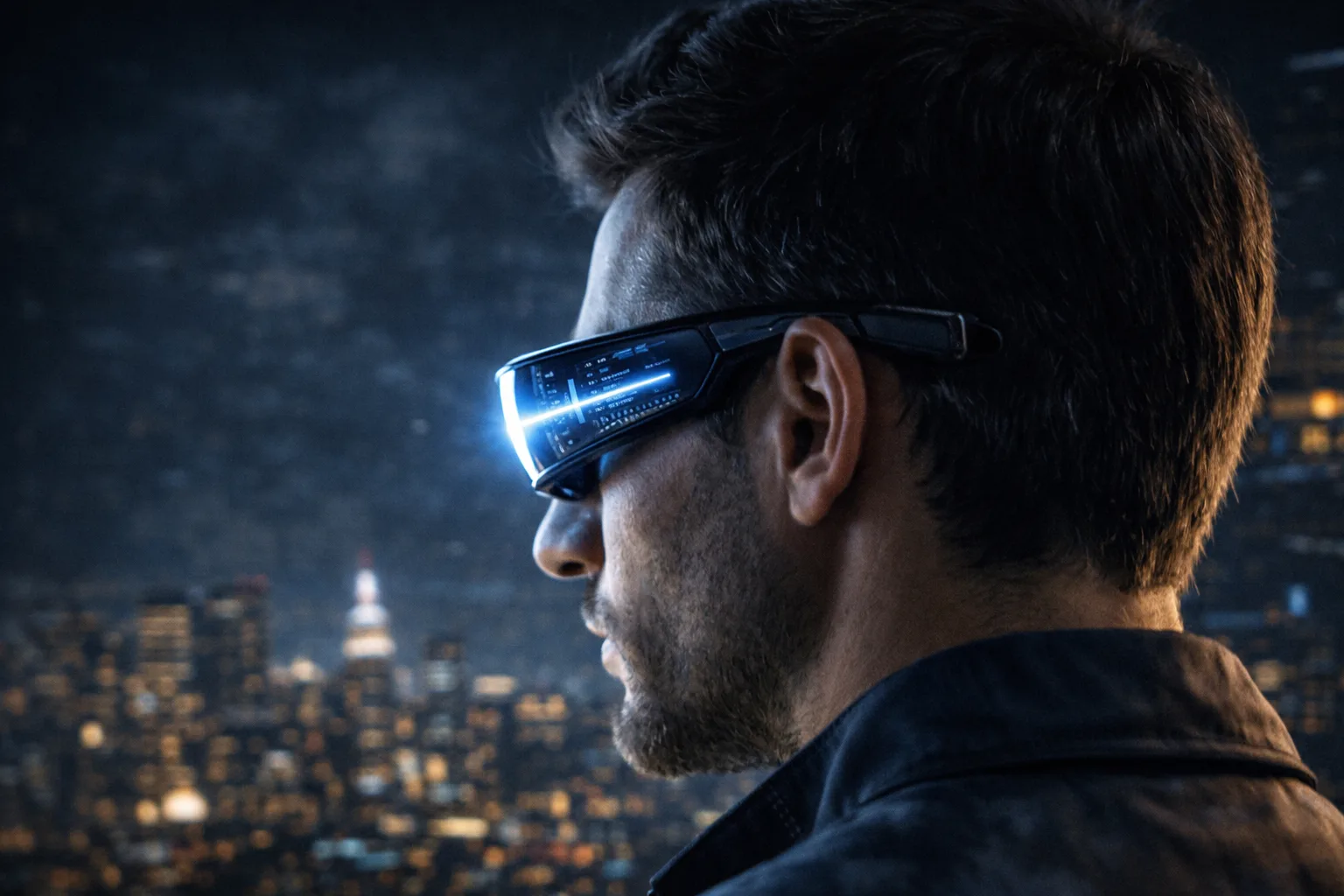
Smart glasses are quietly shaping up to be one of the most disruptive consumer technology shifts since the smartphone. While most investors are focused on Big Tech headlines, the real opportunity may lie beneath the surface in the companies building, supplying, and selling the hardware that could define the next decade.
After years of false starts and skepticism, the smart glasses market is gaining real traction. Advances in artificial intelligence, miniaturization, and battery technology are turning what was once a niche concept into a serious contender for mainstream adoption.
And if the trend plays out the way industry leaders expect, it could create a multi-billion-dollar ecosystem that savvy investors can tap into early.
From Google Glass Failure to AI-Powered Comeback
The last major attempt to bring smart glasses into the mainstream came from Google with its now-infamous Google Glass, which was discontinued in 2015 after privacy concerns and weak consumer adoption.
But the environment today looks completely different.
Artificial intelligence has fundamentally changed what wearable devices can do. Instead of clunky, limited functionality, smart glasses are now being designed as always-on AI assistants capable of interpreting the world in real time.
As Qualcomm CFO Akash Palkhiwala explained:
“[Smart glasses] can see what you can see and hear what you can hear, and you can have a conversation with it, like you’re talking to a person. It’s perfectly suited to have an agentic AI experience.”
That shift from hardware novelty to AI interface is what’s driving renewed investor interest.
Meta Platforms Is Leading Early, but Competition Is Coming Fast
Right now, Meta is the clear frontrunner in the smart glasses race.
Its Ray-Ban branded smart glasses, developed in partnership with EssilorLuxottica, have gained meaningful traction. Industry estimates suggest global shipments reached roughly 8.7 million units in 2025, more than quadrupling year over year.
Meta controls more than 85% of that market today.
Even so, the category is still small relative to Big Tech’s core businesses. Meta’s Reality Labs division, which includes wearables, generated just over $2 billion in revenue last year, a fraction of the company’s total.
That is about to change.
Apple, Alphabet (Google’s parent), and Samsung are all expected to release competing smart glasses products in the coming years.
Some analysts believe Apple alone could ship tens of millions of units by the end of the decade, potentially creating a business worth more than $15 billion annually.
That kind of scale would move smart glasses from a niche product into a core consumer category.
Why Retailers and Suppliers May Be the Smarter Bet
Here’s where most investors get it wrong.
The instinct is to pile into Big Tech names. But history shows that when a new hardware category emerges, the biggest winners are often the ecosystem players, not just the headline brands.
1. Eyewear Leaders Are Already Winning
EssilorLuxottica has been one of the earliest beneficiaries thanks to its partnership with Meta and ownership of brands like Ray-Ban.
The company saw strong momentum in 2025 as smart glasses demand picked up, pushing its valuation into the upper tier of European public companies.
However, the stock has faced volatility recently as investors weigh future competition from Apple and Google.
Meanwhile, Warby Parker has emerged as a key partner for Google’s smart glasses push. The company received a $75 million investment tied to that partnership, signaling strong strategic alignment.
If smart glasses adoption accelerates, Warby Parker could see meaningful upside through both product sales and brand positioning.
2. Retail Distribution Could Be a Major Profit Driver
National Vision is another under-the-radar player.
The company plans to roll out Meta smart glasses across its retail footprint, positioning itself as a key distribution channel. Analysts estimate smart glasses could represent a growing share of both revenue and profit over time.
That is a classic retail leverage play: higher-margin, premium products layered onto an existing distribution network.
The Semiconductor Backbone of the Smart Glasses Boom
Behind every smart device is a supply chain, and this is where some of the most compelling opportunities exist.
Qualcomm
Qualcomm is already deeply embedded in the smart glasses ecosystem, providing the processors that power many extended reality devices.
The company is targeting billions in revenue from XR (extended reality) devices by the end of the decade and appears to be ahead of schedule.
Despite recent stock pressure tied to weakness in the smartphone market, this segment could become a meaningful growth driver.
GlobalFoundries
GlobalFoundries plays a different role, manufacturing critical components for displays and connectivity.
As smart glasses evolve to include built-in displays, demand for specialized chips is expected to rise significantly.
Some industry projections suggest that even modest adoption, such as 10% of global eyewear users switching to smart glasses, could translate into hundreds of millions of units and billions in semiconductor demand.
The Battery Bottleneck Could Create a Breakout Winner
One of the biggest technical hurdles for smart glasses is power.
These devices need to be lightweight, compact, and capable of running AI continuously. That creates massive demand for next-generation battery technology.
Enovix is one company positioned to benefit.
The firm focuses on high-energy-density silicon batteries, which could be critical for wearable devices. While the stock has struggled due to broader weakness in the smartphone market, smart glasses could provide a second growth engine.
If battery constraints are solved, adoption could accelerate quickly.
A High-Risk, High-Reward Bet on Intellectual Property
For more speculative investors, Vuzix offers exposure to the intellectual property side of the market.
The company holds hundreds of patents related to augmented reality and wearable displays.
If smart glasses follow a similar path to smartphones, where a handful of companies collect licensing fees across the ecosystem, Vuzix could benefit disproportionately.
That said, this is a higher-risk play given its smaller size and limited current revenue.
The Biggest Risks Investors Need to Watch
Despite the excitement, smart glasses are far from a guaranteed success.
Privacy Concerns Are Front and Center
The biggest immediate hurdle is privacy.
Devices that can record video, capture audio, and analyze surroundings raise serious concerns. Lawsuits and regulatory scrutiny are already emerging, particularly around how data is collected and used.
If regulators step in aggressively, it could slow adoption significantly.
Mass Adoption Is Not Guaranteed
Even with better technology, consumer behavior is unpredictable.
Smartphones are deeply entrenched. Replacing them will require not just better functionality, but a compelling reason for consumers to change habits.
Competition Will Be Fierce
Once Apple and Google fully enter the market, competition will intensify.
Margins could compress, and early leaders may lose market share.
The Bottom Line for Investors
Smart glasses are no longer a futuristic concept. They are becoming a real category with real revenue potential.
But the biggest winners may not be the companies grabbing headlines.
Instead, investors should focus on:
- Suppliers powering the technology
- Retailers distributing the products
- Component manufacturers solving key bottlenecks
That is where the most asymmetric opportunities often exist.
If adoption accelerates over the next five to ten years, the smart glasses ecosystem could mirror the smartphone revolution, creating massive value across multiple layers of the market.
The key is positioning early, before the shift becomes obvious to everyone else.
About Author