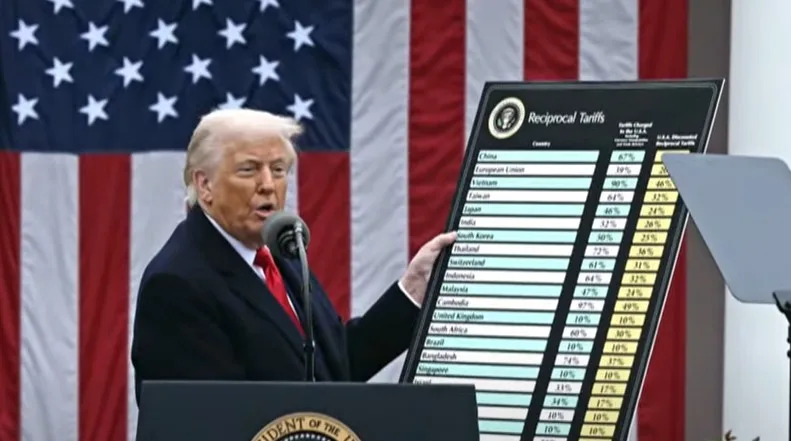
When President Trump announced sweeping tariffs in April, economists sounded alarms about runaway inflation and the risk of a deep recession. Companies rushed to stockpile goods, and consumers braced for sticker shock. Months later, those fears appear exaggerated.
Inflation is elevated but stable, and the U.S. economy continues to grow despite facing the most aggressive trade levies in nearly a century.
“I’m not sure they’ve mattered as much as people thought they would,” said Kelly Kowalski, head of investment strategies at MassMutual.
Inflation Is Up, but Less Than Feared
Consumer prices rose 3% year-over-year in September, still above the Federal Reserve’s 2% target. Tariffs have contributed to inflation, but only modestly—mainly in goods such as furniture, clothing, and electronics.
A major reason inflation hasn’t spiked higher is that many companies are paying less in effective tariffs than the headline rates suggest. A Pantheon Macroeconomics analysis of customs data shows the U.S. Treasury is on pace to collect about $34 billion in October, which would equate to roughly $400 billion in tariff revenue annually—well below Treasury Secretary Scott Bessent’s projection of $500 billion to $1 trillion.
Pantheon estimates that the average effective tariff rate is around 12.5%, not the 17% or more seen in some categories. That gap reflects widespread use of exemptions, rerouted supply chains, and corporate workarounds.
How Companies Are Dodging the Pain
Businesses have proven remarkably nimble in adjusting their global operations. Some have shifted production from China to Vietnam, Mexico, and Turkey, where tariffs are lower or trade agreements more favorable.
“They’re saying: I’m not avoiding offshore, but I’m diversifying,” said Randy Altschuler, CEO of Xometry, an online marketplace connecting manufacturers and suppliers worldwide.
Others are using creative logistics. Signet Jewelers, which imports about half its jewelry from India, is storing goods in bonded warehouses—facilities that allow companies to defer duties until goods are sold. The firm also plans to expand production in lower-tariff regions, according to Chief Operating and Financial Officer Joan Hilson.
Logistics giant GXO is seeing similar patterns. CEO Patrick Kelleher said companies are increasingly requesting free-trade zones to reduce exposure and are recalibrating inventory levels to avoid paying tariffs on goods that sit unsold in storage.
Absorbing the Costs — Not Passing Them All On
Even where companies pay full tariffs, many are eating the costs instead of hiking prices sharply. Bank of America estimates that consumers are paying between 50% and 70% of tariff costs, while corporations are absorbing the remainder.
Corporate profit margins remain higher than pre-pandemic levels, giving businesses room to cushion the blow. Pantheon’s research suggests that even if retailers shoulder 30% of tariff costs, they can maintain margins similar to those seen throughout the 2010s.
In the auto sector, for example, average car prices in September were up only 1.1% from March, according to JPMorgan, despite tariffs of 15% or higher on many imports. JPMorgan analysts estimate carmakers are covering about 80% of tariff costs, passing just 20% to customers. After years of sharp price increases, automakers fear further hikes could crush demand.
Clothing retailer Aritzia faces double-digit reciprocal tariffs on imports from Vietnam and Cambodia after the closure of the de-minimis loophole for small online orders. Yet its profitability remains strong. Executives said that without tariffs, its adjusted EBITDA margin would be 18% to 19%; with them, it remains between 15.5% and 16.5%. “Our pricing strategy is not based on tariffs,” said CEO Jennifer Wong.
Supply Chains Are Shifting — But Slowly
Labor Department data shows import prices haven’t fallen much, suggesting foreign suppliers aren’t discounting to offset U.S. duties. Instead, they’re redirecting shipments to other markets or negotiating new terms with American buyers. This gradual reshuffling of global supply chains—away from China and toward emerging markets—has been one of the biggest structural consequences of Trump’s trade agenda.
Vietnam’s manufacturing exports to the U.S. have risen by double digits in 2025, while Mexico’s share of U.S. imports has reached record highs, according to data from the Peterson Institute for International Economics. Those shifts may eventually reduce America’s reliance on Chinese manufacturing but will take years to fully materialize.
Consumer Spending Still Resilient
Tariffs were also expected to crush consumer confidence. In April, sentiment hit its lowest level since 2022. But record-high stock markets and near-full employment have kept Americans spending.
Consumer spending, which makes up nearly 70% of U.S. GDP, remains strong through the fall quarter. Retail sales and travel spending both beat forecasts in September, a sign that higher prices haven’t forced widespread belt-tightening.
That resilience has surprised economists who warned that tariffs would act as a tax on households. Instead, the mix of strong labor markets, high savings, and booming asset prices has helped consumers absorb the shock.
The Risks Linger Beneath the Surface
Despite short-term stability, economists caution against assuming tariffs are cost-free. The levies are quietly reshaping how companies hire, invest, and plan for the future. Businesses facing supply-chain uncertainty are more cautious about adding headcount or expanding production.
Hiring has slowed notably in manufacturing, and the number of companies citing “policy uncertainty” in Federal Reserve Beige Book surveys has doubled since June. Economists expect more of the tariff burden to flow through to consumers in 2026 as corporate profits normalize and pricing power fades.
If inflation remains stuck above 3%, the Federal Reserve could delay further rate cuts—potentially squeezing growth and asset prices next year.
Why It Matters for Investors
For investors, the message is clear: tariffs are reshaping the global economy in ways that defy early predictions. Short-term market shocks have been muted, but the long-term impact will depend on how efficiently companies reconfigure supply chains and maintain margins.
- Winners: Domestic logistics, warehousing, and automation firms like GXO and Xometry, as well as regional manufacturing hubs in Mexico and Southeast Asia.
- Losers: Retailers and import-heavy sectors with thin margins—especially apparel and consumer electronics.
- Watch closely: Treasury revenue trends and inflation data; if tariff collections rise sharply, that could signal tightening corporate margins and higher consumer prices ahead.
In short, Trump’s tariffs have neither derailed the economy nor sparked a manufacturing renaissance. They’ve created a middle ground—one where companies adapt, consumers pay selectively, and investors must stay alert to which industries thrive under the new global trade order.
About Author