Tesla is officially closing the chapter on two of its longest running vehicle lines as Elon Musk accelerates the company’s pivot away from traditional electric vehicles and toward robotics and artificial intelligence.
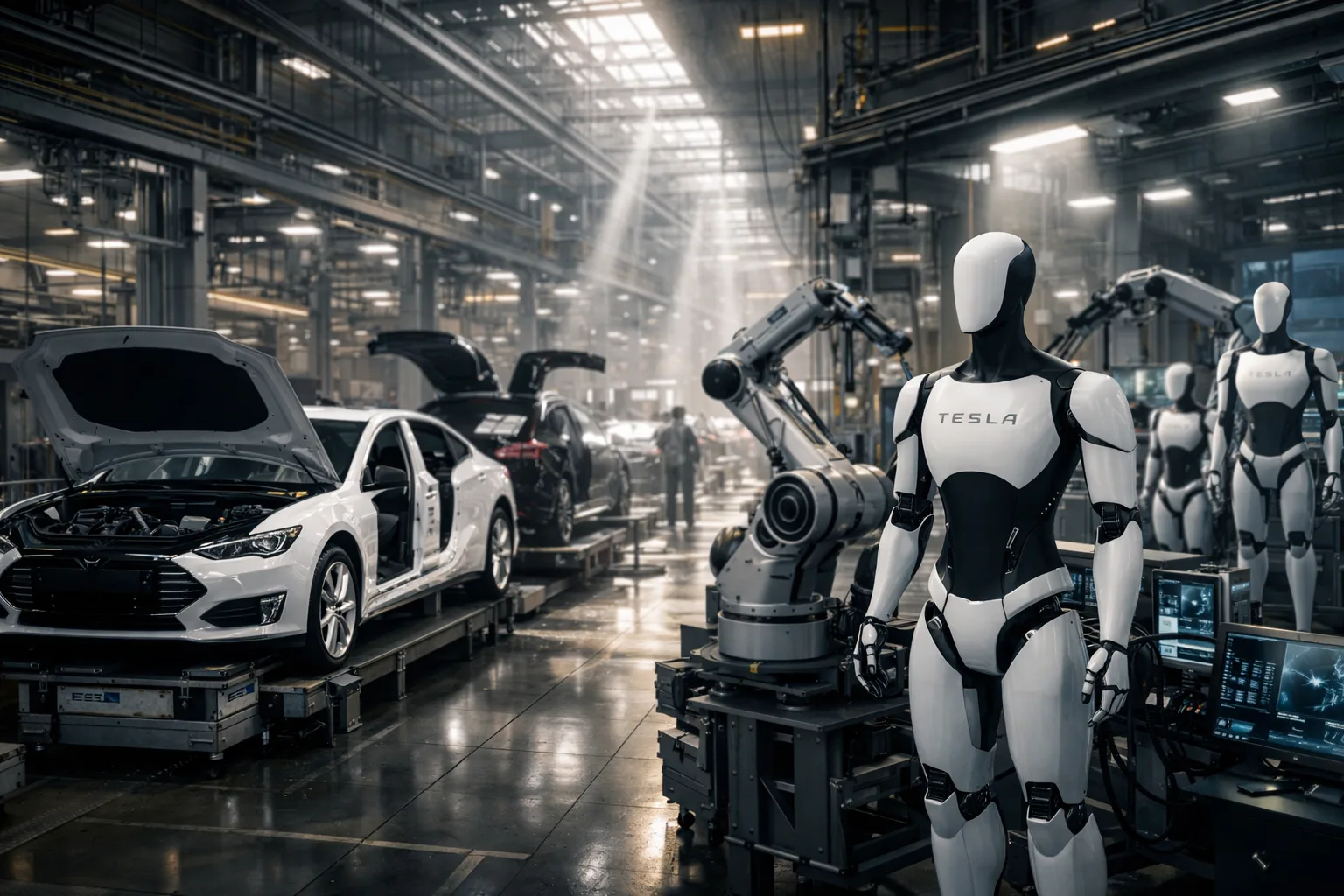
During Tesla’s fourth quarter earnings call, Musk confirmed that production of the Model S sedan and Model X SUV will be phased out and that the Fremont, California factory lines currently used for those vehicles will be converted to manufacture Optimus humanoid robots.
“It’s time to basically bring the Model S and X programs to an end with an honorable discharge,” Musk said on the call. “If you’re interested in buying a Model S and X, now would be the time to order it.”
The decision marks a significant strategic shift for Tesla and signals that the company increasingly sees its future growth coming from robotics, autonomy, and software rather than premium electric vehicles.
Why Tesla Is Retiring Its Oldest Models
The Model S launched in 2012 and the Model X followed in 2015, making them Tesla’s oldest products still in production after the original Roadster. At the time, they represented Tesla’s proof that electric vehicles could compete with luxury brands on performance, range, and technology.
Over the past decade, however, the competitive landscape has changed dramatically. Legacy automakers and Chinese EV manufacturers now offer dozens of competing models across every price tier. Price pressure has intensified globally, squeezing margins and forcing Tesla into repeated price cuts to maintain volume.
On Tesla’s website, the Model S currently starts around $95,000 and the Model X starts near $100,000. These vehicles occupy a shrinking premium niche, while the bulk of Tesla’s sales now come from the lower priced Model 3 and Model Y.
Last year, the Model 3 and Model Y accounted for roughly 97 percent of Tesla’s 1.59 million global deliveries. The Model 3 starts around $37,000 and the Model Y around $40,000 following price reductions and the introduction of more affordable variants.
Simply put, the S and X no longer move the needle financially. Their production volume is relatively small, their margins have compressed, and their role as halo products has diminished as newer competitors match or exceed Tesla on luxury features.
Revenue Pressure Is Forcing Strategic Choices
Tesla’s earnings report underscored why the company is making more aggressive strategic bets. Tesla reported its first annual revenue decline on record, with sales falling in three of the past four quarters. Slowing EV demand in key markets such as Europe and China, combined with rising competition and pricing pressure, has weighed on revenue and profitability.
Investors have increasingly questioned whether Tesla’s EV business can sustain high growth without new mass market products or major breakthroughs in autonomy. Musk has responded by redirecting attention toward long term technologies that could create entirely new revenue streams.
Musk has repeatedly framed Tesla not as a car company but as an AI and robotics company in transition. The retirement of the Model S and X aligns with that narrative.
Fremont Factory Will Shift to Optimus Production
The Fremont factory has long been one of Tesla’s most important manufacturing hubs. Converting production lines away from vehicles and toward robotics represents a rare move for a major automaker.
Musk told investors that Tesla plans to replace the S and X lines with large scale robot manufacturing capacity.
Musk said on the call that Tesla is replacing its production line for S and X in Fremont “with a 1 million unit per year line of Optimus.”
That figure, if achieved, would place Tesla among the largest robotics manufacturers globally almost overnight. For comparison, most industrial robot manufacturers measure annual shipments in the tens or hundreds of thousands, not millions.
However, scaling to one million humanoid robots per year will require massive execution across manufacturing, supply chains, software reliability, and regulatory approvals.
“Because it is a completely new supply chain,” Musk said, “there’s really nothing from the existing supply chain that exists in Optimus.”
Tesla also expects to expand staffing at the Fremont facility as production ramps.
Tesla expects to boost headcount at the Fremont facility, Musk added, “and to significantly increase output.”
That implies job growth in advanced manufacturing, robotics assembly, and AI systems integration, even as traditional vehicle assembly roles shift.
What Optimus Is and Why Tesla Thinks It Matters
Optimus is Tesla’s humanoid robot project designed to perform physical tasks in industrial, commercial, and eventually consumer environments. Tesla has demonstrated early prototypes walking, handling objects, folding clothing, and performing simple factory tasks.
Tesla says Optimus is being designed as a general purpose robot capable of learning through AI and neural networks rather than rigid programming. Musk has suggested that Optimus could ultimately perform tasks such as warehouse logistics, manufacturing labor, elder care assistance, and household chores.
In the earnings release, Tesla said it plans to unveil the third generation of Optimus this quarter, calling it its “first design meant for mass production.”
That language suggests Tesla believes it has reached a level of mechanical reliability and manufacturability that could support commercial deployment rather than just laboratory demonstrations.
If successful, Optimus could represent a fundamentally different business model from automobiles. Robots could be sold directly, leased under subscription models, or deployed in Tesla owned facilities to reduce labor costs internally.
How Optimus Fits Into Tesla’s Broader AI Strategy
Optimus leverages much of the same AI infrastructure Tesla uses for autonomous driving, including neural networks, vision processing, edge computing, and custom silicon. Tesla continues to invest heavily in its Dojo supercomputer platform to train AI models at scale.
Musk has argued that Tesla’s real competitive advantage is its ability to build vertically integrated AI systems that operate in the physical world. While autonomous driving remains a regulatory and technical challenge, robotics offers a parallel path to monetize those AI capabilities.
Humanoid robots also align with long term labor trends. Many developed economies face aging populations, labor shortages in manufacturing and logistics, and rising wage pressures. Automation demand is increasing across warehouses, factories, healthcare facilities, and service industries.
If Tesla can produce reliable robots at scale with competitive pricing, the addressable market could be enormous.
Risks and Execution Challenges Investors Should Watch
While the strategic vision is ambitious, investors should remain realistic about the risks.
First, humanoid robotics remains technically difficult. Balance control, dexterity, safety, battery life, and real world reliability all remain unresolved challenges at scale. Early demos do not guarantee production success.
Second, regulatory and safety approvals could slow deployment, especially for robots operating in public or residential environments.
Third, competition is intensifying. Companies such as Boston Dynamics, Figure AI, Agility Robotics, and Chinese robotics manufacturers are racing to commercialize humanoid and industrial robots. Several competitors are backed by major tech firms and venture capital.
Fourth, capital allocation risk remains. Tesla is investing heavily in robotics, AI infrastructure, and autonomy while its core EV business faces margin pressure. If robot commercialization takes longer than expected, near term financial performance could remain volatile.
Finally, consumer perception matters. Tesla’s brand has historically been tied to electric vehicles and clean energy innovation. A major pivot toward robotics may change how investors value the company and how analysts model future revenue.
What This Means for Tesla’s Vehicle Strategy
Ending the Model S and X does not mean Tesla is abandoning vehicles entirely. The company continues to rely heavily on the Model 3 and Model Y for volume and cash flow. Tesla is also developing next generation lower cost platforms designed to improve affordability and manufacturing efficiency.
However, the move signals Tesla is no longer prioritizing premium low volume models that require dedicated factory resources. Capital and engineering focus are being redirected toward scalable technologies with potentially higher long term returns.
Investors should expect Tesla to behave more like a technology platform company than a traditional automaker over the coming years. That includes higher R&D spending volatility, more speculative timelines, and potentially wider valuation swings.
Market Reaction and Investor Outlook
Markets have increasingly priced Tesla based on future optionality rather than current vehicle margins. Optimus adds another layer of optional upside, but also increases uncertainty.
If Tesla successfully delivers mass production robots that generate meaningful revenue within the next several years, the company could unlock an entirely new valuation framework tied to AI and automation markets rather than automotive multiples.
If execution falters or commercialization drags, investors may re focus on the fundamentals of Tesla’s vehicle business and margin pressures.
For long term investors, the key indicators to watch include:
- Timing and credibility of Optimus generation three demonstrations
- Evidence of manufacturing readiness and supplier contracts
- Early commercial partnerships or pilot deployments
- Cost targets per robot and gross margin potential
- Regulatory progress for autonomous and robotic deployments
- Stability of Tesla’s EV cash flow during the transition
Bottom Line for Investors
Tesla ending production of the Model S and Model X is not just a product decision. It reflects a broader strategic reallocation of capital and manufacturing capacity toward robotics and artificial intelligence.
Musk is betting that Optimus can eventually become a platform business that dwarfs the economics of selling cars. That bet carries significant upside but also meaningful execution risk.
For investors, Tesla increasingly represents a high volatility technology growth story rather than a predictable automotive manufacturer. The Fremont factory conversion will serve as one of the clearest signals yet of whether Tesla can translate bold vision into scalable commercial reality.
If Optimus succeeds, Tesla could redefine what kind of company it truly is. If it struggles, the company may face renewed pressure to stabilize its core EV business while funding ambitious long term bets.
Either way, the next 12 to 24 months will be critical in determining whether Tesla’s robotics pivot becomes its next growth engine or its next major test.
About Author