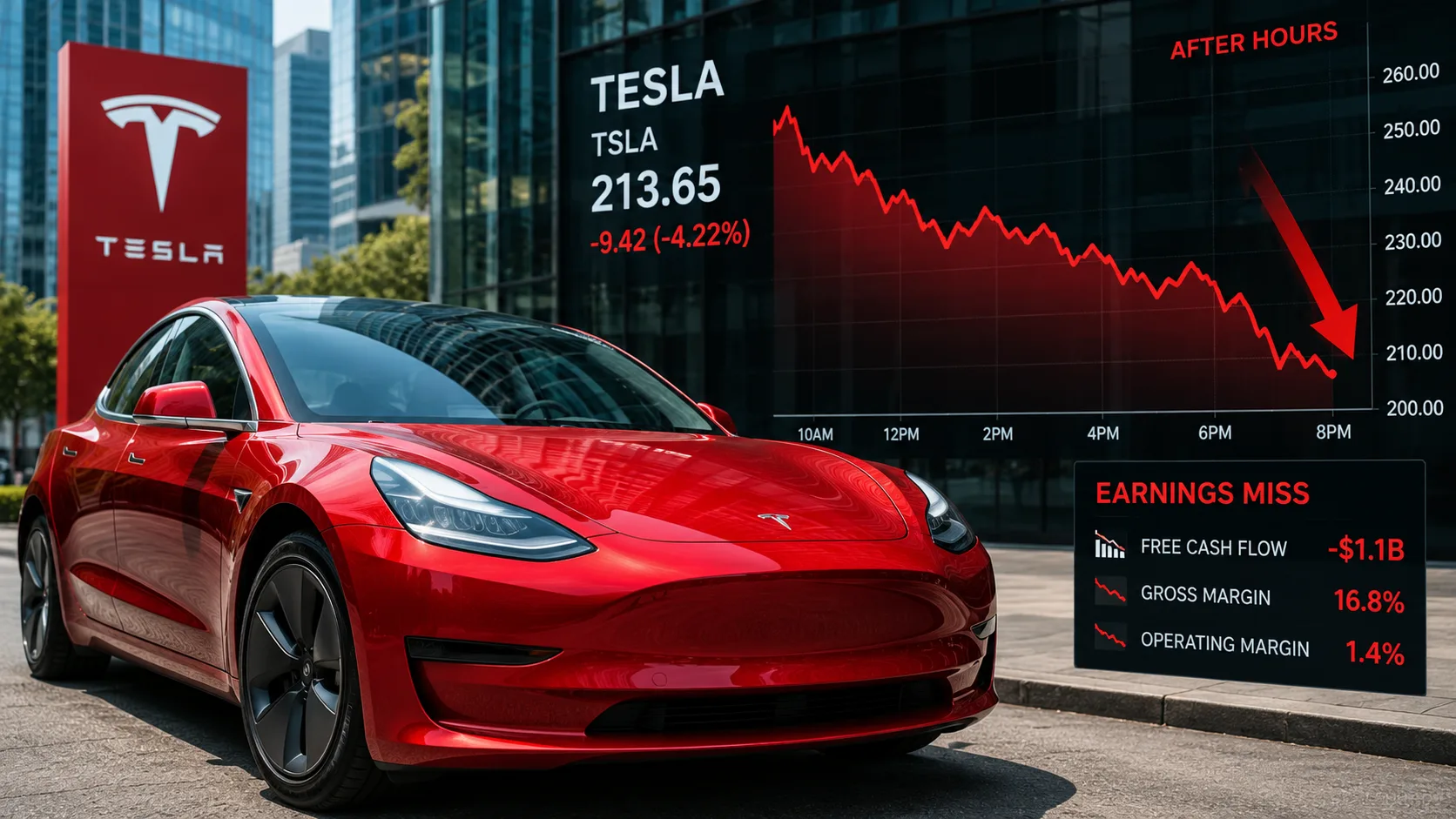
Tesla stock fell in after-hours trading Wednesday after the electric vehicle maker reported second-quarter earnings that missed Wall Street expectations, even as revenue came in ahead of forecasts.
The results highlight the growing challenge facing Tesla as it spends aggressively on artificial intelligence, autonomous driving, robotics, and manufacturing expansion while profitability continues to weaken.
Investors are now weighing whether Tesla’s massive AI investments will justify the company’s rising costs and declining margins.
Tesla Stock Falls After Earnings Miss
Tesla reported adjusted earnings per share of $0.33, well below Wall Street expectations of $0.51.
Revenue came in at $28.24 billion, topping analyst estimates of $25.71 billion.
Despite the revenue beat, investors focused on weaker profitability.
Following the report, Tesla stock dropped roughly 4% in after-hours trading, adding to what has already been a difficult year. Shares have declined approximately 17% year-to-date, significantly underperforming the broader Nasdaq.
Key Tesla Earnings Highlights
Here are the biggest numbers from Tesla’s latest quarter:
| Metric | Reported | Wall Street Estimate |
|---|---|---|
| Earnings Per Share | $0.33 | $0.51 |
| Revenue | $28.24 billion | $25.71 billion |
| Net Income | $1.11 billion | Down 5% YoY |
| Gross Margin | 16.8% | 19.4% expected |
| Operating Margin | 1.4% | Down from 4.1% last year |
| Free Cash Flow | -$1.1 billion | Positive $146 million last year |
While revenue increased 26% from a year ago, profitability deteriorated across nearly every major metric.
Profit Margins Continue to Deteriorate
One of the biggest concerns for investors was Tesla’s shrinking margins.
Gross margin fell to 16.8%, missing analyst expectations of 19.4%.
Several factors contributed to the decline:
- Lower average selling prices on vehicles
- Reduced regulatory credit revenue
- A greater mix of lower-priced Model 3 and Model Y vehicles
- Higher manufacturing and operating costs
Operating expenses surged 47% year over year to $4.35 billion as Tesla increased spending on artificial intelligence, robotics, semiconductor development, and manufacturing expansion.
As a result, operating margin collapsed from 4.1% a year ago to just 1.4%.
Free Cash Flow Turns Negative
Perhaps the most concerning figure for investors was Tesla’s cash generation.
The company reported negative free cash flow of $1.1 billion, compared with:
- Positive $146 million one year ago
- Positive $1.44 billion in the first quarter of 2026
At the same time, capital expenditures jumped 142% to $5.79 billion.
Tesla says the spending is funding long-term growth initiatives including:
- AI computing infrastructure
- Battery manufacturing
- Solar production
- Semiconductor manufacturing
- Robotics development
Chief Financial Officer Vaibhav Taneja previously told investors capital expenditures could exceed $25 billion this year.
Tesla Is Becoming More Than an EV Company
CEO Elon Musk continues shifting Tesla’s strategy away from simply selling electric vehicles.
Instead, the company’s future increasingly revolves around artificial intelligence and automation.
Major initiatives include:
- Expanding Robotaxi service into additional U.S. cities
- Scaling production of the driverless Cybercab
- Building Optimus humanoid robots
- Developing proprietary AI chips
- Expanding Full Self-Driving software
Tesla said Full Self-Driving (Supervised) subscriptions increased 56% year over year to 1.48 million subscribers.
The company also confirmed that production lines for Optimus robots are now being installed, with manufacturing expected to begin soon.
Musk acknowledged that scaling robot production will be one of the company’s most difficult manufacturing challenges because virtually every component is new.
Competition Continues to Pressure Tesla
Tesla is also facing growing competition in the global EV market.
Chinese manufacturers including BYD, Nio, and Xiaomi continue gaining market share by offering technologically advanced electric vehicles at lower prices.
Meanwhile, Tesla is still working to recover from consecutive years of declining vehicle deliveries.
Earlier this month, the company reported a 25% year-over-year increase in second-quarter deliveries, offering some evidence that demand may be stabilizing.
Higher gasoline prices following geopolitical tensions in the Middle East also helped support EV demand in several international markets.
Robotaxi Remains the Long-Term Bet
Autonomous driving remains central to Tesla’s long-term investment thesis.
The company is expanding its Robotaxi operations while preparing production of the fully autonomous Cybercab.
However, Musk stressed that Tesla will prioritize safety before accelerating deployment.
“We need to be cautious about causing any accidents or causing any harm to anyone,” Musk said during the earnings call.
Tesla executives also confirmed that:
- Robotaxi vehicles are now operating using Version 15 of Full Self-Driving software.
- The Cybercab will use the same software platform.
- Starlink connectivity will support future autonomous vehicles.
- AI developed by SpaceXAI (formerly xAI) will eventually help manage Optimus robots.
What Tesla Stock Investors Should Watch Next
Tesla’s latest earnings illustrate a company in the middle of a major transition.
Traditional automotive profitability continues to weaken, while billions of dollars are being invested into technologies that may take years to generate meaningful returns.
For investors, several key questions remain:
- Can Robotaxi become a profitable large-scale business?
- Will Optimus robots develop into a meaningful revenue stream?
- Can Tesla stabilize vehicle margins amid increasing global competition?
- How long will investors remain willing to fund aggressive AI spending?
The answers to those questions are likely to play a major role in determining the direction of Tesla stock over the coming quarters.
The Bottom Line
Tesla delivered another quarter of strong revenue growth, but that wasn’t enough to offset weakening profitability. Earnings missed expectations, free cash flow turned negative, and margins deteriorated as spending on AI, robotics, and manufacturing accelerated.
While Elon Musk continues betting Tesla’s future on autonomous driving, humanoid robots, and artificial intelligence, investors appear increasingly focused on whether those long-term ambitions can translate into sustainable profits. Until there is clearer evidence that these investments are paying off, Tesla stock may remain under pressure despite continued revenue growth.
About Author