Tesla’s stock took a hit this week after President Donald Trump fired off a sharp message on Truth Social targeting Elon Musk’s long-running reliance on government incentives. In a late-night post, Trump called for the Department of Government Efficiency—nicknamed “DOGE”—to investigate the massive subsidies that have helped fuel Musk’s sprawling empire of electric vehicles, rockets, and satellites.
The president’s comments rattled Tesla shareholders already on edge over policy uncertainty, potential cuts to green energy programs, and Musk’s increasingly vocal political stances.
If you own Tesla stock—or are considering buying—it’s time to look deeper than the headline drop. This flare-up isn’t just about Tesla’s daily share price. It’s about the future of U.S. government support for electric vehicles, space exploration, satellite internet—and whether Tesla’s business model remains bulletproof if the subsidy tap dries up.
The Truth Social Post That Sparked the Slide
Let’s start with the quote that made headlines. In Trump’s own words, posted on Truth Social:
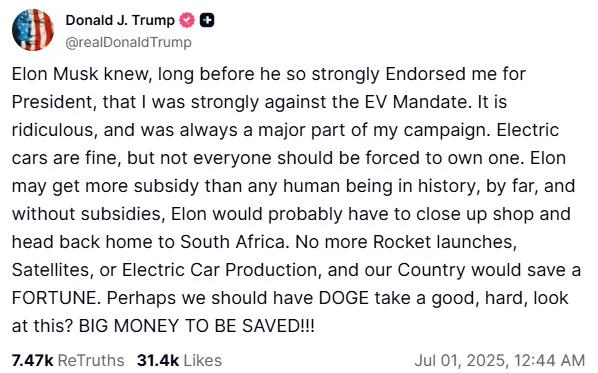
“Elon may get more subsidy than any human being in history, by far, and without subsidies, Elon would probably have to close up shop and head back home to South Africa. No more Rocket launches, Satellites, or Electric Car Production, and our Country would save a FORTUNE. Perhaps we should have DOGE take a good, hard, look at this? BIG MONEY TO BE SAVED!!!”
This isn’t the first time Trump has taken aim at subsidies for green energy and Musk’s companies. But the directness of the threat—and the suggestion that the Department of Government Efficiency could actively scrutinize or slash government support—was enough to push Tesla’s shares down about 4% in early Tuesday trading.
Why Musk and Trump Are at Odds
The irony here is thick. Elon Musk was once a high-profile Trump ally. He campaigned alongside Trump during the 2024 election cycle and advised the administration on technology and efficiency issues. But the relationship began to sour this year over two big friction points: Trump’s tax and spending bill, and policy rollbacks for electric vehicles.
Musk has publicly slammed the Republican-led spending package. On his social media platform X, he posted bluntly in response to Trump’s post: “I am literally saying CUT IT ALL. Now.”
Musk’s beef? The bill threatens to roll back or limit incentives for electric vehicle buyers—like the $7,500 tax credit that’s been key to Tesla’s pricing strategy in the U.S.—while failing, in his view, to rein in other deficit-expanding spending. He also feels the GOP is playing favorites when it comes to energy policy, giving fossil fuels more runway while squeezing the clean tech sector he’s built his empire on.
This has spiraled into a broader feud. Earlier this year, Musk floated the idea of starting a new political movement. On X, he wrote: “Time for a new political party that actually cares about the people.”
How Big Are Tesla’s Subsidies, Really?
Trump’s statement might sound hyperbolic, but he’s not entirely wrong: government support has been essential to Tesla’s rise.
A few examples:
- EV tax credits: U.S. consumers who buy qualifying Tesla models have historically received federal tax credits worth thousands per vehicle. Even when Tesla temporarily hit its cap on credits, new rules brought them back under the Inflation Reduction Act.
- Regulatory credits: Tesla has earned billions by selling carbon credits to other automakers that need to meet emission targets.
- State and local incentives: Tesla’s massive Gigafactories have benefited from state-level tax breaks and subsidies. Nevada famously gave Tesla an estimated $1.3 billion package for its original Gigafactory near Reno.
- SpaceX contracts: While not Tesla-specific, SpaceX has scored huge NASA and Pentagon contracts that keep revenue flowing to Musk’s broader empire.
The real kicker is that Tesla’s profitability has, at times, leaned heavily on these credits. In multiple quarters, regulatory credit sales made up the difference between a profit and a loss.
What Could Happen If Subsidies Are Cut?
For investors, the real question is: if Trump or DOGE succeed in clawing back support, what does it mean for Tesla’s revenue and profit margin?
EV demand: Without consumer tax credits, some buyers may balk at Tesla’s sticker prices, potentially slowing growth in the all-important U.S. market.
Competition: Other EV makers, including Ford, GM, and foreign rivals like BYD, are also hunting subsidies. If Tesla loses access while others keep theirs (say, through different sourcing rules or local manufacturing incentives), it could erode Tesla’s competitive edge.
New projects: Tesla’s next-gen battery plants and the ramp-up of new vehicle lines often rely on local or federal incentives to pencil out. If that pipeline shrinks, expansion plans could get delayed.
Investor perception: Wall Street’s confidence in Tesla is partly built on its ability to dominate the EV market profitably, keep costs down, and out-innovate slower incumbents. A messy political battle over subsidies adds a layer of uncertainty that could mean more volatility ahead.
Musk’s Counter: Cut It All
Interestingly, Musk’s own position is that he’d like to see the playing field leveled entirely—by eliminating all energy subsidies, not just his own. As he posted: “I am literally saying CUT IT ALL. Now.”
That sounds principled, but skeptics point out that Tesla has benefitted from years of head-start subsidies that helped the company scale when no one else could. Removing subsidies now could hit newer EV startups harder than Tesla, but it might still crimp Tesla’s margins in the short run.
What Should Investors Do Now?
If you hold Tesla stock, here’s the bottom line: don’t panic, but pay attention. Here are some key things to watch:
✅ Monitor the tax bill: Watch how the final spending package shakes out. Will it include steep cuts to EV incentives or carbon credits?
✅ State incentives matter too: Even if federal tax credits get trimmed, states like California and Texas still offer local perks. Tesla’s footprint and relationships in those states will be key.
✅ Diversification is real: Tesla isn’t just a car company. Its energy storage division, charging network, and potential robotaxi future could offset some lost subsidy revenue. Investors should watch how these divisions grow.
✅ Musk’s unpredictability: Love him or hate him, Elon Musk’s public statements move markets. If the feud with Trump escalates, expect more share price swings.
✅ Long-term view: Big-picture, Tesla remains a leading force in EVs and clean tech. The path won’t be subsidy-free overnight, and global demand for electric cars and clean energy solutions is still rising.
The Takeaway
Tesla’s drop after Trump’s late-night post shows just how sensitive the market still is to political risk. For all the talk about innovation and autonomous driving, the company’s ties to public money remain a huge part of the story.
Investors would be smart to brace for continued headlines and volatility as the Trump-Musk relationship evolves. But they should also keep an eye on the fundamentals that still matter: global EV adoption rates, battery cost breakthroughs, and Tesla’s ability to keep leading on technology.
About Author