Tesla has officially kicked off mass production of its long-awaited Semi truck, with the next-generation Roadster scheduled to take the stage next. For investors, however, the bigger story may be what comes after both of them.
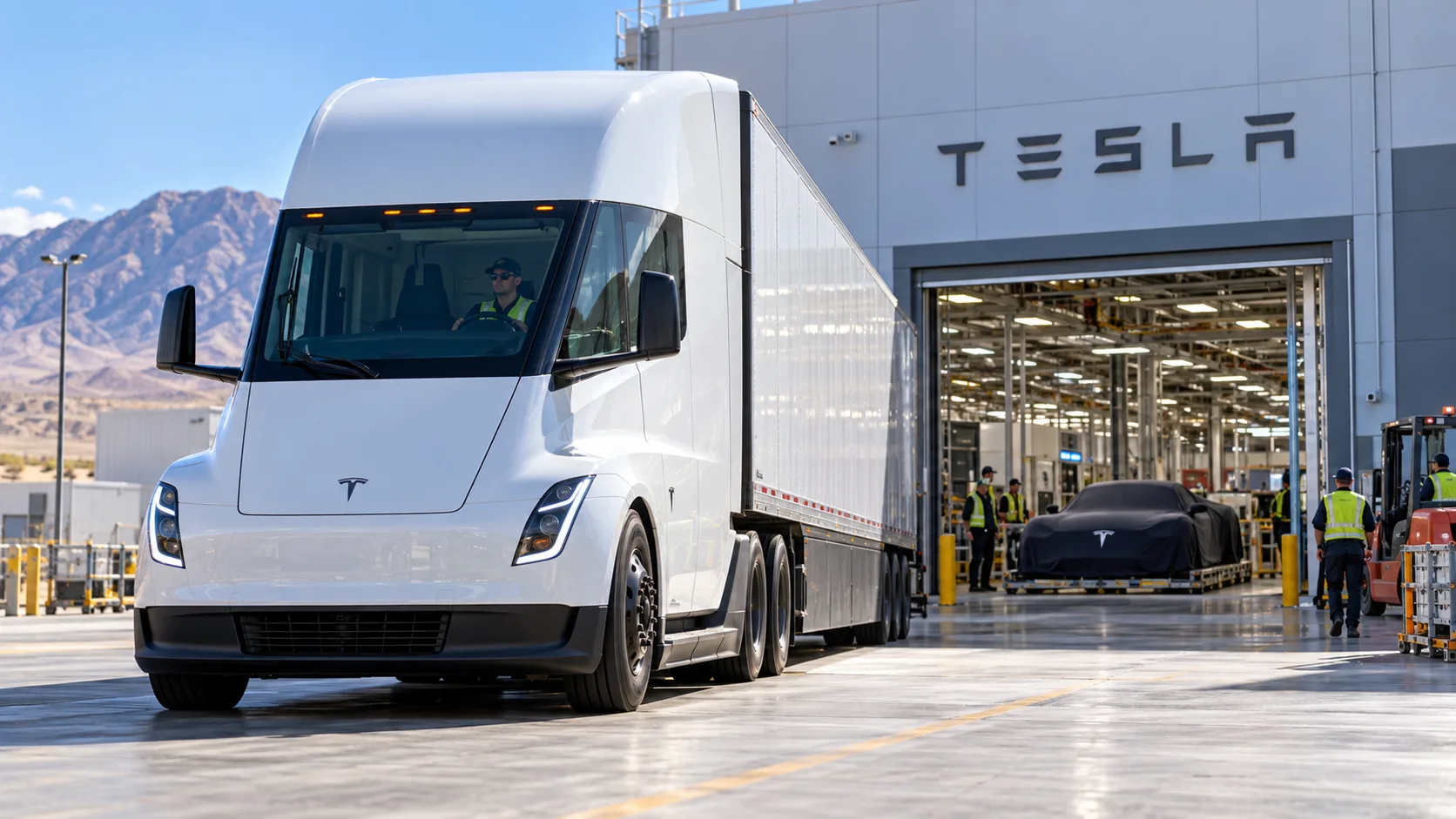
Tesla held a launch event in Nevada marking the start of mass production for the electric Class 8 truck Elon Musk has been promising for years. The company eventually wants to produce 50,000 Semis annually, giving Tesla a potentially meaningful foothold in the enormous commercial trucking market.
The timing could hardly be better. Diesel prices have climbed sharply, putting additional pressure on trucking companies that burn thousands of gallons of fuel per vehicle every year. Tesla believes those economics could make electric trucks increasingly attractive to fleet operators.
Wall Street’s reaction was far less enthusiastic. Tesla shares fell following the event, continuing a difficult year for a stock that entered Friday down roughly 16%.
That reaction highlights the larger issue facing Tesla: launching another vehicle may no longer be enough to move the stock. Investors are increasingly focused on whether Musk can turn autonomy, artificial intelligence and robotics into businesses large enough to justify Tesla’s ambitions.
The Semi Finally Moves From Promise to Production
Tesla says the Semi can travel up to 500 miles while fully loaded. Using the company’s megawatt charging system, the truck can recharge to roughly 60% in about 30 minutes.
Those numbers matter because commercial trucking operates under very different economics than passenger vehicles. Consumers may choose an EV because of performance, technology or environmental considerations. Fleet operators care much more about cost per mile, vehicle uptime, reliability and how quickly a truck can pay for itself.
Musk focused heavily on that calculation during the Nevada event. With benchmark diesel prices around $6.50 per gallon, compared with roughly $3.70 a year earlier, fuel has become an increasingly painful expense for trucking companies.
Tesla’s pitch is straightforward: if electricity can substantially lower operating costs while the truck delivers enough range and reliability, the Semi could make economic sense even without the kind of consumer excitement that helped sell Tesla’s passenger cars.
The company is targeting eventual production of 50,000 Semis annually. That would represent roughly 10% of the heavy trucks sold each year across the U.S. and Europe, according to the figures presented around the launch.
Even reaching a fraction of that target would turn the Semi from a long-delayed side project into a meaningful new business.
Why the Semi Could Be More Important Than It Looks
Commercial trucking offers Tesla something increasingly valuable: customers who make purchasing decisions largely based on math.
A trucking company does not need to be emotionally attached to the Semi. It needs the truck to lower costs, stay on the road and provide a reasonable return on the money invested in it.
That distinction matters because commercial fleets can buy dozens, hundreds or even thousands of vehicles at a time. A handful of large fleet contracts could create substantial volume far faster than winning individual consumers one vehicle at a time.
The challenge is that Tesla now has to prove the economics outside controlled demonstrations. Range under heavy loads, battery degradation, charging availability, repair costs and downtime will ultimately matter more than specifications presented onstage.
This is where the Semi story becomes much more interesting for investors. Tesla has spent years selling the promise. Mass production finally gives the market a chance to judge the truck based on actual deliveries, usage and operating costs.
Then Comes the Roadster
Tesla isn’t giving investors much time between product launches. The company’s next-generation Roadster is expected to receive its own event on October 1, with the vehicle expected to cost more than $200,000 and potentially incorporate technology connected to Musk’s SpaceX.
The Roadster serves a completely different purpose than the Semi. Tesla is unlikely to sell enough of them to materially change companywide revenue, but that may not be the point.
Tesla built much of its early reputation by making electric vehicles exciting rather than merely practical. A Roadster capable of extreme acceleration or demonstrating unusual new technology could help restore some of that image at a time when the broader EV market has become far more crowded.
Think of the Roadster as Tesla’s halo product. It does not need hundreds of thousands of sales to matter. It needs to make consumers, investors and competitors pay attention again.
Tesla’s Bigger Problem Is Outside the Car Business
The Semi and Roadster can both strengthen Tesla’s automotive lineup, but neither appears capable of carrying the company’s valuation by itself.
Wall Street increasingly treats Tesla as a combination of an automaker, artificial intelligence company, autonomous transportation platform and robotics business. That means the traditional vehicle operation is increasingly becoming the financial foundation supporting much larger ambitions.
Tesla’s difficulties scaling its robo-taxi business have therefore become especially important. The service launched in 2025, but investors are still waiting for evidence that autonomous transportation can grow into the enormous commercial network Musk has envisioned.
There has also been relatively little news this year around Optimus, Tesla’s humanoid robot project. The potential markets for autonomous transportation and humanoid robots are far larger than the market for expensive sports cars and could eventually exceed the opportunity Tesla has in conventional vehicle manufacturing.
That helps explain why the Semi can reach a major operational milestone while the stock barely celebrates. Investors are waiting for proof that Tesla’s biggest bets can move from demonstrations and promises into scalable businesses.
Three Numbers Could Matter More Than the Launch
Over the next several weeks, investors should watch three areas closely.
1. Semi Production
The 50,000-truck annual production goal sounds impressive, but the pace of the ramp will matter more than the headline number.
Investors should watch how quickly Tesla moves from launch quantities toward thousands of commercial deliveries and whether major fleet customers begin placing repeat orders. Repeat business would be particularly significant because it would suggest operators are seeing favorable economics after actually using the trucks.
2. Vehicle Deliveries
Tesla is expected to report third-quarter deliveries on October 2. Wall Street is looking for roughly 460,000 vehicles, compared with nearly 500,000 during the same quarter last year.
The comparison comes with an important complication. Last year’s quarter benefited from buyers rushing to take advantage of the $7,500 federal EV purchase tax credit before it expired.
Even so, the delivery number will provide another indication of the health of Tesla’s core automotive operation, which continues to generate the revenue and cash needed to finance the company’s much larger technology ambitions.
3. Autonomy
Autonomy may ultimately matter far more to Tesla’s stock than either the Semi or Roadster.
Tesla has spent years arguing that self-driving technology could transform the economics of its installed vehicle fleet. If robo-taxis begin scaling meaningfully, investors could eventually view Tesla vehicles as revenue-producing assets rather than simply products sold once to consumers.
That opportunity is enormous, but so is the execution challenge. Until Tesla demonstrates that autonomy can scale safely, reliably and economically, it remains one of the biggest unanswered questions surrounding the company’s valuation.
The Part of the Semi Story Investors May Be Missing
Tesla does not necessarily need the Semi to become another Model Y for the program to matter.
Commercial trucking could become another market where Tesla combines batteries, manufacturing, charging infrastructure and eventually autonomous driving. Those capabilities become considerably more valuable when they work together.
Imagine the economics of a large electric freight fleet operating from dedicated Tesla charging infrastructure. Add increasingly capable autonomous driving over time, and the potential savings could extend beyond fuel into labor and fleet utilization.
That scenario remains speculative today, but it explains why the Semi deserves more attention than its immediate sales contribution might suggest. Tesla could be building another platform where several of its core technologies eventually intersect.
October Could Tell Investors Much More
The Roadster event on October 1 comes first, followed almost immediately by Tesla’s third-quarter delivery report. Investors will then turn toward Tesla’s next earnings report for updates on margins, capital spending, robo-taxis, Optimus and the Semi production ramp.
Each announcement will generate its own headlines, but the more important question is whether the pieces are beginning to reinforce one another.
Tesla has already proved it can manufacture electric passenger vehicles at enormous scale. The next phase requires showing that it can repeat that success across trucks, autonomous transportation and robotics.
About Author