Artificial intelligence has become the biggest force driving the U.S. stock market over the past three years. But a new threat is emerging that few investors have been watching: local communities increasingly don’t want AI data centers built in their backyards.
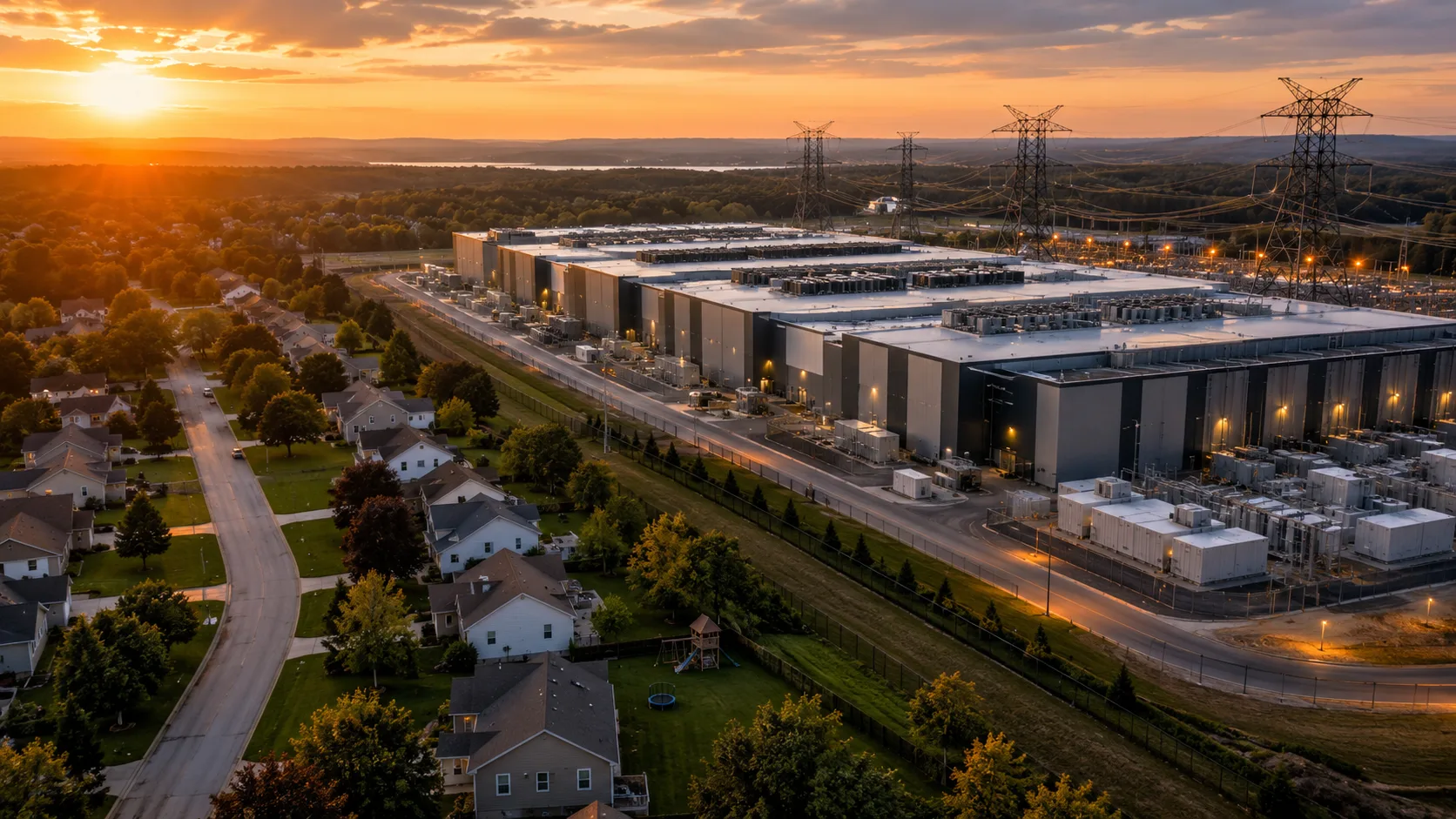
Across the country, residents are organizing protests, filing lawsuits, lobbying lawmakers, and blocking multi-billion-dollar projects that power the AI revolution. The movement has accelerated so quickly that industry analysts are beginning to warn it could become one of the biggest long-term risks facing AI companies.
For investors who have grown accustomed to viewing AI as an unstoppable growth story, this may be one of the first meaningful signs that the industry’s expansion could face real-world limits.
The AI Buildout Is Running Into Resistance
The scale of the opposition has changed dramatically.
According to Data Center Watch, 75 AI data-center projects worth roughly $130 billion were blocked or delayed during the first quarter of 2026 alone. That matches the total number of delayed or canceled projects during all of 2025.
The pushback is no longer isolated to a handful of communities.
Residents in New York, New Jersey, Arizona, Illinois, Ohio, South Carolina and other states have organized campaigns against new facilities, while lawmakers have introduced legislation ranging from reduced tax incentives to outright moratoriums on large-scale data-center construction.
A June Reuters/Ipsos survey highlights just how widespread the opposition has become:
- 44% of Americans oppose new data centers
- 21% support them
- When asked about projects in their own communities, support falls to just 14%, while 57% oppose them.
For an industry expected to receive trillions of dollars in investment over the next several years, those numbers are difficult to ignore.
Why Communities Are Fighting Back
Traditional cloud-computing facilities have existed for decades, but AI data centers are significantly larger and require dramatically more electricity.
Opponents frequently cite several concerns:
- Massive electricity consumption
- Higher local utility bills
- Increased strain on power grids
- Constant low-frequency equipment noise
- Environmental impacts
- Heavy construction with relatively few permanent jobs afterward
Many communities argue they bear the costs while receiving limited long-term economic benefits.
Researchers at the Federal Reserve Bank of Dallas recently estimated that rapid data-center expansion could contribute approximately 0.13 percentage points to annual inflation by 2030, partly because of higher electricity demand.
Growing public concerns about artificial intelligence itself—including job displacement and cybersecurity risks—have only strengthened local opposition.
AI Companies Are Beginning to Acknowledge the Problem
Technology executives increasingly admit the industry underestimated how local communities would respond.
Andrew Feldman, CEO of AI chip maker Cerebras Systems, recently acknowledged that AI companies moved too quickly without adequately explaining the benefits of these projects to nearby residents.
Developers have responded by promising:
- New infrastructure investments
- Noise reduction measures
- Local school funding
- Additional community engagement
- Assurances that residential electricity service won’t be affected
Even with those efforts, many projects continue facing organized resistance.
Some developers now report that misinformation circulating online has made productive conversations with communities increasingly difficult.
Why This Matters for Investors
The biggest investment implication isn’t that AI demand is weakening.
Demand remains exceptionally strong.
Instead, the concern is whether companies can actually build enough infrastructure to meet that demand.
Morgan Stanley estimates hyperscale technology companies will spend roughly $800 billion on capital expenditures in 2026, while industry projections call for approximately $4 trillion in additional data-center infrastructure investment through 2028.
Since ChatGPT launched in late 2022, enthusiasm surrounding artificial intelligence has fueled much of the S&P 500’s extraordinary gains.
Many Wall Street analysts expect AI-related investments to generate a significant share of corporate earnings growth over the next several years.
If permitting delays, lawsuits, regulatory restrictions, or community opposition slow construction, some of those growth expectations may also need to be adjusted.
Which Companies Face the Greatest Risk?
Not every AI company faces the same level of exposure.
Large technology companies such as Microsoft, Alphabet (Google), and Amazon operate global networks of data centers and generally have greater flexibility when choosing where to build new capacity.
Smaller AI infrastructure companies may have less room for error.
Analysts note that businesses relying on only a handful of massive projects could experience more significant financial impacts if even one development is delayed or canceled.
For example, opposition has intensified around one proposed CoreWeave facility in New Jersey that would account for a meaningful portion of the company’s existing computing capacity if completed.
Several AI companies have also begun acknowledging this emerging issue in regulatory filings, warning investors that increasing public resistance could affect future expansion plans.
Politics Could Become the Next Battleground
The issue is rapidly moving beyond local zoning disputes.
Several states have already reconsidered tax incentives for new data centers, while lawmakers have proposed statewide pauses on future construction.
At the federal level, lawmakers from both parties have introduced proposals aimed at slowing or restricting additional development.
Meanwhile, AI companies and their supporters are increasing political spending, arguing that expanding American AI infrastructure is critical to maintaining competitiveness with countries like China.
Construction unions have also emerged as some of the industry’s strongest allies because of the thousands of jobs created during the building phase.
The Bottom Line
Artificial intelligence remains one of the strongest long-term investment themes in the market, but investors may need to start paying closer attention to a risk that doesn’t appear in most earnings forecasts.
The AI boom depends on rapidly expanding computing capacity. If local opposition, environmental concerns, and new regulations continue delaying large-scale data-center construction, infrastructure, not demand, could become the industry’s biggest bottleneck.
For now, Wall Street largely believes major technology companies can adapt by shifting projects to more favorable locations. But the growing backlash serves as a reminder that even the fastest-moving technological revolutions eventually encounter political, regulatory, and community resistance.
For investors, data-center permitting may become an increasingly important indicator to watch alongside AI chip sales, cloud spending, and corporate earnings in the years ahead.
About Author