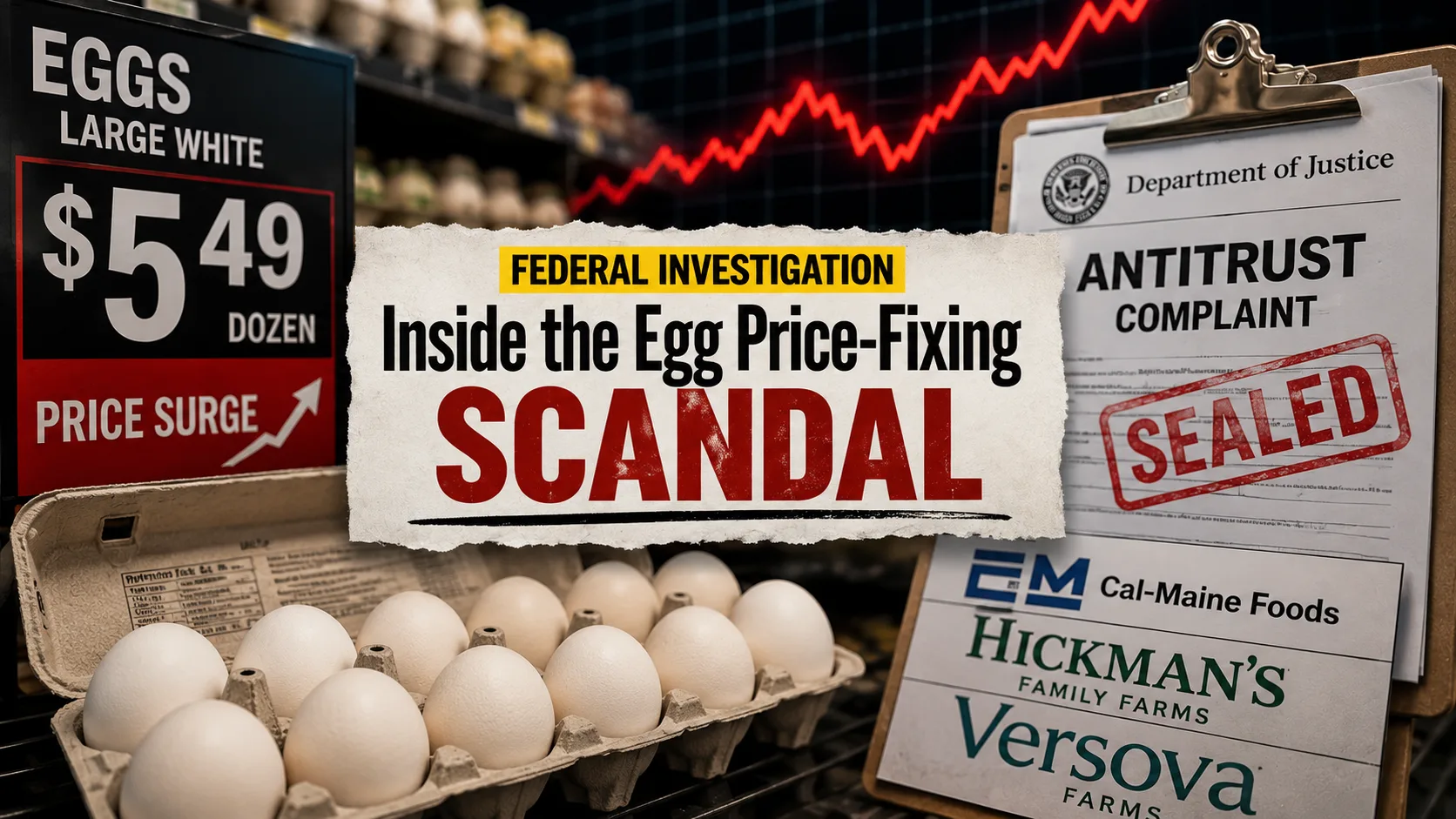
Egg prices became one of the defining inflation stories of the past several years, frustrating consumers, restaurants, and policymakers alike. While widespread outbreaks of avian influenza were widely blamed for the historic surge, federal prosecutors now allege that some of the nation’s largest egg producers may have made the situation even worse.
A newly unsealed U.S. Department of Justice complaint accuses three major egg companies of coordinating bids, exchanging private messages, and manipulating the wholesale pricing system that helps determine what Americans ultimately pay at the grocery store.
If proven, the allegations could rank among the largest food price-fixing scandals in recent memory and raise new questions about competition in the U.S. agricultural industry.
Key Takeaways
- The U.S. Department of Justice alleges Cal-Maine Foods, Hickman’s Egg Ranch, and Versova conspired to manipulate wholesale egg prices between 2022 and 2025.
- Prosecutors claim executives coordinated bidding strategies that influenced industry benchmark prices used by grocery retailers.
- The alleged activity occurred during a period of severe bird flu outbreaks and record-high consumer egg prices.
- The companies deny wrongdoing or settled without admitting liability.
- Investors should watch for increased antitrust scrutiny across agricultural commodity markets.
A Conference Call That Became the Center of a Federal Investigation
According to the Justice Department’s complaint, executives from America’s largest egg producers participated in a conference call on December 19, 2022, to discuss strategies for supporting higher wholesale egg prices during one of the tightest supply environments in decades.
Federal prosecutors allege the discussion centered on placing aggressive bids into the Egg Clearinghouse, an online wholesale marketplace that plays an important role in establishing industry pricing benchmarks.
One executive allegedly remarked:
“As a group we need to bid like they vote in Chicago, early and often.”
The complaint says the companies then coordinated dozens of bids over several days, helping move benchmark prices higher across multiple regions.
After benchmark prices increased, another executive allegedly circulated a market report celebrating the results with the message:
“Great job in the northwest today!”
The Hidden Pricing System Behind Nearly Every Carton of Eggs
Most Americans never see the wholesale market that determines egg prices.
Instead of producing every egg they sell, suppliers frequently purchase inventory through the Egg Clearinghouse, a niche marketplace sometimes referred to as the “Wall Street of Eggs.”
Pricing information collected from that exchange is used by market data firm Expana, formerly known as Urner Barry, to publish benchmark wholesale prices.
Those benchmarks are then incorporated into supply contracts between egg producers and grocery retailers across the country.
Because many retail contracts reference these published prices, even relatively small movements in the benchmark can eventually ripple through supermarkets nationwide.
According to prosecutors, influencing this pricing system could affect millions of consumers regardless of whether large numbers of eggs actually changed hands.
Prosecutors Say the Bidding Strategy Resembled Market “Spoofing”
The Justice Department alleges that executives used bidding practices similar to spoofing, a trading strategy regulators have aggressively pursued in financial markets.
According to the complaint, the companies allegedly:
- Entered unusually high bids for eggs.
- Created the appearance of stronger market demand.
- Encouraged higher benchmark prices.
- Removed some bids once sellers attempted to accept them.
Federal investigators claim this pattern occurred repeatedly throughout late 2022 and resurfaced during another period of rapidly rising egg prices in late 2024.
The complaint also cites an alleged text message from Cal-Maine’s former CEO encouraging another producer by saying:
“Let it rip.”
Prosecutors further allege executives lobbied Expana throughout the holiday season to publish higher price quotations while placing less weight on competing market data.
Bird Flu Was Real. The Government Says It Wasn’t the Whole Story.
The Justice Department is not disputing that avian influenza dramatically reduced egg supplies.
The outbreak forced producers to cull tens of millions of laying hens, creating one of the largest supply disruptions the industry has ever experienced.
Wholesale egg prices climbed above $5 per dozen during late 2022 before remaining elevated through much of 2024 and into early 2025.
Consumers experienced:
- Grocery store purchase limits
- Restaurant egg surcharges
- Panic buying
- Persistent shortages
- Record-high retail prices
Federal prosecutors argue that the alleged coordination among producers compounded those supply-driven increases, pushing prices even higher than normal market forces alone would have produced.
Egg Producers Reject the Allegations
Each company has pushed back against the government’s claims.
Cal-Maine Foods said the communications referenced in the complaint did not improperly influence pricing and maintained that its conduct complied with the law.
Versova denied wrongdoing but agreed to settle the civil claims, saying doing so allows the company to remain focused on its business operations.
Hickman’s current owners stated that the alleged conduct occurred before they acquired the company in late 2025.
Importantly, none of the settlements include admissions of wrongdoing.
The Settlement Comes With Millions of Eggs Instead of Massive Fines
Rather than continue fighting the civil allegations in court, the companies agreed to resolve the case through a proposed settlement.
The agreement includes:
- Donation of more than 50 million eggs to food banks.
- Payment of $3.3 million to New York and several other participating states.
- Court approval before becoming final.
The Justice Department also noted that benchmark egg prices began falling after the investigation became public in March 2025, coinciding with declining bird flu cases, rebuilding poultry flocks, and softer consumer demand.
Why Wall Street Is Paying Close Attention
While this case focuses on eggs, its implications extend well beyond grocery aisles.
The investigation raises broader questions about competition within agricultural commodity markets and whether pricing benchmarks can be manipulated in industries where relatively few companies dominate supply.
Potential implications for investors include:
- Increased antitrust enforcement across food producers.
- Greater regulatory oversight of agricultural pricing systems.
- Higher legal and compliance costs.
- Additional civil lawsuits from retailers or consumers.
- Increased earnings uncertainty for companies operating in concentrated markets.
For investors following consumer staples, agriculture, food inflation, and commodity markets, the case represents another reminder that regulatory risks can emerge quickly—even in industries traditionally viewed as defensive.
What This Means Going Forward
The allegations have not yet been proven in court, and the companies continue to deny wrongdoing. However, the Justice Department’s complaint offers an unusually detailed look into the mechanics of an obscure wholesale market that ultimately influences prices paid by millions of American families.
Whether the case results in additional penalties, private lawsuits, or new regulations remains to be seen. What is already clear is that one of the country’s most essential grocery staples has become the focus of a major antitrust battle that could reshape oversight of agricultural markets for years to come.
About Author