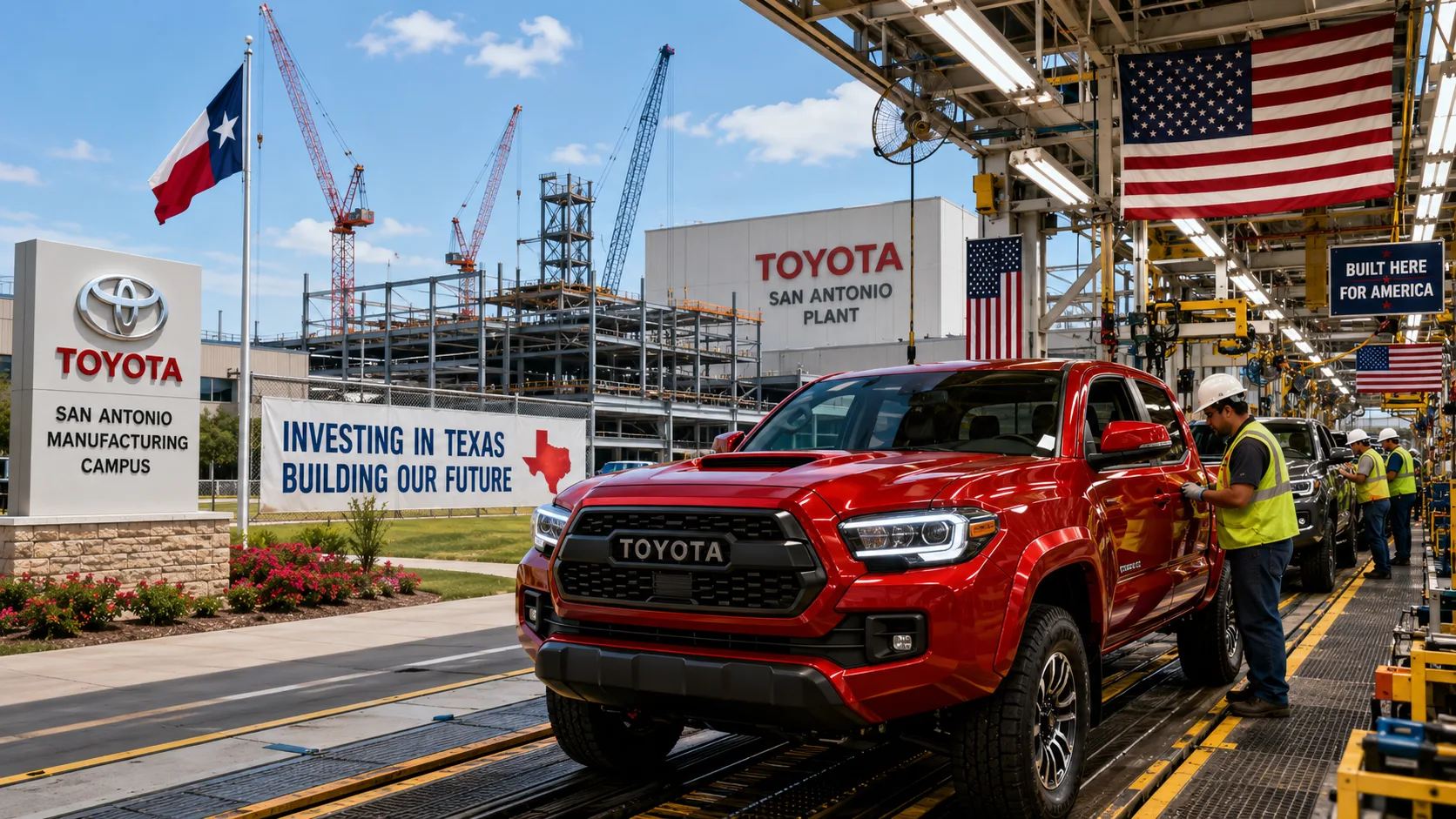
Toyota is making one of its largest manufacturing commitments in the United States in years.
The automaker announced plans to invest $3.6 billion to dramatically expand its manufacturing campus in San Antonio, Texas, adding a second assembly line, creating roughly 2,000 new jobs, and gradually shifting production of its popular Tacoma pickup truck from Mexico to Texas over the next four years.
Beyond the headlines, the announcement highlights several major trends investors are watching closely: the reshaping of North American manufacturing, the growing influence of trade policy, and continued investment in U.S. industrial production.
Toyota Is Bringing More Tacoma Production to the United States
Toyota said the San Antonio expansion will add approximately 2.5 million square feet to its existing manufacturing campus, nearly doubling the facility’s size by 2030.
The new assembly line will allow the plant to produce:
- Toyota Tacoma
- Toyota Tundra
- Toyota Sequoia
Tacoma production currently takes place at Toyota’s Baja California facility in Mexico and another plant in Guanajuato. Under the new plan, production from Baja California will gradually shift to Texas, while Guanajuato will continue building Tacomas.
Toyota previously moved Tacoma production from Texas to Mexico in 2020. The latest announcement marks a significant reversal.
By the time construction is complete, Toyota expects approximately 6,000 employees to work at the San Antonio campus, supported by 23 onsite suppliers.
A Bigger Bet on U.S. Manufacturing
Toyota says the investment reflects confidence in North America’s long-term manufacturing future.
The expanded facility will include newer production technologies designed to improve flexibility and efficiency while supporting future vehicle demand.
Since construction began in 2003, Toyota will have invested approximately $8.3 billion into its San Antonio operations.
Last year alone, the facility produced more than 197,000 vehicles, making it the exclusive production site for both the Toyota Tundra and Toyota Sequoia.
Production is also scheduled to begin later this year at a new rear axle manufacturing facility located on the campus.
Texas Continues Winning Major Manufacturing Projects
The announcement is another significant victory for Texas, which has attracted billions of dollars in manufacturing investments across industries ranging from semiconductors to electric vehicles and advanced industrial production.
State officials say Toyota’s expansion qualified for support through the Texas Enterprise Fund and the JETI program, including a $20 million state grant and additional incentives.
Supporters argue Texas continues attracting large industrial projects because of its business-friendly regulatory environment, skilled workforce, transportation infrastructure, and available land.
For investors, continued manufacturing growth can have ripple effects across construction, logistics, industrial suppliers, and regional employment.
Tariffs Remain Part of the Conversation
Toyota’s announcement also arrives as the Trump administration continues encouraging manufacturers to expand production inside the United States.
President Donald Trump has imposed tariffs on imported vehicles, auto parts, steel, and aluminum while arguing that the measures encourage companies to build more products domestically.
Following Toyota’s announcement, Trump wrote on Truth Social:
“Toyota is moving from Mexico to the United States (Texas!). A really big deal. Tariffs at work!”
Whether tariffs were the primary driver behind Toyota’s decision remains open to debate.
Automakers have generally maintained that North America’s integrated supply chain remains essential for keeping production costs competitive. Toyota emphasized that it remains committed to manufacturing across the United States, Canada, and Mexico while supporting efforts to resolve ongoing issues surrounding the U.S.-Mexico-Canada Agreement (USMCA).
Why Investors Should Watch This Move
Toyota’s announcement illustrates several broader trends that could influence the automotive industry over the next decade.
Manufacturers are increasingly evaluating where they build vehicles as labor costs, supply chain risks, geopolitical tensions, and trade policy evolve.
At the same time, governments continue offering sizable incentives to attract high-paying manufacturing jobs.
For Toyota, expanding U.S. production may help reduce exposure to future trade disruptions while positioning the company closer to one of its largest truck markets.
For suppliers, construction companies, industrial equipment manufacturers, and regional economies, the investment creates new opportunities that extend well beyond the automotive sector.
The Bigger Picture
Toyota’s $3.6 billion investment is more than a factory expansion.
It represents another example of manufacturers reassessing global production strategies amid changing trade policies, supply chain priorities, and growing political pressure to increase domestic manufacturing.
Whether more automakers follow Toyota’s lead could become one of the most important industrial stories investors watch over the coming years.
About Author