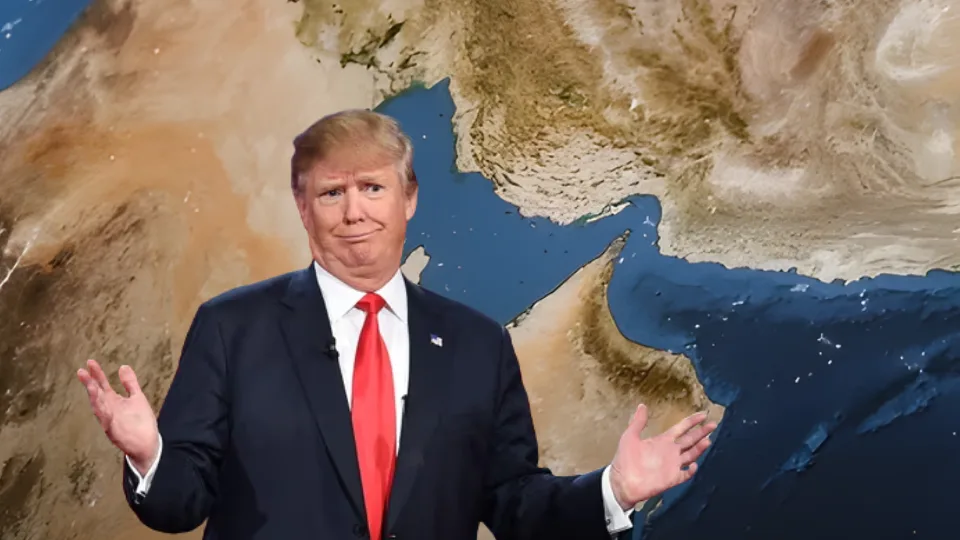
President Donald Trump is signaling a shift in strategy toward Iran, suggesting Washington may be willing to wait for the country’s economic problems to deepen rather than launch another round of military strikes.
“We are low-keying it,” Trump told Axios on Sunday. “We are only semi-negotiating with them. We are just watching Iran with its huge inflation and the fact they have no money.”
The change in tone comes as negotiations over the Strait of Hormuz remain deadlocked, Iran hardens its demands for reopening the critical energy corridor, and attacks continue to discourage commercial ships from entering both Hormuz and the Red Sea.
For investors, the immediate consequence is continued uncertainty around one of the most important energy chokepoints in the world. Oil prices moved higher Monday as hopes for a quick resolution faded.
Trump Appears Willing to Wait Iran Out
Only days ago, Trump was projecting confidence that an agreement with Tehran could be approaching. His latest comments suggest the White House may now see Iran’s deteriorating economy as leverage that could eventually force the government back to the negotiating table on more favorable terms.
Trump reinforced that message on Truth Social by posting a chart highlighting the Iranian rial’s plunge in value, accompanied by the phrases “Iran has no money” and “currency is trash.”
The strategy could represent a significant shift from direct military escalation toward economic attrition. Rather than immediately using additional strikes to force concessions, Washington appears prepared to maintain sanctions, the naval blockade and other forms of pressure while Iran absorbs the economic consequences.
That approach could also reduce the immediate risk of another major U.S.-Iran military confrontation. But it does little to solve the problem currently confronting energy markets: the Strait of Hormuz remains severely disrupted, and neither side appears ready to make the concessions necessary to reopen it.
Iran’s Price for Reopening Hormuz Is Getting Steeper
Iran has presented Washington with sweeping conditions for reopening the Strait of Hormuz.
Tehran’s demands reportedly include lifting U.S. sanctions and the American naval blockade, withdrawing U.S. military forces from the region, releasing frozen Iranian assets and compensating Iran for damage suffered during the war.
Iranian Foreign Minister Abbas Araghchi said Sunday there was “no possibility of restarting negotiations” while Washington continues what Tehran considers violations of a June memorandum of understanding without compensation.
“Intermediaries are still making efforts to find ways to resume negotiations,” Araghchi said.
The result is a difficult diplomatic stalemate. Washington appears unwilling to provide the concessions Iran is demanding, while Tehran is attempting to use control over one of the world’s most strategically important waterways as leverage.
Iran has separately been negotiating with Oman over defined transit routes through Hormuz. Araghchi said those discussions have reached their final stage, although he emphasized that an agreement with Oman would not amount to reopening the strait.
Oman described the negotiations as taking place in a “positive and constructive atmosphere,” while urging an end to attacks against vessels to provide more room for diplomacy.
The U.S. Naval Blockade Isn’t Letting Up
While Trump may be stepping away from immediate military escalation, American pressure at sea is intensifying.
U.S. Central Command said American forces had redirected 55 commercial vessels away from Iranian ports as of Sunday, up from 35 on Aug. 2. That means another 20 vessels were redirected in roughly a week.
American forces have also disabled two vessels and boarded two others to ensure compliance with the blockade, according to the military.
Those numbers underscore an important distinction in Trump’s emerging strategy. Washington may be reducing the emphasis on offensive strikes, but it is not easing the economic and maritime pressure surrounding Iran.
The blockade could become even more important if Trump’s goal is to allow Iran’s economic problems to accumulate over time.
For Tehran, however, that makes compromise increasingly difficult. Iran is demanding that the blockade be removed as part of any broader agreement, while Washington appears to view the blockade as one of its strongest bargaining chips.
One of the World’s Most Important Oil Routes Remains Choked
The Strait of Hormuz has now been severely disrupted for more than five months.
Before the war erupted in February, approximately one-quarter of the world’s seaborne oil trade and roughly one-fifth of global liquefied natural gas moved through the waterway.
That makes even relatively small changes in Hormuz shipping traffic potentially important for global energy markets.
Shipping tracker Kpler recorded just eight confirmed crossings through the strait last Friday, a 33% decline from the previous day.
Meanwhile, the security situation remains dangerous.
The United Arab Emirates said Saturday that Iran fired a missile at an oil tanker owned by the Abu Dhabi National Oil Company as the vessel attempted to transit Hormuz.
Pressure is also continuing farther west. Yemen’s Iran-backed Houthi militia claimed responsibility Sunday for an attack on an oil refinery in Saudi Arabia as well as equipment in Yemen’s Red Sea port city of al-Makha.
The combination leaves shipping companies confronting risk on two critical maritime routes simultaneously.
Iran Is Considering Even Tougher Restrictions
Tehran could go further.
Iranian state media last week published a draft plan that would formalize restrictions on traffic through Hormuz. The proposal would reportedly bar American and Israeli vessels from the strait and require compensation from countries Iran considers hostile before their ships could transit the waterway.
Iran’s parliament is reviewing the proposal, according to state media.
Under the initial draft, vessels violating the restrictions could face penalties equivalent to 20% of the value of the cargo they are carrying.
If enacted and enforced, such restrictions could make normalization of commercial shipping considerably more complicated even if military tensions temporarily ease.
It would also raise a larger question for global markets: whether the crisis has permanently changed the way Iran views the Strait of Hormuz, transforming access to the waterway into an explicit instrument of economic and geopolitical leverage.
Oil Prices Rise as a Quick Deal Looks Less Likely
Energy markets are already reflecting some of that uncertainty.
Brent crude futures climbed 1.1% Monday to $84.45 a barrel, while U.S. West Texas Intermediate futures rose about 1% to $78.98.
ING Bank has maintained its forecast for Brent crude to average approximately $80 per barrel this quarter, based on expectations that shipping flows eventually normalize during the third quarter. But the bank also warned that substantial risks surround that forecast.
“There doesn’t seem to be much of a compromise, which ultimately makes it more difficult to reach a sustainable deal,” Warren Patterson, ING’s head of commodities strategy, wrote Friday.
The danger is that the apparent de-escalation from Washington proves temporary.
“Things could go from bad to worse once again,” Patterson warned.
That possibility is particularly important because Trump’s latest position does not necessarily mean the military option has disappeared. It suggests that, for now, the administration believes time and economic pressure may accomplish more than another round of strikes.
Trump’s Gamble: Can Economic Pain Force Iran to Bend?
The emerging strategy amounts to a high-stakes waiting game.
Trump appears to believe Iran’s economic weakness gives Washington the advantage. Maintaining sanctions, restricting access to Iranian ports and allowing inflation and currency depreciation to intensify could eventually make Tehran more willing to compromise.
Iran appears to be making the opposite calculation.
By keeping Hormuz restricted and demanding sanctions relief, troop withdrawals, frozen assets and war reparations, Tehran is betting that rising oil prices and disruption to global shipping will eventually increase pressure on Washington and its allies to make concessions.
Both sides therefore appear to believe time is working in their favor.
That is precisely what makes the situation dangerous for markets.
A prolonged standoff could keep a geopolitical risk premium embedded in oil prices, increase shipping and insurance costs, complicate LNG flows and leave the global economy exposed to another sudden escalation.
For investors, Trump’s decision to “low-key” the confrontation may reduce the immediate probability of another U.S. attack. It does not mean the Hormuz crisis is nearing an end.
With Iran hardening its conditions, the U.S. maintaining its blockade and commercial shipping continuing to avoid the region, the economic confrontation may simply be entering its next phase.
About Author