President Donald Trump is opening the U.S. market to as much as 300,000 metric tons of tariff-free imported beef over the next 90 days. The move could lower costs for meat processors and fast-food chains, although the savings shoppers see at the grocery store may be far smaller than the headline suggests.
Trump’s Plan to Lower Ground Beef Prices
Trump announced Friday that the United States will temporarily allow up to 300,000 metric tons of beef intended for ground-beef production to enter the country without being subject to out-of-quota tariffs.
That works out to roughly 661 million pounds of imported beef over three months.
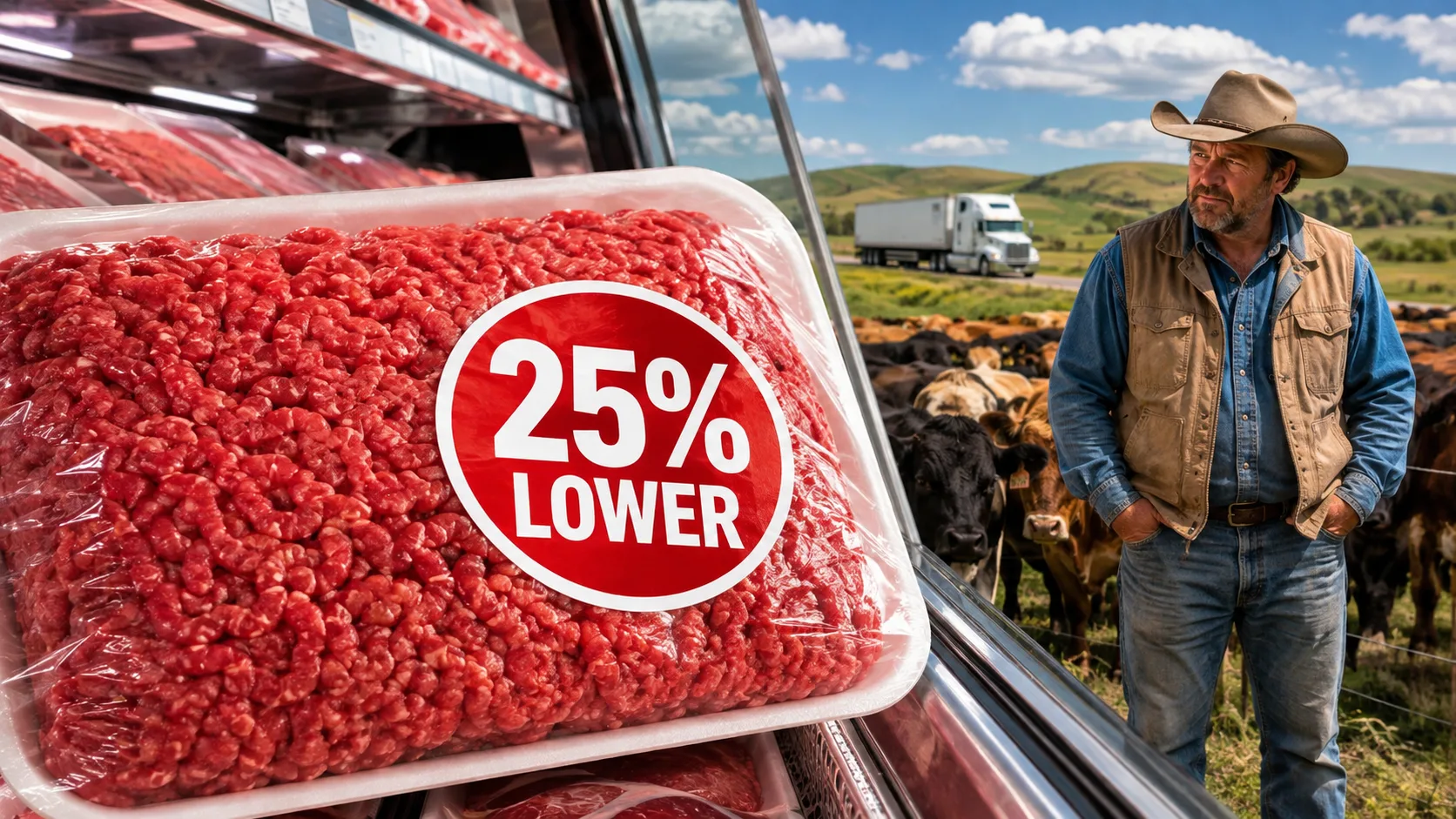
“We have a commitment that this beef will be sold at 25 percent below current market prices,” Trump said in his announcement.
The president described the agreement as a way to reduce grocery costs while giving American ranchers time to rebuild the domestic cattle herd. However, the administration did not identify which countries would supply the beef, which importers had agreed to the discount or how the 25% reduction would be calculated and enforced.
Those missing details will determine whether the policy meaningfully lowers grocery prices or simply reduces costs for the companies importing, processing and distributing the meat.
The United States uses a tariff-rate quota system for beef imports. Product entering within established country quotas generally faces a tariff of 4.4 cents per kilogram. Beef imported above those limits can face a tariff of 26.4%.
For beef valued near $7 per kilogram, the difference can exceed $1.80 per kilogram. Eliminating that cost across a large volume of imports creates meaningful savings somewhere in the supply chain.
The question is where those savings ultimately land.
Why Beef Prices Have Surged
American beef prices have been driven higher by a shrinking cattle herd, years of drought, elevated feed costs and the liquidation of breeding animals.
The United States entered 2026 with one of its smallest cattle herds in decades. Ranchers sold animals during periods when water, grazing land and affordable feed were difficult to secure. Once breeding cows leave the system, replacing them takes years.
Rebuilding requires ranchers to hold back young females that could otherwise be sold. Those animals must mature, breed and produce calves before the additional supply reaches meat processors.
That creates a significant delay between higher cattle prices and increased beef production.
Strong cattle prices normally encourage ranchers to expand. Producers gain the confidence to retain heifers, invest in land and absorb higher operating costs because they expect future cattle sales to remain profitable.
Trump’s import plan complicates that calculation. Ranchers now have to consider whether Washington will repeatedly introduce cheaper foreign beef whenever retail prices become politically uncomfortable.
The National Cattlemen’s Beef Association said cattle markets moved sharply lower following Trump’s announcement. CEO Colin Woodall warned that importing government-supported, below-market beef could discourage producers from expanding their herds.
“Today’s announcement and other market interventions throw cold water on the prospect of herd expansion and sacrifices long-term stability for short term messaging,” Woodall said.
Grocery Shoppers May See Less Relief Than Expected
The phrase “ground beef imports” makes it sound as if hundreds of millions of pounds of retail hamburger will soon appear in supermarket meat cases.
The actual supply chain is more complicated.
A large share of imported beef from countries such as Australia and Brazil arrives frozen. Much of it consists of lean beef and trimmings that processors blend with fattier American beef to produce hamburger.
That imported product frequently goes into food-service operations, including fast-food restaurants, institutional kitchens and prepared foods. Many supermarket meat departments rely heavily on fresh domestic beef for the hamburger displayed in their cases.
As a result, the tariff waiver could lower the cost of beef used in restaurant burgers faster than it lowers the price of fresh ground beef at the grocery store.
The 25% commitment also appears to apply to the imported product rather than every package of hamburger sold in the United States.
Retail ground beef prices include processing, packaging, transportation, refrigeration, labor and supermarket margins. The imported beef is one component of that final price.
Even if the imported product is sold 25% below prevailing market prices, consumers should not automatically expect the average price of ground beef to fall by the same amount.
The Biggest Winners Could Be Food Companies
Meat Processors Gain Access to Cheaper Inputs
Large meat processors have faced an increasingly difficult margin environment. Tight cattle supplies have pushed animal costs higher while consumers and restaurants have become more resistant to additional price increases.
Tariff-free imported beef could reduce the cost of lean trimmings used in hamburger production. That would give processors more flexibility to protect margins, maintain production volumes and negotiate contracts with restaurant customers.
The financial impact will depend on which companies can access the imported supply and how much of the tariff savings they retain.
Investors should watch the beef-segment margins of major processors. If those margins improve while retail prices remain elevated, it would suggest processors are capturing a meaningful portion of the benefit.
Fast-Food Chains May Benefit First
Fast-food companies are among the most likely beneficiaries because frozen imported beef is widely used in food-service channels.
Beef represents a major input cost for burger chains. Even a modest reduction in wholesale prices can generate substantial savings when spread across hundreds of millions of meals.
Restaurant operators could use those savings to protect value-menu pricing, introduce new promotions or improve restaurant-level margins.
Companies with large purchasing operations and the ability to renegotiate supplier contracts quickly will be in the strongest position. Smaller restaurant operators may receive less benefit because they lack the same bargaining power.
Grocery Chains Could Use Beef as a Traffic Driver
Supermarkets may use cheaper imported beef to run targeted promotions, especially on frozen hamburger patties, bulk packages and prepared foods.
Ground beef is a highly visible household staple. A prominent discount can attract shoppers who then purchase higher-margin products during the same visit.
However, the impact across the meat department will likely be uneven. Imported grinding beef has less direct influence on premium steaks, roasts and fresh cuts produced from American grain-fed cattle.
Consumers could see compelling promotional prices without experiencing a broad decline across every beef category.
Ranchers Face the Most Immediate Risk
American cattle producers carry the greatest downside if increased imports pressure cattle prices.
Ranchers have endured years of drought, high feed costs and herd liquidation. Those who remained in the industry were finally positioned to benefit from tight supply and historically strong cattle prices.
An unexpected increase in foreign beef creates uncertainty at precisely the time producers are deciding whether to rebuild.
If cattle prices fall enough, ranchers may sell young females instead of retaining them for breeding. That would provide more beef in the near term while delaying the recovery of the domestic herd.
A Short-Term Price Cut Could Extend the Beef Shortage
The obvious expectation is that greater supply will reduce prices. That logic works in the short run, especially for imported lean beef and food-service hamburger.
The longer-term effect could be less favorable.
American ranchers need strong and predictable cattle prices to justify expansion. If government intervention repeatedly limits the upside during periods of tight supply, producers have less reason to invest in rebuilding.
That could leave the United States with a smaller domestic herd for longer and increase reliance on imported beef.
Imports were already running at historically high levels before Trump’s announcement. The American Farm Bureau Federation reported that the United States imported 562,000 metric tons of beef and beef products during the first quarter of 2026, up 18% from the previous year and 122% from five years earlier.
The newly authorized 300,000 metric tons would represent a major increase over the next three months if importers use the full allowance.
Foreign supply can help fill the immediate gap. It cannot quickly solve drought conditions, high feed costs or the biological timeline required to raise cattle.
The policy therefore creates a tradeoff. Consumers and food companies may receive temporary relief, while ranchers face a weaker incentive to produce the additional cattle needed for a lasting recovery.
The Three Numbers That Will Determine Whether It Works
Investors should focus on three measurements over the next 90 days.
1. Actual Import Volume
The authorization allows up to 300,000 metric tons, but the full amount may not arrive.
Foreign suppliers need available cattle, approved processing capacity, refrigerated transportation and access to U.S. distribution networks. The tariff waiver reduces the cost of importing beef, although it cannot instantly create new global production.
A low utilization rate would limit the policy’s effect on wholesale and retail prices.
2. Retail Price Pass-Through
Investors should compare import costs with wholesale ground-beef prices, restaurant promotions and grocery-store prices.
If wholesale prices decline while retail prices remain high, processors, distributors or retailers are capturing the savings. Broad consumer relief requires competition to push those savings through the supply chain.
The administration’s promised 25% discount will be meaningful only if the lower price survives each step between the importer and the shopper.
3. Herd-Rebuilding Decisions
Future cattle inventories and heifer-retention data will show how ranchers respond.
An increase in breeding animals would signal that producers still have enough confidence to expand. Continued liquidation would suggest the import policy has weakened the economic case for rebuilding.
This third number may matter most. Imported beef can influence prices for several months. Herd decisions affect the domestic market for years.
Signals Investors Should Monitor
- Implementation details: The White House must clarify which countries, importers and beef products qualify.
- The 25% commitment: Investors need to know whether it applies to import prices, wholesale contracts, restaurant purchases or retail packages.
- Cattle futures: Continued weakness would indicate that traders expect imports to reduce demand for domestic cattle.
- Processor margins: Improving margins could show that meat companies are retaining part of the tariff savings.
- Fast-food promotions: More aggressive burger pricing would suggest restaurants are receiving cheaper beef.
- Supermarket prices: Targeted discounts are likely to appear before any broad decline in fresh ground-beef prices.
- Import shipments: Actual arrivals will reveal whether the 300,000-metric-ton allowance can be fully used within 90 days.
- USDA cattle data: Heifer retention and herd inventories will indicate whether domestic producers are still willing to expand.
- Further government intervention: Food affordability is becoming a major political issue ahead of the November elections. If beef prices remain elevated, additional measures could follow.
The Financial Takeaway
Trump’s tariff waiver could lower the cost of imported beef and provide some relief to processors, restaurants and consumers. The benefits are unlikely to be distributed evenly.
Fast-food companies and large meat processors may see savings first because they use significant quantities of frozen imported beef. Grocery shoppers could receive smaller, targeted discounts, especially if supermarkets continue relying on fresh domestic beef in their meat cases.
Ranchers face a different outcome. Lower cattle prices could weaken the incentive to rebuild the American herd, extending the supply problem the policy is designed to address.
The next 90 days will show whether Trump’s plan produces meaningful grocery relief or primarily shifts money between importers, processors, restaurants and cattle producers. The long-term result will depend on whether American ranchers still believe expanding their herds is worth the risk.
Sources
https://www.cbsnews.com/news/trump-waives-ground-beef-import-tariffs
https://www.dtnpf.com/agriculture/web/ag/news/article/2026/08/21/trump-proposes-lifting-tariff-rate
https://www.fb.org/intel/markets/relaxing-beef-import-quotas-sends-mixed-signals-to-ranchers
About Author