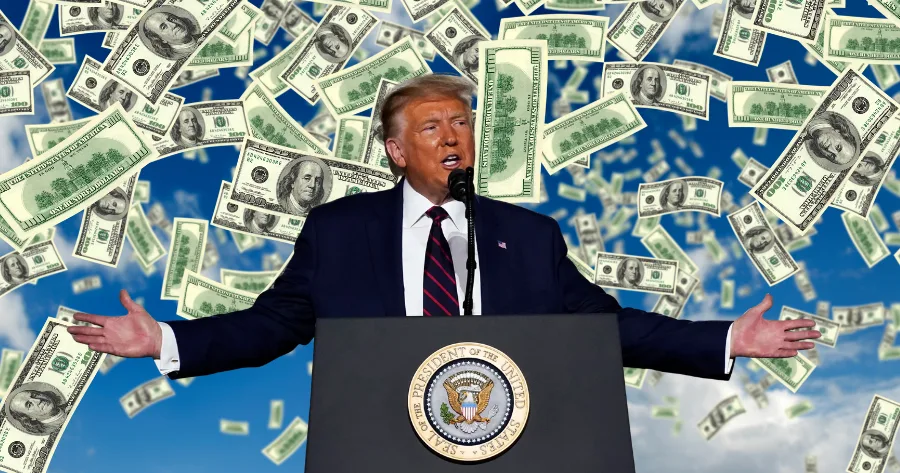
President Donald Trump is promising a $5,000 payment to every adult American citizen if Republicans retain control of both chambers of Congress in November. The proposal could cost roughly $1.2 trillion, require congressional approval and inject a massive new variable into the outlook for inflation, interest rates and federal borrowing.
Trump Ties $5,000 Payments to the Midterm Elections
Trump unveiled what he called the “Trump Dividend” during the Republican Party’s midterm convention in Dallas on Wednesday night.
“Here is my promise: if the Republicans win the House of Representatives and the United States Senate, both of them… because of our tremendous strength and success economically, I will issue a dividend to every adult citizen in the United States of America for $5,000,” Trump told the crowd.
“If the Republicans win, you win with us and you get $5,000,” he added.
Trump urged voters to “pretend that I’m on the ballot,” directly connecting the payment proposal to Republican victories in the House and Senate.
The president provided few operational details. There is currently no legislation establishing the payment, no confirmed funding mechanism and no publicly released eligibility standard beyond Trump’s initial statement that every adult citizen would qualify.
Vice President JD Vance subsequently suggested that wealthy Americans could be excluded and that tariff revenue might help finance the payments. That qualification would reduce the total cost, but the available tariff revenue remains far below what would be needed.
Republican Sen. Bernie Moreno of Ohio said he plans to prepare legislation so Congress could consider the dividend after the November 3 election.
The proposal immediately encountered resistance from both sides of the aisle. Democrats criticized it as another unfulfilled promise, while fiscal conservatives questioned how the government could afford it. Republican Rep. Chip Roy of Texas said he wanted to know how the administration planned to pay for a program carrying a price tag well above $1 trillion.
The Numbers Are Enormous
The United States has approximately 240 million adult citizens. Providing each one with $5,000 would cost around $1.2 trillion before accounting for administrative expenses.
That would make the Trump Dividend one of the largest single federal cash-distribution programs in American history. It would exceed the amount most Americans received from any individual round of pandemic stimulus payments and approach the scale of major annual federal spending categories.
The comparison with tariff revenue exposes the proposal’s biggest financial challenge.
The federal government collected approximately $154.5 billion in tariff revenue during the first 10 months of fiscal 2026, according to Treasury data cited by TIME. Even if all of that money were redirected toward checks, it would cover only a small fraction of the estimated cost.
Tariffs also represent federal revenue already flowing into the broader budget. Using those receipts for dividend payments would leave less money available for existing obligations unless Congress approved offsetting spending cuts, additional taxes or more borrowing.
The government is already operating under significant fiscal pressure. The federal deficit totaled nearly $1.8 trillion in fiscal 2025, while the national debt recently surpassed $40 trillion. Interest payments have become one of Washington’s largest expenses as higher borrowing costs compound the effect of years of deficit spending.
Adding another $1.2 trillion without an equivalent offset would increase Treasury borrowing and push the country deeper into deficit.
A Dividend Without a Surplus
Trump described the payment as similar to a cash distribution made by a successful corporation. The analogy has political appeal, although the federal government’s financial position differs sharply from that of a profitable company returning excess cash to shareholders.
A corporate dividend normally comes from earnings or accumulated cash. The federal government currently spends substantially more than it collects.
That distinction matters because the government would have three broad ways to finance the checks:
- Increase federal borrowing.
- Raise additional revenue.
- Reduce other government spending.
Each option would carry consequences.
Borrowing the full amount could increase the supply of Treasury securities at a time when investors are already focused on deficits, debt sustainability and elevated interest costs. Raising taxes or tariffs could offset part of the expense, although either could create new economic pressures. Spending cuts large enough to finance the program would require politically difficult reductions elsewhere in the federal budget.
The proposal therefore represents a potential transfer of purchasing power rather than the distribution of an existing federal surplus.
Is Trump’s $5,000 Promise an Illegal Offer to Buy Votes?
Federal law prohibits offering or making a payment to someone in exchange for voting, withholding a vote or voting for or against a particular candidate. A willful violation can carry fines and up to two years in prison.
Trump’s decision to tie the dividend to Republican control of Congress has raised questions about whether the pledge crosses that line.
The legal issue is unresolved, and the statute does not automatically make the proposal illegal. Trump described a government program that would apply broadly after the election, regardless of how any individual recipient voted or whether that person voted at all.
Attorney John Day told the Associated Press that the proposal would be legal for that reason, describing it as a campaign promise rather than an individual payment offered in exchange for a particular vote.
Congressional approval would create another important distinction. Presidents routinely campaign on tax cuts, benefits and spending programs that could financially help voters if enacted. A universally available payment authorized through legislation may be treated differently from a campaign or candidate directly paying selected voters.
Any final legal assessment would depend heavily on the program’s actual language, eligibility conditions, funding source and implementation. Those details do not yet exist.
The Financial Reality
A $5,000 check would be significant for millions of American households, but the government currently lacks the legislation and identified surplus required to distribute it.
The estimated $1.2 trillion cost would force Congress to confront a difficult choice between new borrowing, higher revenue and major spending reductions. Each route carries consequences for Treasury yields, inflation and asset prices.
For investors, the announcement should currently be treated as a campaign proposal rather than an approved economic program. Its importance will rise sharply if lawmakers release legislation and explain where the money would come from.
Until then, the clearest market signal is the promise itself: direct cash payments and fiscal policy are moving to the center of the 2026 election debate.
About Author