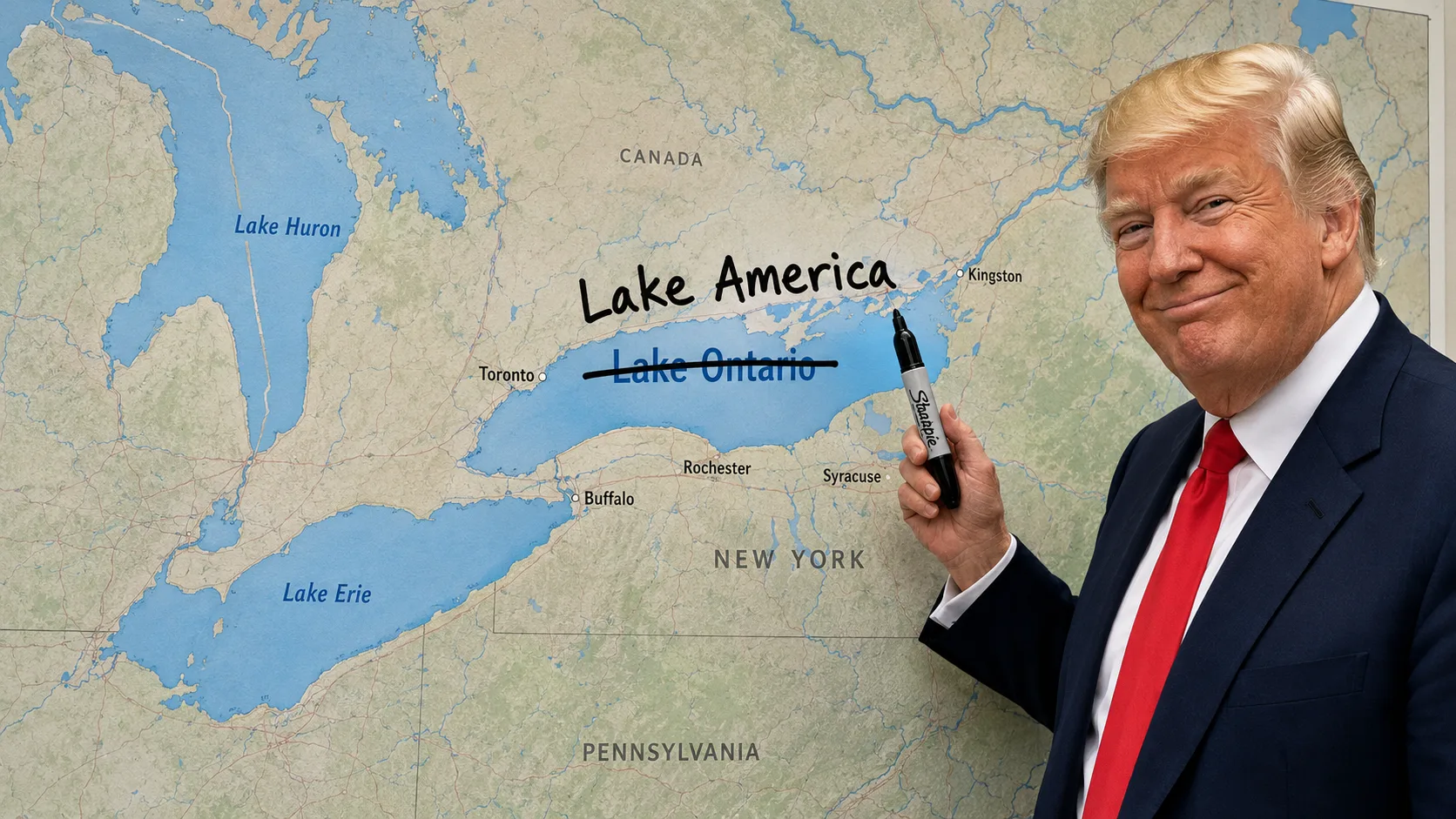
President Donald Trump has officially renamed Lake Ontario “Lake America” for use by the U.S. government, turning a geographic label into the latest pressure point in a rapidly escalating trade war with Canada.
The Name Will Change on U.S. Maps
Trump signed an executive order Thursday directing the Interior Department and the U.S. Board on Geographic Names to update the federal Geographic Names Information System within 30 days.
The order means federal agencies, maps, contracts and official communications will use “Lake America.” Canada and other countries remain free to call it Lake Ontario.
Trump declared the change effective immediately while displaying a Great Lakes map with “Lake America” printed in red. Another sign promised to make the Great Lakes “even greater.”
The administration says the lake has played a critical role in American trade, defense, manufacturing and energy production. The White House order also argues that U.S. investments and Coast Guard operations have helped protect the wider Great Lakes system.
Canadian officials quickly rejected the new name.
Prime Minister Mark Carney said the lake’s Indigenous name predates both Canadian Confederation and the Declaration of Independence.
“Canadians also know that naming reality means calling it Lake Ontario, then, now and always,” Carney wrote.
Ontario Premier Doug Ford said it would remain Lake Ontario “to Canadians and the rest of the world.” New York Gov. Kathy Hochul also said her state would refuse to use Trump’s preferred name.
The Map Is Part of a Much Bigger Fight
The renaming has little direct economic effect. Its timing gives it financial significance.
It comes after negotiations between the United States and Canada collapsed, prompting Washington to impose 50% tariffs on roughly $20 billion in Canadian goods. Canada responded with matching countermeasures covering approximately C$27.6 billion, or about $20 billion in U.S. currency, of American imports.
Canada’s tariffs are scheduled to take effect September 8 and will range from 15% to 50%. Products targeted include steel, dairy, appliances, agricultural equipment, electronics, clothing and certain aluminum goods.
Ottawa also announced C$7.5 billion in additional support for affected businesses and workers. That package includes liquidity programs, worker assistance and funding intended to help Canadian companies find new markets.
Trump insisted the renaming was not designed to send a geopolitical message. He then accused Canada of taking advantage of the United States on trade and defense.
That contradiction captures the real risk. The dispute is becoming increasingly political, making it harder for either government to compromise without appearing to surrender.
Where Investors Could Feel the Pressure
Manufacturing and Steel
The U.S. and Canadian manufacturing sectors function through deeply connected supply chains. Materials and components can cross the border several times before becoming finished products.
Tariffs at multiple stages can compound expenses. Manufacturers may face higher steel, aluminum, equipment and transportation costs even when their final products are assembled in the United States.
Companies with thin margins and heavy cross-border exposure could feel the greatest pressure.
Agriculture and Consumer Prices
Canadian retaliation targets dairy products, farm equipment and other politically sensitive American exports. That could weaken demand for certain U.S. producers while raising costs for Canadian buyers.
Investors should watch whether affected companies can pass those costs to customers. If they cannot, tariffs could compress margins. If they can, consumers may encounter higher prices.
Great Lakes Commerce
Lake Ontario connects the Great Lakes system with the St. Lawrence River and international markets. The executive order does not alter shipping rights, customs procedures or maritime boundaries.
Still, the lake’s symbolic elevation underscores the economic importance of the region. Steel, grain, minerals, energy products and industrial cargo move through the broader Great Lakes-St. Lawrence Seaway.
Any future restrictions, inspections or logistical retaliation would carry far greater consequences than a name change.
The Three-Level Escalation Test
Investors can evaluate the dispute through three levels:
- Symbolic escalation: Renaming landmarks and exchanging political insults create headlines but have limited financial impact.
- Commercial escalation: Tariffs raise costs, disrupt orders and pressure corporate margins.
- Structural separation: Businesses redirect supply chains, Canada develops new export markets and both countries reduce their dependence on each other.
The third level presents the largest long-term risk. Temporary tariffs can disappear following a negotiated agreement. Supply chains and capital investments moved elsewhere may never fully return.
The Most Important Signal Is Canada’s Response
The obvious interpretation is that “Lake America” represents another provocative Trump branding campaign. The deeper investor story is Canada’s accelerating effort to reduce its economic reliance on the United States.
If Canadian companies redirect exports toward Europe and Asia, the consequences could outlast the current tariff fight. American businesses could eventually face less reliable access to Canadian energy, metals, agricultural inputs and industrial capacity.
A symbolic confrontation could therefore speed up a structural change already underway.
What Comes Next
Investors should watch the September 8 implementation of Canada’s counter-tariffs, any resumption of bilateral negotiations and signs that Washington may expand its existing measures.
Corporate guidance will also matter. Manufacturers, agricultural businesses, retailers and transportation companies may begin quantifying the effect of tariffs in earnings forecasts.
The renaming itself will not move markets. The deteriorating relationship behind it could.
About Author