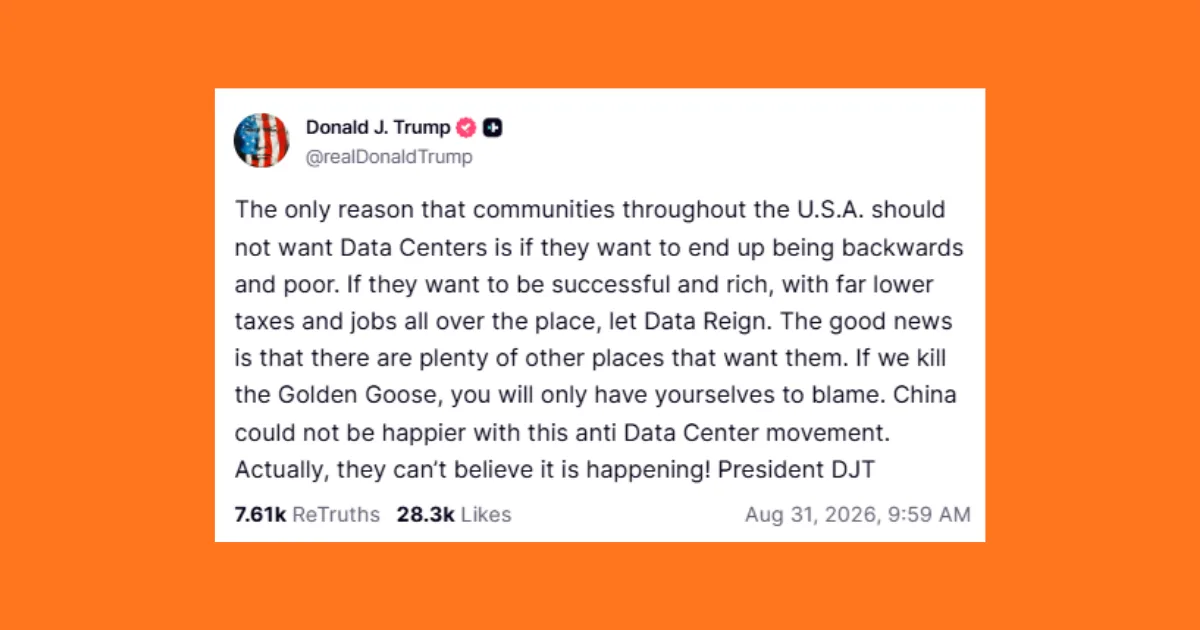
Trump delivered his blunt warning Monday as public resistance to new data centers spread across the United States.
“The only reason that communities throughout the U.S.A. should not want Data Centers is if they want to end up being backwards and poor,” Trump wrote on Truth Social.
“If they want to be successful and rich, with far lower taxes and jobs all over the place, let Data Reign,” he added.
Trump framed the issue as an economic and national-security contest. He called data centers a “Golden Goose” and argued that opposition would benefit China by making it harder for the United States to expand the computing capacity needed to develop and operate advanced AI systems.
That argument collides with a political reality that is becoming difficult for either party to ignore. Gallup found that 71% of Americans opposed construction of an AI data center in their local area, including 48% who strongly opposed it. Just 26% favored a local project.
Opposition crossed party lines. Majorities of Republicans, Democrats and independents said they would oppose a data center near where they live. Residents cited water consumption, electricity demand, pollution, traffic, land use and the risk of higher utility bills.
The backlash has become especially important in Ohio, where Republican Sen. Jon Husted faces Democratic challenger Sherrod Brown in a special election for the Senate seat previously held by Vice President JD Vance.
An August memo from the National Republican Senatorial Committee reportedly described data centers as the “anchor hanging around Husted’s neck” and warned that a loss blamed on the issue could make politicians nationwide reluctant to support future projects. Brown has made data-center-driven power costs central to his campaign, according to the committee.
With control of the House and Senate at stake in November, an infrastructure issue once discussed mainly by utility planners and technology executives has moved directly into campaign politics.
The AI Boom Has Reached the Kitchen Table
Wall Street has spent years treating AI infrastructure as a supply-chain story. The familiar questions concern chip availability, cloud demand, model performance, capital expenditures and returns on investment.
Voters are asking a different set of questions: Who pays for the new power plants and transmission lines? Will household electric bills rise? How much water will a facility consume? How many permanent jobs will remain after construction? What tax concessions did the developer receive?
Those questions explain why the backlash has accelerated so quickly. Gallup found that half of data center opponents cited excessive resource consumption. Water and energy use were each mentioned by 18% of opponents. Roughly one in five raised quality-of-life concerns, while a similar share pointed to possible economic costs, including higher utility bills and taxpayer-funded construction.
Supporters see a different equation. Two-thirds of respondents who favored local development cited economic benefits. Jobs were the dominant reason, followed by tax revenue and broader development.
Both sides are responding to real economic incentives. A hyperscale facility can bring a large upfront construction project, expand the local tax base and attract supporting infrastructure. Its ongoing employment footprint may be modest compared with the electricity, land and water it consumes. The result depends heavily on the specific project, utility rules, tax agreement and location.
That makes the national debate unusually difficult to settle with a single talking point. “Jobs and growth” may be true in one community. “Higher costs and limited local benefit” may be true in another.
Trump’s language raises the political temperature, yet it does not resolve that local cost-benefit calculation. Communities want evidence that the promised prosperity will reach residents before the economic and environmental costs appear on their bills.
Local Consent Is Becoming an AI Supply Constraint
The most important investor takeaway is that public acceptance now belongs alongside chips, power generation, transformers and financing on the list of constraints facing AI expansion.
The United States can manufacture or import more equipment. It can finance new generation. It can also improve cooling efficiency. Local permits, utility approvals and political consent can still delay a project for years or force it into a different market.
That creates a new form of scarcity. Locations with abundant power, available land, supportive regulators and durable community agreements could become more valuable. Sites lacking those advantages may see higher development costs, longer timelines or canceled projects.
The constraint also changes how investors should evaluate the AI spending boom. Announced capital expenditures do not automatically translate into completed, energized facilities. The path from a corporate budget to operational computing capacity passes through zoning boards, grid interconnection queues, environmental reviews, rate cases and local elections.
Power Producers and Utilities Face a Cost Allocation Test
Data centers can provide utilities with large, steady customers. They can also require substantial spending on generation, substations and transmission.
The central financial question is cost allocation. If a utility can secure long-term commitments from developers and make the new customer pay for dedicated infrastructure, the expansion may support earnings while protecting existing ratepayers. If costs are spread broadly across the customer base, political resistance can intensify quickly.
The U.S. Energy Information Administration projects major long-term growth in electricity consumed by data center servers. It estimates that servers accounted for about 7% of commercial-sector electricity use in 2025 and could represent 22% to 33% by 2050. Cooling requirements add another layer of demand.
For investors, rising electricity consumption can support utilities, power generators, natural gas infrastructure, nuclear energy, grid equipment and energy-storage providers. The opportunity comes with a condition: regulators and voters must accept the rate structure used to fund it.
AI Suppliers Could Face Timing Risk
Chipmakers, networking vendors, cooling-system manufacturers and construction contractors depend on facilities being completed on schedule. A permit delay can push equipment orders into a later quarter even when long-term demand remains intact.
That distinction matters during earnings season. A delayed project may look like weaker demand in the short run while representing deferred revenue over a longer horizon. Investors will need to separate genuine cuts in AI spending from geographic shifts and construction delays.
Data Center Real Estate May Split Into Winners and Losers
The political backlash could widen the valuation gap between sites that already have power access and projects still seeking approval.
Existing campuses in business-friendly jurisdictions may gain strategic value because they reduce permitting risk and shorten the time required to bring new computing capacity online. Speculative land without secured power could become harder to monetize, regardless of how attractive the original development plan appeared.
The premium may move toward certainty: contracted electricity, clear water access, approved zoning and a local agreement that survives an election cycle.
The Backlash May Redirect the Boom Instead of Ending It
The obvious interpretation is that voter opposition threatens the entire AI investment cycle. A more likely outcome is geographic concentration.
Computing demand does not disappear when one county rejects a project. Developers can move capital toward states and municipalities with available power, faster permitting and local officials willing to negotiate. Trump emphasized that point when he wrote that “there are plenty of other places that want them.”
This migration could strengthen the bargaining power of infrastructure-ready regions and owners of energized sites. It may also leave the economic gains concentrated in fewer communities while opponents lose the tax base they hoped to reshape on better terms.
The risk for investors is therefore more nuanced than a simple collapse in AI spending. Political resistance could raise project costs, stretch construction schedules and change where capital flows. It could also accelerate creative solutions such as dedicated generation, long-term power contracts, closed-loop cooling and community benefit agreements.
Companies that solve the local cost problem may gain an advantage over rivals that rely on broad promises of future prosperity.
Five Signals That Could Move the Market
The Ohio Senate Race
The Husted-Brown contest is becoming a national test of whether data center opposition can decide a major election. If voters punish a candidate associated with expansion, politicians in other states may adopt tougher positions quickly.
Utility Rate Cases
Watch how regulators assign the cost of new generation and grid upgrades. Strong developer commitments could calm ratepayer concerns. Cost sharing with households could deepen the backlash.
Local Moratoriums and Permit Delays
An increase in pauses, zoning restrictions or rejected projects would signal that political risk is moving from polling into capital expenditure timelines.
Community Benefit Agreements
Developers may offer infrastructure funding, tax guarantees, water protections or local hiring commitments. The strength and enforceability of these packages could determine which projects advance.
November’s Midterm Elections
Republicans currently hold narrow control in Washington. If data centers influence competitive races, both parties will study the results and adjust their positions. That could affect federal permitting, energy policy and incentives for AI infrastructure in 2027.
America’s AI Ambition Now Depends on Local Economics
Trump is arguing that data centers are essential to prosperity and competition with China. Voters are demanding proof that the benefits will outweigh the local costs.
For investors, this conflict changes the AI infrastructure thesis. Political consent has become a scarce input, and the most valuable projects may be those that protect household utility bills while delivering credible jobs and tax revenue.
The AI buildout still has powerful momentum. Its next phase will be decided as much in utility commissions, county meetings and voting booths as in Silicon Valley boardrooms.
About Author