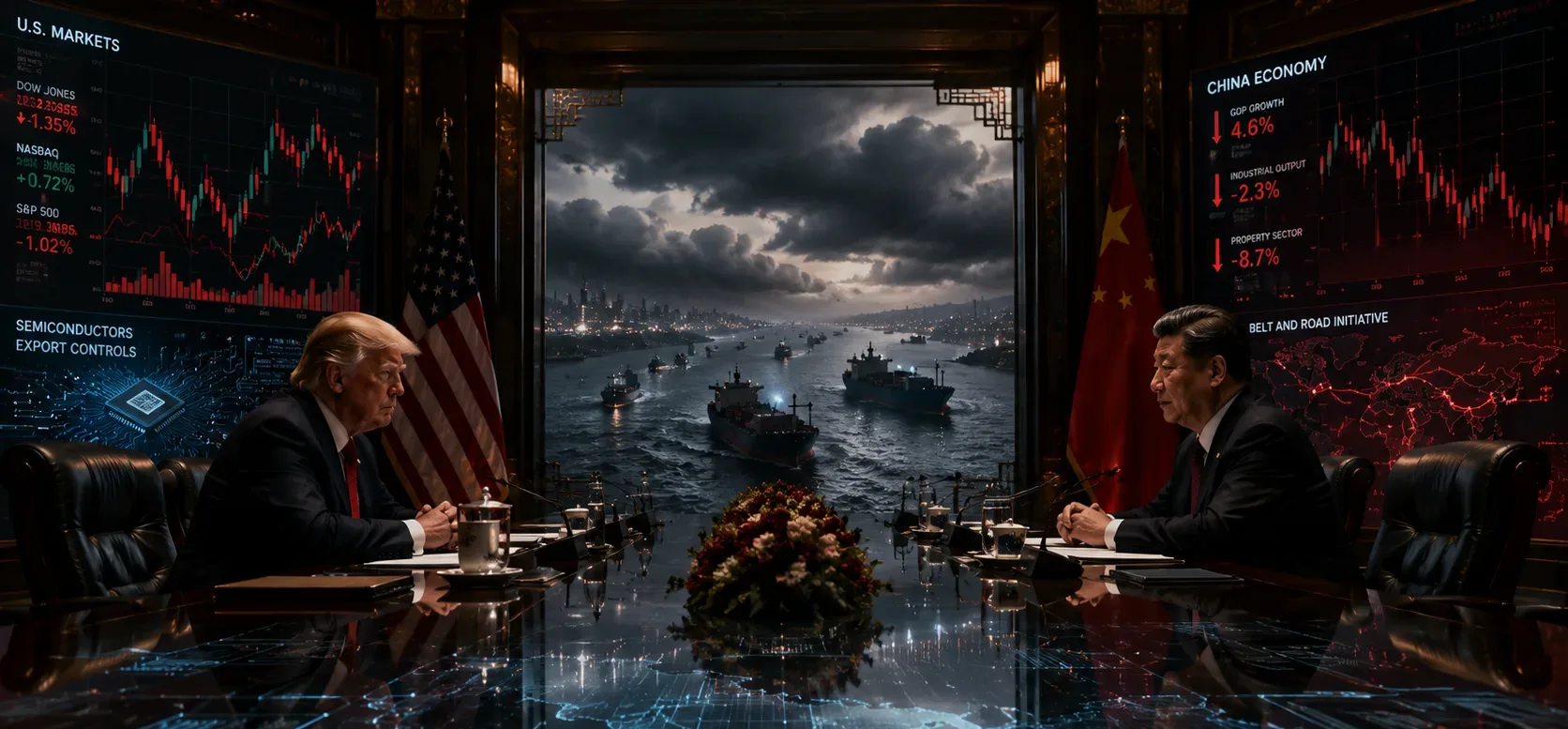
President Donald Trump arrived in Beijing looking for economic wins, trade headlines, and visible momentum ahead of the 2026 midterms. President Xi Jinping appears focused on something very different: buying time, preserving stability, and quietly positioning China for the next decade of economic and geopolitical competition.
That disconnect matters for investors because this summit lands at a dangerous moment for global markets. Oil markets remain unstable after the Iran conflict. Supply chains are still fragile. AI and semiconductor restrictions are escalating. At the same time, both Washington and Beijing are trying to prevent a full economic rupture without surrendering strategic leverage.
Markets are watching for trade agreements. The deeper story is whether the world’s two largest economies are moving toward temporary stabilization or simply preparing for a colder and more prolonged economic conflict.
Behind the Handshakes Sits a Much Bigger Economic Problem
The White House entered the summit emphasizing trade, investment, agriculture, aerospace, and energy cooperation. Trump is also reportedly pushing for expanded Chinese purchases of American farm goods including soybeans, corn, wheat, beef, and poultry.
But Beijing’s incentives are much broader than signing commodity purchase agreements.
China’s economy is under growing strain. Domestic demand remains weak. Deflationary pressure continues building. The country’s property slowdown has not fully healed, while industrial overcapacity keeps intensifying across sectors tied to state-backed manufacturing.
That reality explains why Xi appears determined to avoid escalation with Washington right now.
Zongyuan Zoe Liu of the Council on Foreign Relations summarized the dynamic directly: “Xi is playing a longer game, focused on strategic patience rather than substantive compromise.”
That line may end up being the most important takeaway from the summit.
Investors expecting a dramatic reset in U.S.-China relations could be disappointed. Beijing appears more interested in reducing immediate pressure while continuing to strengthen strategic industries including batteries, semiconductors, pharmaceuticals, and artificial intelligence.
Wall Street May Be Missing the Next Global Supply Shock
One of the biggest risks hiding beneath the summit is the growing concern over what policymakers are calling “China Shock 2.0.”
A recent report from the U.S.–China Economic and Security Review Commission warned that Beijing is massively expanding state-backed industrial production even as parts of its domestic economy weaken. The concern is that China could flood global markets with subsidized exports across advanced manufacturing sectors.
That creates pressure on pricing, margins, and competitiveness globally.
The sectors most exposed include:
- Semiconductors
- EV batteries
- Industrial machinery
- Solar equipment
- Pharmaceuticals
- Artificial intelligence infrastructure
The report warned that China is trying to “reduce China’s reliance on foreign technology while increasing the world’s dependence on China.”
That strategy has enormous implications for investors.
If Washington responds with tighter tariffs, export controls, or industrial subsidies, investors could see another phase of supply chain fragmentation similar to what followed the first U.S.-China trade war. Companies heavily dependent on Chinese manufacturing or Chinese demand could face renewed volatility.
At the same time, domestic manufacturing plays, defense contractors, energy infrastructure companies, and strategic commodity producers could continue benefiting from the global economic realignment.
The Middle East Crisis Quietly Shifted Negotiating Power
One major reason this summit matters more than previous meetings is the Middle East.
The Iran conflict and instability near the Strait of Hormuz have placed enormous pressure on global energy markets. Rising oil prices have become a political vulnerability for the White House, especially heading toward the midterms.
China understands this.
Beijing remains one of Iran’s largest oil buyers and maintains deep political ties with Tehran. Analysts increasingly believe China sees strategic value in allowing the United States to remain consumed by Middle East tensions while Beijing strengthens its own economic position.
Susan Thornton, former acting assistant secretary of state for East Asian and Pacific affairs, suggested China may view American entanglement in the region as a useful distraction.
“It seems like they are kind of hanging back and waiting to see what will happen,” Thornton said.
That matters because it changes negotiating leverage.
A White House facing energy inflation and geopolitical instability may have stronger incentives to stabilize relations with Beijing in the short term, even while broader strategic competition intensifies underneath the surface.
The Real Fight Still Revolves Around Chips, AI, and Taiwan
Trade headlines may dominate media coverage, but the summit’s real tension revolves around technology and military power.
The United States continues tightening export controls targeting advanced semiconductor and AI technologies. China continues opposing American support for Taiwan and U.S. arms sales to the island.
Neither side appears willing to back down.
This is critical for investors because the AI boom has become directly tied to national security competition.
Companies exposed to AI chips, cloud infrastructure, advanced manufacturing equipment, cybersecurity, defense technology, and energy-intensive data infrastructure remain at the center of the U.S.-China rivalry.
Any escalation involving Taiwan or semiconductor restrictions could immediately impact:
- Nvidia suppliers
- Semiconductor fabrication equipment makers
- Rare earth supply chains
- Shipping companies
- Defense contractors
- AI infrastructure plays
Investors should assume this strategic conflict remains active regardless of whatever trade headlines emerge from Beijing this week.
One Sector Could Walk Away With Immediate Benefits
One area where the summit could produce near-term economic movement is agriculture.
China may agree to additional purchases of American agricultural products as a goodwill gesture. Markets are particularly watching corn, sorghum, wheat, beef, and poultry.
Soybeans remain more complicated because China continues sourcing heavily from Brazil while domestic demand inside China remains soft.
Still, any agricultural commitments could benefit:
- U.S. fertilizer companies
- Grain exporters
- Farm equipment manufacturers
- Rail transport firms
- Agricultural commodity traders
More than a dozen major U.S. business executives reportedly accompanied Trump during the visit, including leadership from agricultural giant Cargill.
That signals corporate America sees opportunity even while geopolitical tensions remain elevated.
The Signals Investors Need to Watch After Beijing
Here are the key catalysts investors should monitor following the summit:
- Any formal agricultural purchase commitments from China
- Announcements tied to energy cooperation
- New export control measures involving semiconductors or AI
- Taiwan-related rhetoric from either side
- Oil price movement connected to Middle East shipping risks
- Treasury market reaction if trade tensions ease temporarily
- Industrial and manufacturing stock performance tied to reshoring trends
- Currency movement involving the U.S. dollar and Chinese yuan
Investors should also pay close attention to whether this summit produces actual policy changes or simply temporary diplomatic stabilization.
That distinction matters enormously.
The Bigger Picture Markets Cannot Ignore
This summit is less about solving the U.S.-China rivalry and more about managing it before it spirals into something economically dangerous.
Trump wants visible economic wins and political momentum. Xi appears focused on preserving stability while continuing China’s long-term strategic positioning beneath the surface.
Markets may initially react positively to any trade headlines or signs of reduced tension. But the deeper structural conflict involving AI, semiconductors, industrial policy, energy security, and Taiwan remains fully intact.
For investors, this increasingly looks like a world where geopolitical strategy and market strategy are becoming the same thing.
About Author