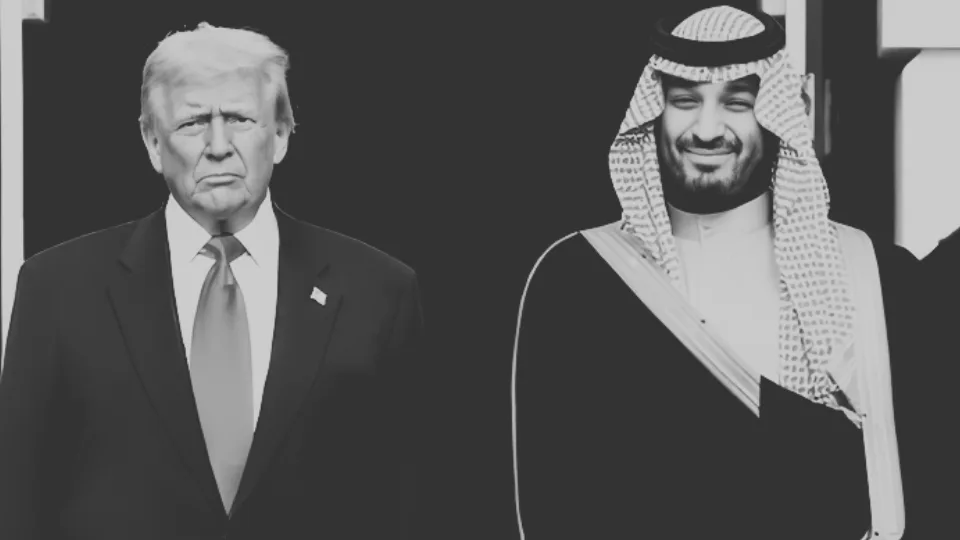
President Donald Trump hosted Saudi Arabia’s Crown Prince Mohammed bin Salman at the White House on Tuesday, marking the crown prince’s first visit in more than seven years and signaling a renewed phase of cooperation between Washington and Riyadh. The meeting featured full diplomatic pageantry and set the stage for an expansive slate of security and investment agreements that could reshape the geopolitical balance in the Middle East.
A High-Profile Visit Amid a Changing Political Landscape
The crown prince arrived in Washington amid ongoing efforts to improve his global image following the 2018 killing of journalist Jamal Khashoggi. The international backlash that followed the assassination strained relations with the United States, but the diplomatic reception on the South Lawn made clear that the Trump administration considers the past dispute largely settled.
U.S. intelligence agencies concluded that Prince Mohammed approved the capture or killing of Khashoggi at the Saudi consulate in Istanbul. The crown prince has denied ordering the operation but acknowledged overall responsibility as the kingdom’s de facto ruler. The issue remains controversial globally, yet Washington and Riyadh appear eager to push forward.
Trump greeted bin Salman on a red carpet with a handshake and a smile as a military honor guard, cannon salute, and fighter jet flyover underscored the significance of the visit. The motorcade was escorted by a U.S. Army mounted honor guard, and the two leaders took a moment to view the aircraft overhead before walking inside.
Strategic Talks Focused on Security, Energy, and High-Tech Investment
Tuesday’s agenda included Oval Office meetings, a formal lunch in the Cabinet Room, and a black-tie dinner at the White House. U.S. and Saudi flags lined the approach as the two leaders began discussing a broad suite of agreements involving defense, civil nuclear energy, and large-scale investment in American artificial intelligence infrastructure.
According to a senior administration official, the United States expects to build on a previously announced $600 billion Saudi investment pledge. The visit is expected to produce dozens of targeted projects, including multibillion-dollar deals in defense technology and energy.
Trump has already signaled a major shift in U.S. policy by backing Saudi Arabia’s request to purchase 48 F-35 fighters. He told reporters Monday, “We’ll be selling” F-35s to Riyadh. If finalized, this would be the first sale of the advanced jets to the kingdom and the first time any Middle Eastern nation outside Israel would operate them, raising questions about the long-standing U.S. commitment to preserving Israel’s qualitative military edge.
Beyond equipment, Saudi Arabia is also pursuing enhanced U.S. security guarantees. Trump is expected to issue an executive order establishing a defense framework similar to the agreement recently extended to Qatar, though it will not rise to the level of a NATO-style treaty that requires congressional ratification.
The Geopolitical Stakes: Keeping Riyadh Out of Beijing’s Orbit
Former U.S. negotiator Dennis Ross, now at the Washington Institute for Near East Policy, said the administration views this moment as a chance to anchor Saudi Arabia firmly within the U.S. strategic orbit.
“President Trump believes all these steps bind the Saudis increasingly to us on a range of issues, ranging from security to the finance-AI-energy nexus. He wants them bound to us on these issues and not China,” Ross said.
Saudi Arabia has been cultivating deeper ties with Beijing in recent years, including cooperation on energy, defense, and digital infrastructure. For Washington, expanding its own economic and military partnerships with Riyadh is viewed as essential to countering that shift.
Pressure on Normalization With Israel Continues
Another major topic on the table is the possibility of Saudi Arabia joining the Abraham Accords, which normalized relations between Israel and several Arab states. Trump brokered those agreements in 2020, bringing Bahrain, the UAE, Sudan, and Morocco into formal relations with Israel. Just weeks ago, Kazakhstan joined.
The White House sees Saudi participation as the transformative step that could redefine Middle Eastern alliances. A senior administration official said, “It’s very important to him that they join the Abraham Accords during his term and so he has been hyping up the pressure on that.”
Riyadh, however, has consistently insisted that any move toward formal ties with Israel must include meaningful progress toward Palestinian statehood. With the Gaza conflict ongoing, the Saudis have little political room to initiate sweeping change.
Jonathan Panikoff of the Atlantic Council does not expect the normalization issue to block broader cooperation. He said, “President Trump’s desire for investment into the U.S., which the crown prince previously promised, could help soften the ground for expanding defense ties even as the president is determined to advance Israeli-Saudi normalization.”
What This Means for Investors
The deepening U.S.-Saudi partnership carries major implications for global energy markets, defense contractors, and AI infrastructure development.
Key investor takeaways:
- Defense stocks may see upward pressure if F-35 sales proceed or if expanded defense cooperation results in new procurement programs. Lockheed Martin, Raytheon, and other U.S. contractors stand to benefit.
- Energy market stability could improve, as closer diplomatic alignment typically reduces the risk of sudden oil supply disruptions or hostile policy swings.
- AI infrastructure firms may receive significant inflows, particularly if Saudi investments mirror the scale of their earlier capital deployments into U.S. tech ventures.
- Geopolitical risk may shift, as Saudi Arabia’s distance from China could strengthen long-term U.S.-aligned supply chains in energy, data infrastructure, and defense.
The visit signals that Washington and Riyadh are moving into a new, more collaborative era, focused not on repairing the past but on shaping the next decade of strategic and economic activity. For investors, the outcomes of this renewed partnership will influence global asset flows, defense budgets, and energy pricing for years to come.
About Author