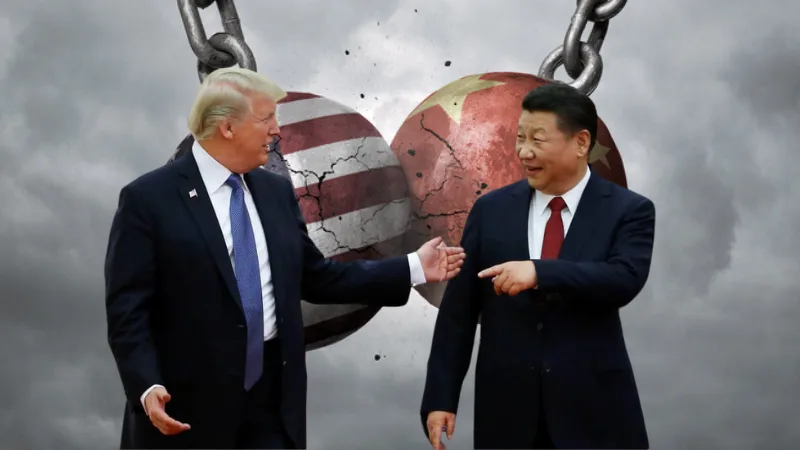
President Donald Trump and Chinese President Xi Jinping are meeting in Washington on Thursday with artificial intelligence, trade and critical minerals expected to be part of the discussions. For investors, one of the most important questions sits several layers below Nvidia and the other headline AI names: who supplies the physical infrastructure required to keep the AI buildout moving?
That includes optical networking equipment, batteries, inverters and power systems. Washington has already begun tightening restrictions around several of those markets, potentially redirecting billions of dollars in future infrastructure spending toward U.S. and allied suppliers. The companies worth watching now are the ones positioned where AI spending, domestic manufacturing and U.S.-China policy intersect.
The AI Boom Is Becoming a Supply-Chain Story
Xi’s September 24 meeting with Trump comes as Washington and Beijing continue negotiating over AI, tariffs, advanced technology and access to critical minerals. Treasury Secretary Scott Bessent and Chinese Vice Premier He Lifeng have already held discussions ahead of the summit that included AI and rare earths.
Those rare earths matter because they feed into electronics, energy systems, defense equipment and other technologies supporting the AI infrastructure boom. At the same time, the United States has been moving to reduce its reliance on Chinese technology in strategically important parts of the supply chain.
The White House took a major step on August 26 when Trump declared a national emergency involving foreign-produced equipment used in the U.S. bulk-power system. The order specifically covers transformers, grid-connected inverters, battery energy storage systems and uninterruptible power supplies supporting critical infrastructure. The FCC has also added certain foreign-produced power inverters to its Covered List following national-security determinations.
Optical networking equipment could eventually become another target. Reuters reported in August that the administration was considering restrictions on imports of new Chinese optical transceivers used inside data centers. No final rule has been announced, so investors should treat that as a developing policy risk rather than a completed ban.
Taken together, however, the direction is becoming clearer. The AI infrastructure race is expanding beyond semiconductors and into the equipment that connects, powers and protects the enormous data centers being built across the country.
The Overlooked Bottleneck Inside AI Data Centers
The easiest way to understand the opportunity is to look at what happens after an Nvidia or AMD processor gets installed.
Thousands of processors inside an AI data center need to communicate with one another at enormous speeds. That requires optical networking equipment capable of moving massive amounts of data with extremely low latency. As AI clusters become larger and more complex, the amount of information moving between processors rises with them.
Then there is the power problem. These facilities consume extraordinary amounts of electricity, which has to be generated, converted, stored and delivered reliably enough to keep thousands of expensive processors operating around the clock.
That creates two increasingly important infrastructure categories. The first is connectivity, including optical transceivers, lasers and high-speed networking equipment. The second is power, including battery systems, inverters and grid infrastructure.
Neither category gets the attention that AI chips receive, yet both can become major bottlenecks as data centers grow larger. U.S.-China tensions could make those bottlenecks even more valuable if American companies are forced to replace Chinese suppliers faster than they otherwise would.
Three Optical Stocks Sitting in the Middle
Coherent (COHR)
Coherent has emerged as one of the larger U.S. beneficiaries of surging demand for optical communications. The company expects fiscal first-quarter 2027 revenue of between $2.2 billion and $2.4 billion, reflecting strong demand across its businesses.
The connection to AI is fairly straightforward. More processors create more traffic between machines, which requires faster and more sophisticated optical links. That gives Coherent exposure to an important part of the AI buildout that receives far less attention than GPUs themselves.
There is also a potentially attractive longer-term dynamic here. Even if the cost of computing eventually declines, the volume of data moving between processors could continue rising dramatically. That would keep pressure on hyperscalers to upgrade the networking layer around their AI systems.
Any U.S. restrictions on Chinese optical transceivers could further reshape the competitive landscape. Investors should still wait for an actual rule before assuming a direct benefit, but Coherent is clearly positioned in a market Washington increasingly views as strategically important.
Lumentum (LITE)
Lumentum provides another example of how quickly AI is changing the optical market.
The company reported fiscal fourth-quarter 2026 revenue of $1.01 billion, compared with $480.7 million a year earlier. Management then guided the following quarter to between $1.225 billion and $1.275 billion, showing how rapidly demand has accelerated.
CEO Michael Hurlston has pointed directly to rising AI compute workloads and expanding bandwidth requirements as forces pushing data-center architectures toward more optical connectivity. That relationship is important because it shows why optics could remain a major AI investment theme even if investor attention eventually shifts away from chipmakers.
AI models require more compute. More compute requires increasingly dense clusters of processors. Dense clusters require massive amounts of bandwidth, and that bandwidth increasingly depends on optical technology. Lumentum sits directly inside that chain.
Applied Optoelectronics (AAOI)
Applied Optoelectronics offers a somewhat different angle because it is aggressively expanding U.S. manufacturing capacity at the same time Washington is trying to reduce dependence on foreign suppliers.
The Texas-based company announced plans this year to expand its Houston-area manufacturing footprint to roughly 900,000 square feet. Management says the expansion could eventually support production of as many as 700,000 800G and 1.6T transceivers per month in the Houston area while increasing laser fabrication capacity by roughly 350% by the end of 2027.
AOI has also received large orders from hyperscale customers and says demand for its high-speed transceivers is exceeding current capacity.
That domestic manufacturing footprint could become increasingly valuable if Washington continues pushing AI infrastructure supply chains toward U.S. production. The risk is execution. Building factories, installing equipment and producing sophisticated optical components at high yields is considerably harder than announcing future capacity.
For AOI, the opportunity is large, but investors will need to watch whether the manufacturing ramp keeps pace with demand.
The Next AI Bottleneck Could Be Electricity
Optics solve the communications problem. Power solves another one that may ultimately prove even larger.
Data-center electricity requirements have become so substantial that power infrastructure is increasingly part of the AI investment thesis. The August 26 executive order explicitly identifies AI and data centers as factors increasing America’s dependence on reliable electricity infrastructure.
That brings an entirely different group of companies into the AI conversation.
Nextpower (NXT)
Nextpower has been moving aggressively beyond its traditional solar-tracking business. The company acquired Prevalon Energy in July, giving it direct exposure to large-scale battery energy storage systems. It also acquired power-conversion assets from Zigor and Apex Power, expanding its presence in inverter technology.
That combination matters because AI data centers increasingly need integrated power infrastructure rather than one isolated piece of equipment. Developers may need storage, conversion equipment, generation and grid-management technology working together to keep massive computing campuses operating reliably.
Prevalon entered the acquisition with more than 6 GWh of battery systems deployed globally and 1.3 GW of firm supply contracts tied to AI and hyperscaler data-center infrastructure, according to Nextpower. The company also recently reported a backlog exceeding $5.5 billion.
If U.S. policy continues encouraging domestic or trusted suppliers of inverters, storage and grid equipment, Nextpower has positioned itself inside several of the markets likely to benefit from that shift.
Fluence Energy (FLNC)
Fluence shows why a powerful industry tailwind does not automatically produce an easy investment story.
The energy-storage company has meaningful exposure to the same power constraints driving data-center investment, and management says customer demand remains strong. Yet Fluence recently cut its fiscal 2026 revenue expectation to approximately $2.4 billion, down from a previous midpoint near $3 billion, largely because of supply-chain and manufacturing problems at its U.S. production operations.
The company now expects an adjusted EBITDA loss of approximately $200 million.
That makes Fluence particularly interesting to watch because the broader market opportunity may be improving while the company’s own execution remains difficult. The distinction matters. A favorable policy environment can create demand, but companies still have to manufacture equipment, deliver projects and protect margins.
Fluence is a reminder that investors should separate the strength of the theme from the strength of the individual business.
A Simple Way to Evaluate the AI Infrastructure Trade
Investors following this theme can boil the story down to three questions: Is demand real? Is supply expanding? Is government policy accelerating the shift?
The first question can usually be answered by looking at orders, backlog and revenue instead of company announcements about potential AI exposure. Lumentum’s rapidly rising revenue, AOI’s hyperscaler orders and Nextpower’s large backlog all provide measurable evidence that spending is already occurring.
The second question is capacity. Domestic manufacturing only becomes strategically valuable if companies can actually produce enough equipment to satisfy customers. AOI is building additional optical capacity, while Nextpower is expanding its inverter and storage capabilities. Fluence offers the cautionary example of what can happen when production ramps fail to go according to plan.
The third question is policy. Restrictions on foreign grid equipment, inverters or optical products could accelerate purchasing decisions by U.S. data-center developers and utilities. The larger the regulatory push, the stronger the incentive becomes to secure domestic or allied suppliers before shortages develop.
Together, those three factors form a useful Demand, Capacity, Policy framework. When all three move in the same direction, the investment story becomes considerably more compelling.
There Is a Catch to America’s AI Supply-Chain Push
The obvious assumption is that restrictions on Chinese suppliers automatically help American manufacturers. The reality is more complicated.
Chinese companies hold major positions across several technology supply chains because they often provide enormous manufacturing capacity at competitive prices. Removing those suppliers faster than U.S. alternatives can scale could increase costs, lengthen delivery times and slow data-center construction.
That means the same policy that creates an opportunity for a domestic equipment manufacturer could also create headaches for the hyperscaler trying to build a multibillion-dollar AI campus.
Capacity therefore becomes critical. Companies with functioning factories and available production could benefit quickly from supply-chain restrictions. Companies still years away from meaningful production may see less immediate upside.
If Washington keeps tightening the rules, existing manufacturing capacity could become almost as important as technological leadership.
The Signals Investors Should Watch
Thursday’s Trump-Xi meeting could provide clues about how aggressively the two countries intend to use technology and critical minerals as negotiating leverage. Rare-earth commitments will be especially important because more dependable Chinese exports could ease pressure across technology, energy and industrial supply chains.
The optical-transceiver question also deserves attention. A formal U.S. restriction would immediately increase scrutiny of domestic suppliers such as Coherent, Lumentum and Applied Optoelectronics. Investors should also watch how the Energy Department implements the August power order, since the details will determine which equipment and suppliers actually face restrictions.
Company execution will matter just as much as policy. AOI’s Texas expansion needs to translate into real production, while Nextpower’s push into power conversion and battery storage needs to generate revenue from the AI data-center market. Fluence, meanwhile, will need to show that its manufacturing problems are improving before investors can fully benefit from the broader storage boom.
Those developments could tell investors more about this trade than any single diplomatic statement from Washington.
About Author