

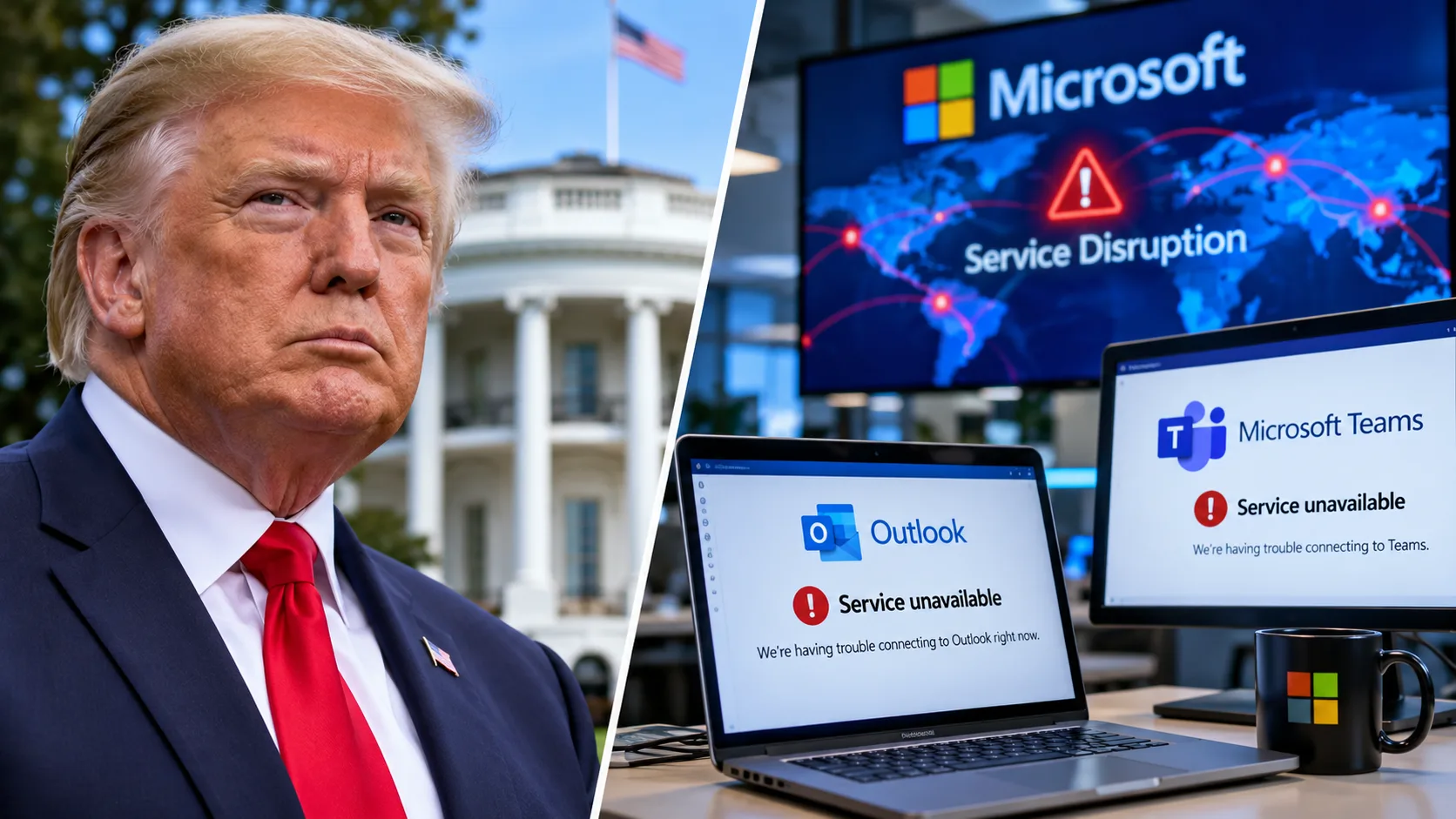
On the same day President Donald Trump’s AI task force met to discuss the growing threat of artificial intelligence-powered cyberattacks, Microsoft suffered a massive global outage that disrupted businesses, government agencies, and critical services across multiple continents.
The timing was remarkable. As administration officials examined how AI could threaten America’s most important infrastructure, one of the world’s largest technology companies was struggling to keep its own systems operating.
Microsoft says it has found no evidence that the disruption was caused by a cyberattack. However, the simultaneous events have exposed a much bigger concern: How vulnerable has the global economy become to failures within a handful of technology companies?
Two Major Events Unfold on the Same Day
On Thursday, November 12, members of President Trump’s artificial intelligence task force met to discuss the growing threat of AI-powered cyberattacks against critical American infrastructure.
According to Reuters, the meeting focused on encouraging companies in sectors such as banking, energy, and emergency services to report cybersecurity incidents and vulnerabilities.
Officials also discussed establishing national standards for AI developers to disclose safety incidents and share cybersecurity information.
The administration is increasingly concerned about autonomous AI agents, systems capable of performing complex tasks with limited human supervision, potentially conducting cyberattacks without direct human authorization.
Meanwhile, Microsoft was experiencing one of its most disruptive service outages in recent memory.
Problems began emerging Thursday morning, affecting Microsoft 365 services including Outlook, Teams, Exchange Online, SharePoint, and Copilot.
By early afternoon, outage-tracking website Downdetector was recording more than 100,000 reports of Outlook problems in the United States.
The disruption quickly became an international problem, affecting users across North America, Europe, Asia, and Australia.
For millions of workers who depend on Microsoft products for daily operations, the outage brought ordinary business activities to a halt.
Government Agencies and Critical Services Were Affected
The disruption extended far beyond employees being unable to check their email.
Government agencies, healthcare organizations, airlines, and businesses reported problems communicating and accessing essential services.
In Britain, police reported difficulties receiving online crime reports, while healthcare officials warned of possible prescription delays.
Government operations in several countries, including Japan and Singapore, also experienced disruptions.
Airlines encountered problems with customer-support email systems, although affected carriers said flight operations continued.
The outage also affected integrations used by artificial intelligence companies, including OpenAI and Anthropic.
The widespread problems demonstrated how deeply Microsoft’s cloud infrastructure has become embedded in the global economy.
A failure affecting a relatively small number of critical systems can create disruptions across thousands of organizations that have no direct control over the underlying technology.
Was Microsoft the Victim of a Cyberattack?
The coincidence immediately raises an obvious question.
Could Microsoft’s outage have been connected to the very cybersecurity threats Trump’s task force was discussing?
As of Friday morning, November 13, there is no verified evidence connecting the two events.
Microsoft executive Charles Lamanna publicly stated that the company had found no indication of malicious or cyber activity.
Instead, Microsoft’s technical updates identified infrastructure problems involving servers unexpectedly becoming unavailable.
According to the company, some servers failed automated health checks and dropped offline. That placed additional pressure on the remaining infrastructure, contributing to connectivity problems across multiple regions.
Microsoft attempted several recovery measures, including adjusting network configurations, redistributing traffic, and restarting affected systems.
Some recovery efforts initially failed to produce sustained improvements.
By early Friday, Microsoft was reporting partial recovery, although normal service had not been fully restored across all affected systems.
The precise root cause remained under investigation.
While the timing of the task force meeting and Microsoft’s problems is unusual, there is currently no indication that the administration’s meeting was prompted by the outage or that the two developments were otherwise connected.
The Bigger Problem: America’s Growing Dependence on a Few Technology Companies
The more consequential story may be what Thursday’s disruption revealed about the structure of the modern economy.
Microsoft, Amazon, and Google provide much of the cloud infrastructure supporting corporate America.
Their systems handle everything from business communications and financial transactions to healthcare operations, government services, and increasingly, artificial intelligence applications.
This concentration creates enormous efficiencies.
Companies no longer need to build and maintain every piece of technology infrastructure themselves. Instead, they can purchase sophisticated computing, storage, communication, and AI services from a handful of providers.
But the arrangement introduces a significant risk.
When a major provider experiences technical problems, disruptions can cascade through thousands of dependent organizations.
Thursday’s Microsoft outage illustrated how quickly that dependency can become a liability.
And the potential consequences could become considerably more serious as AI systems take on greater responsibility for automated decision-making.
Why This Matters for Microsoft and Technology Investors
Microsoft Faces Questions About Reliability
For Microsoft (NASDAQ: MSFT), reliability is a critical part of its competitive position.
The company has invested heavily in cloud computing and artificial intelligence, with Azure, Microsoft 365, and Copilot playing important roles in its long-term growth strategy.
Enterprise customers pay for these services with the expectation that they will remain available when needed.
A major disruption can create operational costs for customers, damage confidence, and encourage businesses to reconsider how dependent they should become on a single provider.
One outage is unlikely to fundamentally change Microsoft’s competitive position. Repeated disruptions, however, could increase pressure on the company to invest more heavily in redundancy, infrastructure resilience, and customer protections.
Investors should pay particular attention to whether the incident results in material service-credit obligations, additional infrastructure spending, or changes in customer demand.
Cybersecurity Companies Could See Greater Demand
The task force meeting highlights another potential investment implication.
As artificial intelligence becomes more capable, companies are facing a wider range of potential cybersecurity threats.
AI could allow attackers to automate vulnerability discovery, develop sophisticated phishing operations, and coordinate attacks at speeds that exceed traditional defensive processes.
That prospect is increasing the importance of cybersecurity providers.
Companies such as Palo Alto Networks (NASDAQ: PANW), CrowdStrike (NASDAQ: CRWD), and Fortinet (NASDAQ: FTNT) operate in markets that could benefit from growing demand for advanced threat detection, automated response, and infrastructure protection.
However, Thursday’s Microsoft disruption also illustrates an important distinction.
Traditional cybersecurity products cannot necessarily prevent failures caused by internal configuration errors, faulty software updates, or infrastructure problems.
Companies may increasingly need to invest in both cybersecurity and operational resilience.
That could expand demand across several technology categories rather than concentrating spending in security software alone.
The AI Infrastructure Business Faces a New Challenge
AI companies are racing to build more powerful systems capable of performing tasks that previously required human involvement.
Those systems depend on data centers, cloud networks, communication platforms, and increasingly complex software integrations.
As AI adoption grows, failures within that underlying infrastructure may have consequences far beyond temporary inconvenience.
An automated customer-service platform that loses connectivity might stop processing requests. An AI-assisted medical workflow could be interrupted. Businesses using AI tools for financial operations could experience delays or errors.
The more responsibilities organizations delegate to AI, the more valuable dependable infrastructure becomes.
For investors, that creates an additional way to evaluate the AI boom: The companies that make advanced AI services more reliable may become increasingly important alongside those developing the AI models themselves.
The Risk Investors May Be Underestimating
There is another side to this story that deserves attention.
The greatest financial threat from advanced technology may sometimes come from ordinary system failures rather than sophisticated hackers.
Companies spend billions protecting networks against external threats. Yet a malfunctioning software component, configuration change, or overloaded server can produce some of the same immediate economic consequences as a cyberattack.
Operations stop. Employees cannot work. Customers experience delays. Government services are disrupted.
The financial damage can begin accumulating regardless of what caused the original problem.
This distinction matters because preventing cyberattacks and maintaining operational resilience require different investments.
Cybersecurity spending focuses heavily on identifying and blocking malicious activity.
Resilience spending focuses on preventing failures from spreading, maintaining backup systems, and restoring services quickly when something goes wrong.
Businesses increasingly need both.
That could create opportunities for companies providing backup infrastructure, disaster recovery, network monitoring, and business-continuity services.
It could also increase operating costs for large cloud providers as customers demand stronger service guarantees.
What Investors Should Watch Next
Several developments could determine whether Thursday’s events have lasting financial implications.
Microsoft’s final explanation: Investors should watch for the company’s official root-cause analysis, including whether the disruption resulted from a software change, infrastructure failure, or another technical problem.
The pace of service restoration: Prolonged outages can increase financial and reputational consequences, particularly among large enterprise and government customers.
New AI cybersecurity standards: Trump’s task force could recommend stronger incident-reporting requirements or voluntary security standards for AI developers and critical infrastructure operators.
Corporate technology spending: Greater concern about infrastructure vulnerabilities could encourage businesses to increase investments in backup systems, cybersecurity tools, and cloud-service diversification.
Microsoft’s upcoming earnings: Management commentary about cloud reliability, service costs, enterprise demand, and AI infrastructure spending could provide clues about the longer-term consequences.
A Warning About the Future of AI
Thursday’s two developments may ultimately prove to be unrelated.
Microsoft has found no evidence of a cyberattack, and the administration’s AI task force was addressing cybersecurity concerns that existed well before the outage.
But the timing highlighted a significant vulnerability.
As the United States accelerates AI adoption, increasingly important economic activities are becoming dependent on interconnected technology systems operated by a relatively small number of companies.
A technical malfunction at one of those providers can now affect businesses and government services around the world.
For investors, the message is straightforward.
The next major opportunity in artificial intelligence may extend beyond companies building smarter systems to those making the systems businesses already depend on more secure, reliable, and resilient.
Thursday’s events offered a timely reminder of why that matters.
About Author