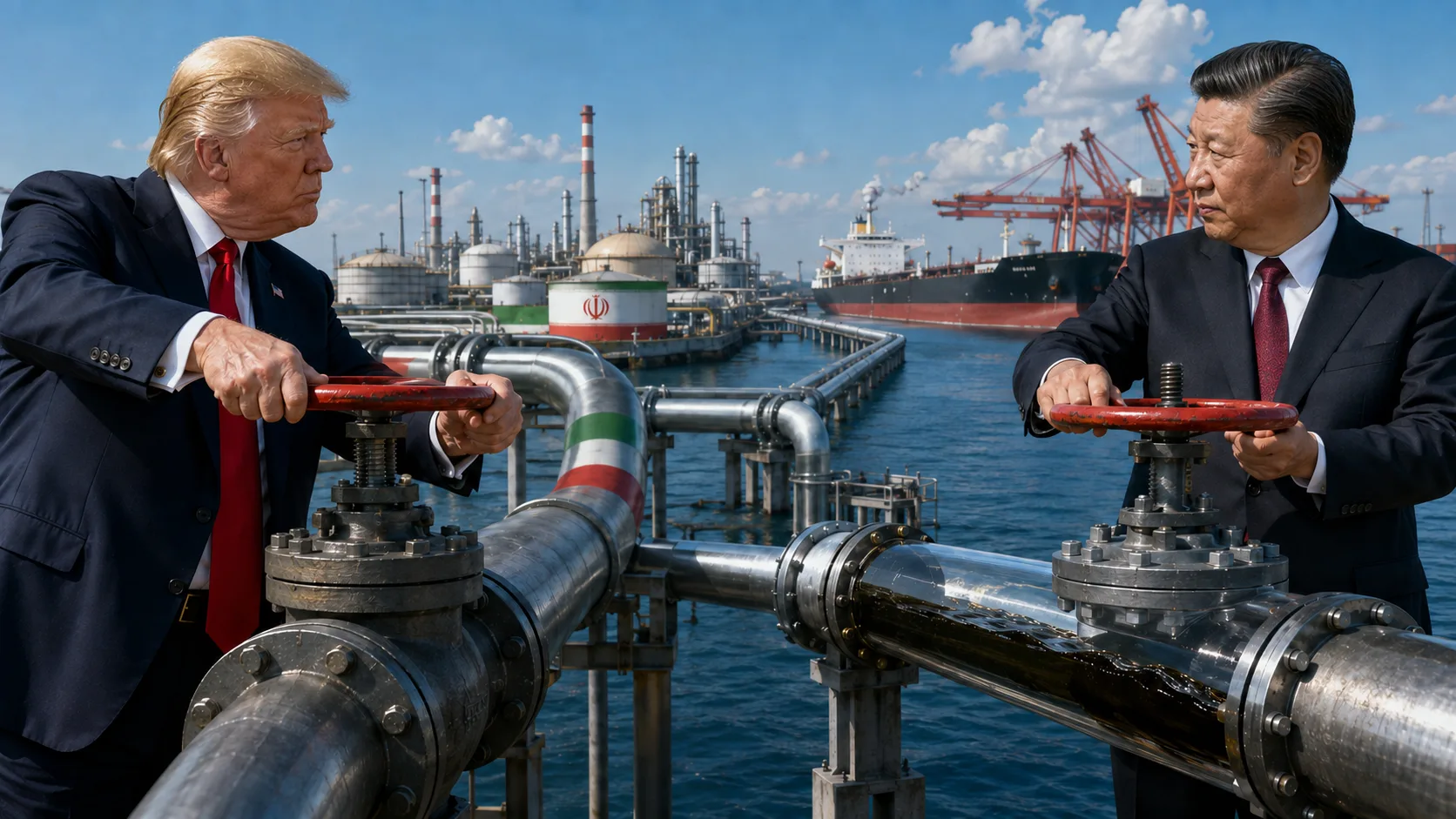
The United States has launched an aggressive campaign to isolate Iran and choke off its remaining sources of revenue. Yet Washington has stopped short of confronting the Chinese banks, refiners and companies that keep Iran’s most important economic lifeline open.
Washington Launches Operation Economic Outcast
Treasury Secretary Scott Bessent unveiled “Operation Economic Outcast” on Monday, describing it as an unprecedented effort to sever the financial connections sustaining Iran’s government and military.
The Treasury Department sanctioned nearly 60 companies, individuals and vessels accused of helping Iran sell oil, acquire nuclear and missile technology, conduct cyber operations and move money through international markets.
Washington also expanded its authority to penalize foreign companies operating in five Iranian sectors:
- Digital assets
- Technology
- Gold
- Aviation
- Shipping
The new designations extend a pressure campaign that has already placed more than 1,000 sanctions on Iran since President Donald Trump returned to office.
The United States has also combined financial pressure with military operations and a blockade of Iranian ports. Those measures have restricted Iran’s oil exports, damaged its economy and contributed to a collapse in the value of the Iranian rial.
Bessent said the objective is to cut “every economic lifeline” supporting Iran until the country faces near-total isolation.
That is an extraordinarily ambitious goal. Achieving it, however, would require Washington to address the country responsible for buying most of Iran’s oil: China.
The China Problem Washington Has Yet to Solve
U.S. officials estimate that China purchases more than 80% of Iran’s oil exports.
That trade provides Tehran with revenue needed to fund its government, support military operations and obtain foreign goods. China has also helped create a parallel financial system that allows Iran to conduct trade outside the U.S. dollar.
This system includes front companies, currency exchanges, Chinese banks, informal payment networks and oil shipments routed through multiple jurisdictions.
Iranian crude is frequently moved through ship-to-ship transfers. Oil can be transferred from sanctioned tankers to vessels that have yet to be blacklisted, making the cargo’s origin more difficult to trace before it reaches China.
Despite the U.S. blockade, China imported more than 500,000 barrels of Iranian oil per day during August, according to shipping data cited by The Wall Street Journal.
The Treasury Department targeted several Chinese and Hong Kong-based companies in its latest action. It also sanctioned a China-owned tanker accused of transporting millions of barrels of Iranian oil this year.
The administration avoided placing major Chinese banks or nationally important refiners on its sanctions list.
That distinction matters.
Small trading firms and tankers can be replaced. A large bank’s access to the dollar-based financial system is far more difficult to replace. Sanctioning a major Chinese institution could force Beijing to choose between supporting Iran and maintaining access to Western markets.
Washington has so far declined to force that decision.
Why China Changes the Entire Sanctions Equation
Economic sanctions work best when the targeted country cannot easily find another buyer, payment system or transportation network.
Iran has all three.
China provides demand for Iranian oil. Chinese currency and financial channels provide alternatives to the dollar. A constantly changing network of tankers, brokers and shell companies helps move the crude.
This has turned enforcement into a costly game of financial whack-a-mole. The United States sanctions one intermediary, only for another company or vessel to take its place.
The latest campaign expands Washington’s ability to target these facilitators, but legal authority alone does not guarantee economic pressure. The real test is whether the administration uses that authority against institutions large enough to change China’s behavior.
Treasury appears to be giving Beijing an opportunity to reduce its involvement voluntarily before escalating.
That may be a deliberate strategy. Trump has made improving relations with China a priority following last year’s tariff confrontation. He met Chinese President Xi Jinping in Beijing in May, and Xi is expected to visit Washington next month.
Sanctioning a major Chinese bank immediately before that summit could derail broader negotiations involving trade, technology and access to rare earth minerals.
The Investor Impact Runs Through Oil
Iranian Supply Could Tighten Quickly
China’s continued purchases have helped keep Iranian oil flowing into the global market. If Washington successfully pressures Chinese refiners or banks to retreat, hundreds of thousands of barrels per day could become more difficult to sell.
A meaningful reduction in Iranian exports could support crude prices, especially if other producers are unwilling or unable to replace the missing supply.
The size and speed of that effect would depend on several factors, including available OPEC capacity, global demand and whether Iranian exporters can find alternative buyers.
Energy investors should pay closer attention to Iranian export volumes than to the number of companies appearing on each sanctions list. Oil flows measure the campaign’s actual effectiveness.
Refiners Face a Difficult Choice
Chinese refiners benefit from access to discounted Iranian crude. Buying sanctioned oil can improve margins, particularly for smaller independent refiners with limited exposure to the United States.
That calculation changes if Washington targets the banks financing those purchases or the ports receiving the oil.
Large refiners with international business relationships have more to lose from secondary sanctions. Smaller companies may continue accepting the risk, although their ability to absorb Iran’s total export volume is limited.
The market signal to watch is whether Iranian crude begins trading at a larger discount. A widening discount would suggest that buyers are demanding greater compensation for sanctions risk.
Tanker Markets Could Become More Volatile
Iran relies heavily on older tankers, opaque ownership structures and frequent vessel transfers to move its oil.
More aggressive enforcement could raise transportation costs, increase insurance risks and remove vessels from legal international trade. That could tighten available tanker capacity in certain regions and create opportunities for compliant shipping operators.
The reverse is also possible. If enforcement remains concentrated on replaceable shell companies and individual vessels, Iran’s shadow fleet may continue adapting with limited disruption to global supply.
Gold and Crypto Move Deeper Into the Sanctions Fight
Treasury’s inclusion of gold and digital assets shows how Iran’s financial system is evolving.
Gold can preserve value when a currency is falling and provide a means of settling transactions outside conventional banking channels. Cryptocurrency can move across borders without relying on a traditional correspondent bank.
The expanded sanctions authority increases compliance risks for exchanges, payment platforms, bullion dealers and financial intermediaries that may unknowingly process Iran-linked transactions.
For investors, this introduces another source of regulatory volatility across crypto markets and international gold trading. Enforcement actions against a major exchange or payment network could have consequences far beyond Iran.
The Restraint May Be Strategic
The obvious conclusion is that Washington’s campaign lacks credibility because it spared China’s largest institutions.
There is another possibility.
The administration may be using the threat of secondary sanctions as leverage ahead of Xi’s expected visit to Washington. Quiet Chinese cooperation could reduce Iran’s oil revenue without triggering a public confrontation between the world’s two largest economies.
Companies sometimes change behavior before sanctions are formally imposed, especially when they depend on access to dollars, U.S. technology or Western customers.
This approach could allow China to reduce Iranian purchases gradually while avoiding the appearance that Beijing surrendered to American pressure.
The risk is that China interprets Washington’s restraint as evidence that the threat will never be enforced. Beijing has already demonstrated its willingness to retaliate through rare earth export restrictions and other trade measures.
A threat that remains unused for too long eventually loses its power.
The Signals That Matter Now
Investors should watch five developments closely:
- Iranian oil exports: A sustained drop would show that the campaign is affecting real revenue rather than adding names to a sanctions database.
- Chinese refinery behavior: Reduced purchases or larger discounts for Iranian crude would indicate growing concern about U.S. enforcement.
- Action against a major bank: Sanctions targeting a prominent Chinese financial institution would mark a dramatic escalation.
- The Trump-Xi summit: Any agreement involving Iranian oil could determine whether pressure increases quietly or erupts into a broader U.S.-China confrontation.
- Chinese retaliation: Restrictions on rare earths, technology inputs or U.S. companies could push the consequences into manufacturing, defense, automobiles and consumer electronics.
The Real Test Is Still Ahead
Operation Economic Outcast gives Washington broader tools to target Iran’s oil sales, financial networks and access to critical technology.
Its effectiveness will be determined in China.
As long as Beijing continues purchasing Iranian oil and providing alternative financial channels, Tehran retains an economic escape route. Sanctioning small companies and tankers can raise costs, but it may struggle to produce the regime-threatening pressure promised by the administration.
The moment Washington confronts a major Chinese bank, refinery or state-connected company, markets will know the campaign has entered a more dangerous phase.
Until then, America’s economic offensive against Iran remains powerful in scope, aggressive in language and constrained by the risk of a much larger confrontation with China.
About Author