A Fragile Thaw Begins in Switzerland
This week, the world’s two largest economies are finally sitting down at the negotiating table—again.
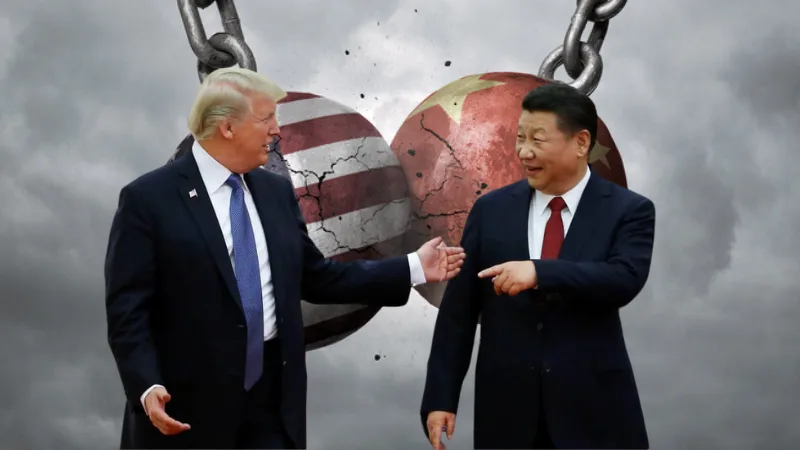
For the first time since President Trump’s sweeping “Liberation Day” tariffs earlier this year, senior U.S. and Chinese officials are meeting in Geneva for formal trade talks aimed at de-escalating a growing economic conflict that has rattled markets, disrupted global supply chains, and strained investor confidence.
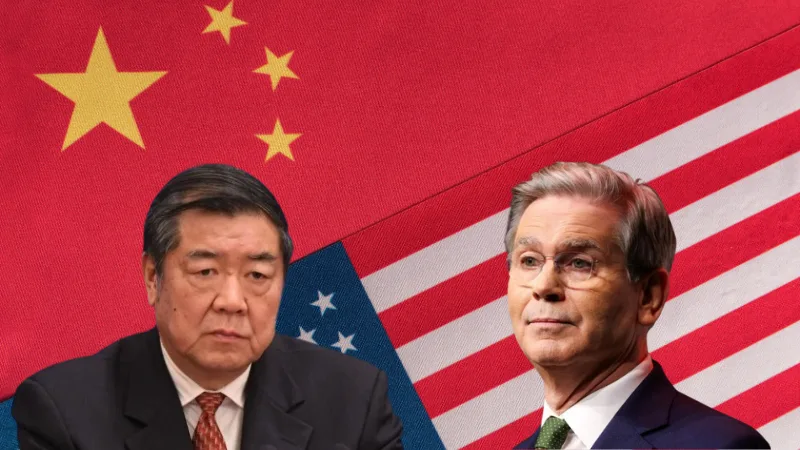
The U.S. delegation includes Treasury Secretary Scott Bessent and Trade Representative Jamieson Greer, while China is sending Vice Premier He Lifeng, one of President Xi Jinping’s top economic strategists. Though both sides have downplayed expectations for a breakthrough deal, the simple fact that talks are happening marks a significant shift in tone after months of silence and rising tension.
Markets responded immediately: U.S. and Asian stock futures ticked higher, Hong Kong’s Hang Seng jumped over 2%, and Chinese blue-chip stocks saw a modest gain. With Beijing also announcing stimulus measures—including interest rate cuts and increased liquidity—investors are watching closely.
But the real question is: What does this mean for your portfolio?
From Tariffs to Talks
The backdrop to these talks is anything but calm. In recent months:
- The U.S. levied tariffs of up to 145% on key Chinese imports, including semiconductors, EVs, and solar technology.
- China hit back with retaliatory tariffs of up to 125%, targeting American agriculture, manufacturing goods, and consumer products.
- China’s April factory activity fell to its lowest level since 2023, signaling deeper cracks in the world’s second-largest economy.
- The U.S. economy posted a modest 0.3% contraction in Q1, while American exporters faced rising input costs.
Both sides are under pressure. And while President Trump framed the tariffs as a necessary economic “reset,” Treasury Secretary Bessent recently admitted that the status quo is “unsustainable,” likening it to an “embargo.”
Investor’s Guide: 13 Key Questions Answered
To help investors cut through the noise, here are 13 essential questions—and straight answers—about what’s really at stake in the U.S.-China trade talks and what it means for the markets.
1. What industries stand to gain or lose the most if the talks lead to even partial tariff reductions?
Winners: Semiconductors, agriculture, luxury goods, and U.S.-based consumer tech firms (e.g., Apple, Tesla) could benefit from reduced trade friction.
Losers: Domestic protectionist industries like steel and aluminum could lose pricing power if tariff protections are rolled back.
2. How are multinational companies with deep China exposure positioning for potential policy shifts?
Companies like Apple and Tesla are diversifying supply chains—moving production into India, Vietnam, and other markets. Most are delaying China-dependent expansions pending clarity.
3. What does this mean for inflation expectations in the U.S. and global markets?
If tariffs are eased, lower input costs could reduce inflationary pressure in sectors like autos, electronics, and clothing. However, China’s stimulus could drive global demand and inflation back up.
4. How are currency markets reacting, particularly the yuan and U.S. dollar?
The yuan strengthened modestly on trade thaw hopes. The U.S. dollar dipped slightly, signaling a short-term “risk-on” sentiment as traders shifted into equities and emerging markets.
5. How does this fit into President Trump’s broader economic and geopolitical strategy?
It’s a political calculation. Trump wants to maintain a tough stance on China while easing domestic economic pressure before the 2026 midterms. These talks are about optics and leverage—not surrender.
6. Is China using these talks to buy time or to signal concessions ahead of the U.S. election cycle?
Both. Beijing is facing weak growth, capital outflows, and sagging business confidence. Engaging in talks offers political cover and potential economic relief without publicly conceding to U.S. pressure.
7. Could a lack of progress lead to further escalation, such as tech export bans or sanctions?
Absolutely. If talks stall, the U.S. could expand export bans on advanced semiconductors, cloud infrastructure, or AI hardware. China could retaliate by tightening rare earth exports or cracking down on U.S. firms operating in China.
8. Are structural reforms—like IP enforcement or forced tech transfer—on the table?
Not yet. These talks are focused on immediate economic de-escalation. Structural issues are likely to be postponed until a potential summit between Trump and Xi.
9. Will there be any transparency into how negotiations progress?
Unlikely. Both sides will control the narrative, offering vague phrases like “constructive dialogue” and “mutual respect.” Investors should rely on market signals and official leaks for direction.
10. Are third-party nations involved or indirectly impacted?
Yes. Switzerland is hosting, but countries like Japan, the EU, and ASEAN nations will be watching closely. Supply chains across Southeast Asia and global capital flows could shift depending on the outcome.
11. Should investors view this as a short-term bounce or a long-term trend reversal?
This is a short-term bounce until proven otherwise. The structural divide between the U.S. and China remains wide. Any longer-term shift will require concrete policy changes—not just polite meetings.
12. What hedging strategies are institutional investors adopting around trade policy risk?
- Geographic diversification (India, LATAM)
- Sector rotation into domestic-focused equities (e.g., healthcare, utilities)
- Options hedging using volatility ETFs or protective puts on tech/industrials
13. Which ETFs or stocks are the best barometers for sentiment on trade resolution?
Keep your eyes on:
- FXI (iShares China Large-Cap ETF)
- XSD (SPDR S&P Semiconductor ETF)
- Apple (AAPL), Tesla (TSLA), Boeing (BA), and Caterpillar (CAT)
- Nucor (NUE) and U.S. Steel (X) for downside tariff risk
Eyes on Geneva, Hands on Your Portfolio
While the Geneva talks are a positive development, they’re not a magic wand. Structural tensions persist. Both governments remain politically entrenched. Still, the fact that diplomacy is back on the table suggests that cooler heads may yet prevail.
For investors, the path forward is less about betting on a grand deal and more about preparing for incremental headlines, policy shifts, and market volatility. Flexibility, diversification, and sector awareness will be critical in the weeks ahead.
About Author