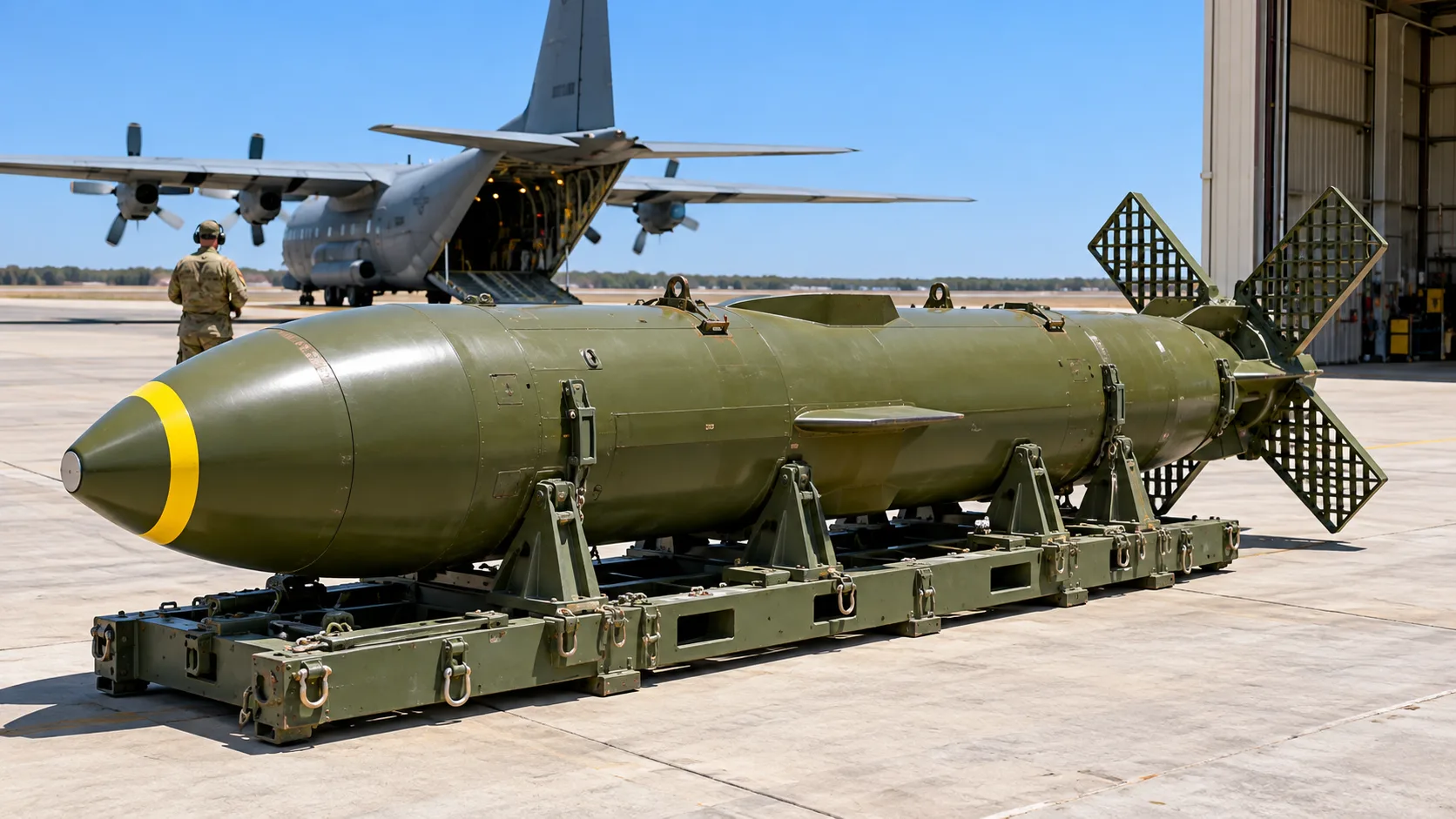
The U.S. military has reportedly developed plans that could include using the “Mother of All Bombs” against Iran. The 21,600-pound weapon could cause enormous destruction, though officials have questioned its ability to destroy deeply buried nuclear facilities.
CNN reported Thursday, October 15, that military planners are considering the GBU-43/B Massive Ordnance Air Blast bomb, commonly called the MOAB, for potential strikes on Iranian energy infrastructure and nuclear sites. Agence France-Presse subsequently reported the findings.
No decision to use the weapon has been reported. The plans would depend on President Donald Trump authorizing additional attacks.
What Is the “Mother of All Bombs”?
The MOAB is a GPS-guided conventional bomb containing approximately 18,700 pounds of explosive. It is delivered from a C-130 transport aircraft and is designed to produce a powerful blast over a wide area, according to the Air Force Armament Museum Foundation.
The United States used the weapon against an Islamic State tunnel complex in Afghanistan on April 13, 2017, during Trump’s first term. U.S. Central Command said that strike targeted fighters and facilities in Afghanistan’s Nangarhar province.
Its possible use against Iran would bring renewed attention to one of the military’s most recognizable weapons. Its effectiveness would depend heavily on the target.
Why Underground Nuclear Sites Present a Problem
The MOAB’s destructive power comes primarily from its enormous blast. That makes it different from weapons specifically designed to penetrate earth and reinforced structures before exploding.
Officials cited in the reporting questioned whether it could destroy Iranian nuclear facilities protected by deep layers of rock. They also raised concerns about civilian casualties from using such a large weapon.
The U.S. military has a separate weapon called the GBU-57 Massive Ordnance Penetrator, or MOP. The Air Force describes that system as designed to reach and destroy weapons held in well-protected facilities. Despite their similar names, the MOAB and MOP serve different purposes.
A large explosion above a facility would not, by itself, establish that equipment or nuclear material deep underground had been destroyed. Assessing the outcome would require verified information about the target and the damage.
Energy Infrastructure Raises Different Risks
The reported inclusion of energy infrastructure is particularly consequential for the economy. Depending on the facilities targeted, additional strikes could disrupt production, processing or distribution.
Iran’s response would also matter. Retaliation affecting commercial shipping or neighboring energy producers could expand the economic damage beyond the original targets. Greater danger to vessels could increase insurance and transportation costs even without a prolonged shutdown.
These are potential consequences, rather than confirmed outcomes of the reported planning. A limited operation followed by de-escalation could have a very different effect from attacks that trigger a broader exchange.
Why Another Escalation Could Hit Household Budgets
The latest report comes as Americans face renewed inflation pressure. Figures released October 14 showed consumer prices increased 3.7% over the past year and 0.6% during September. Prices excluding food and energy rose 2.6% annually.
A sustained increase in energy costs could add pressure to gasoline, transportation and manufacturing expenses. Businesses may absorb some of those costs through lower profits or pass them along to customers.
That would also complicate the Federal Reserve’s decisions. Persistent inflation could strengthen the case for keeping interest rates elevated or raising them further, affecting borrowing costs, bond prices and stock valuations.
Energy producers might benefit from higher oil prices, while airlines and other fuel-intensive businesses could face additional pressure. The effect on individual companies would depend on their operations, hedging arrangements and ability to raise prices.
What Happens Next?
The first development to watch is whether Trump authorizes additional strikes and whether officials confirm the reported options. Military planning alone does not establish that an operation will happen.
If attacks occur, the targets, verified damage and Iranian response would determine the broader consequences. Oil shipments, shipping insurance costs and sustained changes in energy prices would provide clearer evidence of the economic impact than the weapon’s nickname.
The MOAB is powerful, but its capabilities have limits. Whether its use could achieve a military objective, shorten the conflict or provoke further escalation remains uncertain.
About Author