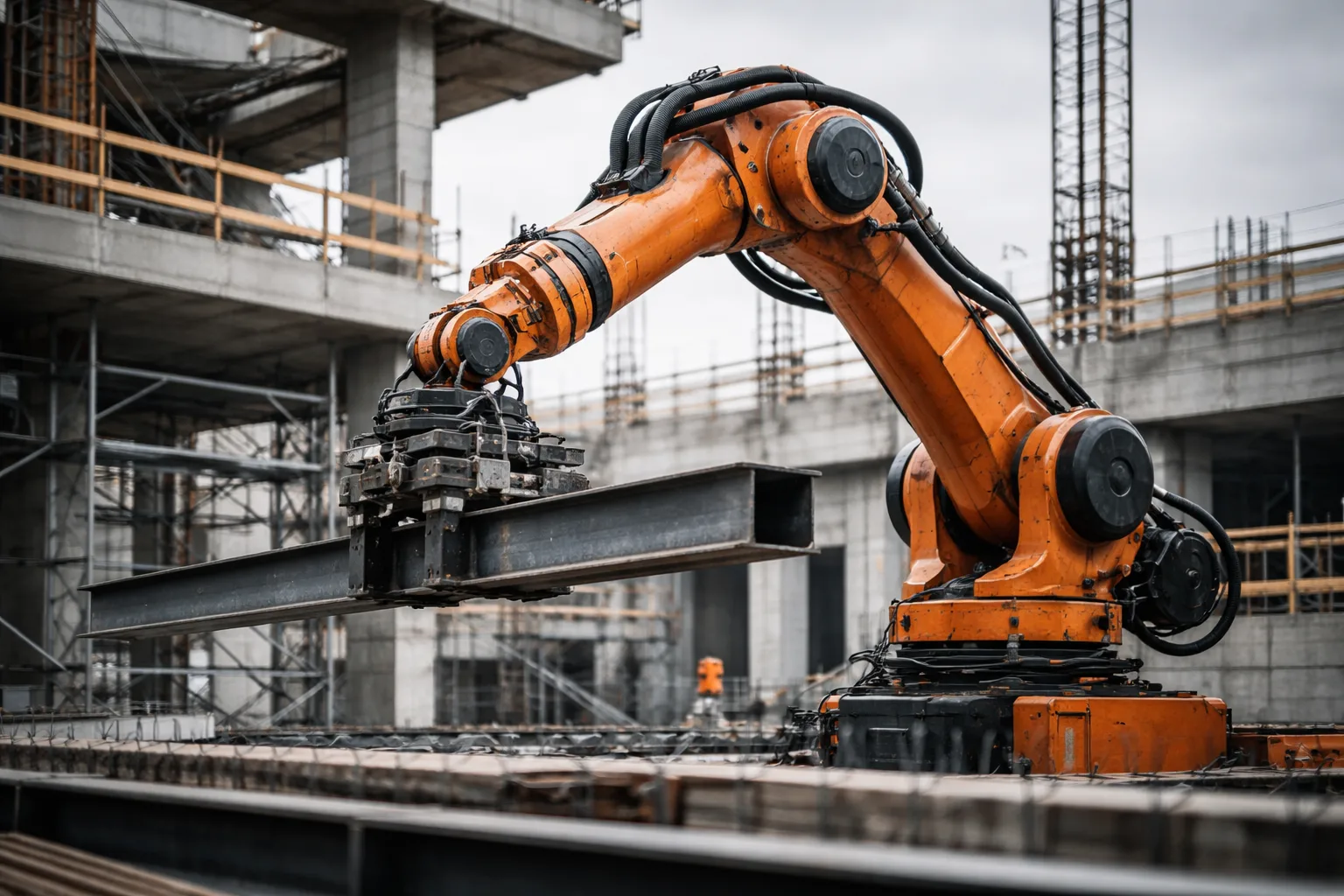
For years, artificial intelligence was viewed primarily as a threat to white-collar professions like programming, marketing, finance, and law. That assumption is starting to crack. A growing wave of investment suggests Wall Street now believes AI’s next major disruption may hit blue-collar work just as hard, and possibly faster than many expect.
Billions of dollars are pouring into startups focused on building AI “brains” for robots capable of operating in the physical world. These systems are designed to handle unpredictable environments like construction sites, factories, oil fields, warehouses, and even kitchens. The implication is straightforward but unsettling. If AI can learn how the real-world works, it can replace human labor far beyond spreadsheets and keyboards.
For investors, this marks a shift in how AI adoption could reshape labor markets, capital spending, and entire industries tied to manual work.
What Makes Physical AI Different from Chatbots
The core challenge in blue-collar automation is not hardware. Robots that can lift, weld, assemble, or move already exist. The bottleneck has always been intelligence. Machines struggle when conditions change, objects move unexpectedly, or tasks require judgment rather than repetition.
That is where the new generation of AI comes in.
These systems are being built to understand physics, spatial relationships, cause and effect, and real-world constraints. The goal is not to script every possible movement, but to give robots flexible reasoning skills so they can adapt on the fly.
Some companies are pursuing humanoid robots, while others focus on task-specific machines. Most researchers now agree the form factor matters less than whether the software can generalize across tasks. If a robot can understand how gravity, force, balance, and materials behave, it could theoretically perform plumbing, electrical work, welding, roofing, vehicle repair, or food preparation.
The popular comparison is to science fiction assistants like C-3PO and R2-D2, minus the personality and humor. The focus is pure function.
Competing Approaches to Teaching Robots the Real World
There is still no consensus on the best way to train AI systems for physical labor. Broadly, two camps have emerged.
One approach relies on massive amounts of real-world data. Big Tech firms and well-funded startups are collecting video, sensor data, and human demonstrations from real environments to train their models. This method is powerful but expensive and slow to scale.
Another approach focuses on simulated environments known as “world models.” These systems are trained on physics-based simulations that teach AI how objects should behave under certain conditions. They rely on mathematical representations of gravity, friction, motion, and material properties rather than constant real-world observation.
This simulation-first philosophy has been championed by Yann LeCun, the former chief AI scientist at Meta, who recently launched a new company called AMI Labs. Proponents argue this method is cheaper, faster, and more scalable, especially when deploying robots across diverse environments.
The Money Is Already Moving
Investor conviction around physical AI is no longer theoretical. The funding numbers are enormous and accelerating.
Toronto-based Waabi recently raised up to $1 billion in financing, making it one of the largest startup funding rounds in Canadian history. While its initial focus is robo-taxis and autonomous trucking, the broader ambition is building general-purpose AI systems that understand real-world driving conditions.
“It’s obvious that the physical AI moment is here,” Waabi founder and CEO Raquel Urtasun told Axios. “Autonomy is the first application where scale is going to happen.”
Pittsburgh-based Skild AI raised roughly $1.4 billion at a reported $14 billion valuation. Its slogan is blunt and ambitious: “Any robot. Any task. One brain.” The company is positioning itself as a universal AI layer that could power machines across industries.
Another fast-rising player, FieldAI, raised nearly $400 million to target what it calls “dirty, dull, or dangerous” work. Energy production, logistics, and large-scale infrastructure projects are early priorities. One of its proposed use cases involves robots helping construct data centers, creating a feedback loop where AI systems help build the infrastructure needed to support more AI.
How Soon Could Blue-Collar Jobs Be Affected?
The timeline remains uncertain. Even if AI-powered robots can outperform humans in controlled settings, real-world deployment comes with high costs. Hardware, maintenance, integration, training, and regulatory hurdles all slow adoption.
For many employers, the economics still favor human labor, at least for now. Switching costs can outweigh productivity gains, especially in small or mid-sized operations. Labor unions, safety standards, and liability concerns also play a role.
That said, the direction of travel is clear. As AI models improve and hardware costs decline, the economic case for automation strengthens. Industries with labor shortages, high injury rates, or extreme working conditions are likely to adopt first.
Autonomous trucking, warehouse automation, mining, energy extraction, and construction support roles are often cited as early candidates.
Why This Matters for Investors
The implications extend far beyond employment statistics.
If AI begins replacing blue-collar labor at scale, companies could see significant margin expansion, especially in industries where labor is the largest cost. At the same time, demand for robotics hardware, AI software platforms, sensors, chips, and energy infrastructure would surge.
There is also risk. Political backlash, regulatory intervention, and social resistance could slow or redirect adoption. Companies that move too fast may face reputational damage or legal challenges.
For investors, the opportunity lies not just in robotics startups, but across the ecosystem. Semiconductor makers, industrial automation firms, cloud providers, energy suppliers, and logistics platforms all stand to benefit if physical AI scales as expected.
The Debate Over Jobs Is Far From Settled
Optimists argue that history shows technology creates more jobs than it destroys. New roles emerge, productivity rises, and economies adapt. In this view, AI will shift workers into higher-value tasks rather than eliminate employment altogether.
Critics counter that AI represents a fundamentally different kind of change. Unlike past technologies, it can replicate both physical and cognitive skills. That raises the possibility that job creation may not keep pace with job displacement, especially for workers without advanced technical skills.
The truth likely lies somewhere in between. What is increasingly clear is that AI’s impact will not be confined to office towers and laptops. The factory floor, the construction site, and the supply chain are now firmly in its sights.
Bottom Line
Investors are no longer betting solely on AI replacing white-collar work. The next phase of artificial intelligence is aimed at the physical world, and the capital flowing into robotics and industrial AI reflects that belief.
Whether this leads to widespread job loss, productivity-driven growth, or a volatile mix of both will depend on how quickly the technology matures and how societies choose to respond. What is certain is that blue-collar automation is moving from science fiction to a serious investment thesis, and the implications will ripple across markets for years to come.
About Author