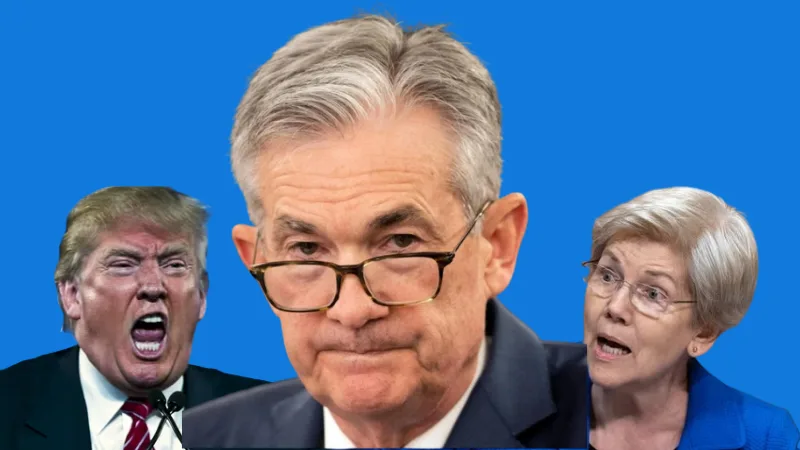
Warren Blames Trump for Powell’s Delay on Rate Cuts — Is There Any Truth to It?
On June 26, 2025, Senator Elizabeth Warren reignited political tensions around monetary policy by publicly blaming President Donald Trump for the Federal Reserve’s recent decision to keep interest rates elevated. In a television interview, Warren said she had long pushed for rate cuts to ease financial pressure on families, but claimed Fed Chair Jerome Powell told her privately that he would have lowered rates in February—if not for what he described as “Trump chaos” changing the economic outlook.
This fiery accusation immediately drew headlines, raising the question: is there any real economic basis for Warren’s blame? Or is this just another episode in the never-ending blame game between political leaders and the central bank?
Let’s unpack what was said, what the data shows, and what it all means for investors trying to navigate interest rate uncertainty in the second half of 2025.
What Warren Said—and Why It Matters
During the interview, Senator Warren stated:
“I want to see the interest rates come down… because those high interest rates are keeping costs up for families… For three years now I’ve been pushing to try to get those interest rates down. And Powell now says, ‘I would have lowered them in February, but the Trump chaos has now changed the economic outlook.’”
This comment is notable for two reasons:
It implies that Powell’s rate decision is being shaped by political developments, not just economic data.
It frames President Trump’s policies as destabilizing to markets—at a time when inflation appears stubborn and the Fed remains cautious.
What Did Powell Actually Say?
As of this writing, Federal Reserve Chair Jerome Powell has not publicly confirmed Warren’s account or directly blamed President Trump for delaying rate cuts. In recent press conferences, Powell has emphasized the Fed’s data-dependent approach. In his June 2025 remarks, Powell stated:
“While inflation has moderated compared to its 2022 peaks, recent indicators suggest that progress has stalled. We are closely monitoring economic conditions before making any adjustments to the federal funds rate.” — Federal Reserve, June 2025 FOMC Press Conference
However, behind the scenes, several reports have surfaced hinting at rising unease inside the Fed about the Trump administration’s early policy moves. Sources cited in Bloomberg and Politico have described “Washington-driven volatility” and “fiscal unpredictability” as contributing to the Fed’s hesitancy.
Whether Powell said exactly what Warren claims remains unconfirmed—but it’s not outlandish based on available information.
What “Trump Chaos” Is She Referring To?
Since re-entering the White House in January 2025, President Trump has moved aggressively on multiple fronts:
Tariff Expansion: Trump announced 100% tariffs on Chinese electric vehicles, higher duties on foreign steel and solar panels, and a broader reshaping of trade policy under “America First 2.0.”
Massive Fiscal Proposals: His administration introduced a sweeping infrastructure bill with limited offsets, proposed new tax cuts, and began discussions to repeal large sections of the Inflation Reduction Act.
Regulatory Overhauls: Major deregulation efforts have begun across energy, finance, and environmental sectors—reigniting legal uncertainty in several industries.
Foreign Policy Shocks: The Trump administration has floated potential withdrawal from NATO’s Article 5 commitments and announced the end of several multilateral trade agreements.
These moves, while popular among some pro-growth advocates, have contributed to rising inflation expectations, market volatility, and uncertainty around the U.S. fiscal trajectory—key inputs into the Fed’s decision-making process.
Did the Economic Outlook Really Shift?
Yes. There is evidence that the Fed’s internal data showed a shift in early 2025. According to the Federal Reserve’s own Summary of Economic Projections from March:
Core PCE inflation ticked up to 3.1% (from 2.8% projected in December).
GDP growth estimates increased, driven by stronger-than-expected consumer spending and anticipated fiscal stimulus.
Labor market strength remained elevated, with unemployment at 3.6%—below the Fed’s neutral threshold.
In plain terms: the Fed expected to start cutting rates, but the economy ran hotter than expected. A combination of Trump-era policies, continued consumer resilience, and rising commodity prices likely pushed the Fed to hold steady.
So yes—the economic outlook did change, and the timing aligns with President Trump’s return.
So, Is Warren Right?
Partially. There’s no smoking gun that proves Powell personally blames Trump for his decision. However, the timing, data, and Fed commentary suggest that Trump’s early policy moves did influence the central bank’s cautious approach.
Still, attributing the entire delay in rate cuts to “Trump chaos” is political oversimplification. The Fed responds to inflation, employment, and financial stability. Trump’s actions were one input—but not the only one.
Here’s what’s actually happening:
Inflation expectations have risen due to tariffs and anticipated fiscal stimulus.
Global markets are responding to more aggressive U.S. trade and spending plans.
The Fed is being cautious not to repeat the 1970s mistake of cutting too early and reigniting inflation.
Warren’s framing is political. The data supports some of her argument—but not all of it.
What This Means for Investors
The implications for markets are real. If you’re trying to interpret how rate policy may evolve in 2025, here’s what to watch:
1. Tariffs as Inflation Drivers
Investors need to pay close attention to President Trump’s trade war reboot. Tariffs on Chinese EVs, European steel, and electronics are inflationary by nature. If these persist—or expand—it could delay rate cuts into late 2025 or even early 2026.
2. Bond Market Signals
The 10-year Treasury yield jumped from 3.9% in January to over 4.7% by June 2025, reflecting investor expectations that rates will stay higher for longer. This creates both risk and opportunity in fixed income—especially short-duration and inflation-protected securities.
3. Equities: Watch Rate-Sensitive Sectors
Tech and small-cap stocks, which are sensitive to rate expectations, may remain volatile.
Banks and financials tend to benefit from higher-for-longer scenarios.
REITs and dividend payers could face headwinds unless the Fed pivots soon.
4. Political Risk as a Market Force
Investors should prepare for an election-year premium on volatility. With Trump in office and Democrats pushing back aggressively, expect frequent fiscal and policy shocks to ripple through markets. Hedging strategies—via volatility ETFs or sector rotation—might be prudent.
Final Word
Senator Elizabeth Warren’s claim that President Trump is to blame for Jerome Powell holding off on rate cuts contains a kernel of truth wrapped in political theater. Trump’s early moves did shift the economic outlook—but the Fed remains, at least in public, data-driven and politically independent.
For investors, the key takeaway is clear: forget the finger-pointing and focus on the fundamentals. Inflation trends, employment data, and geopolitical shifts will dictate where rates go from here.
To provide the best experiences, we use technologies like cookies to store and/or access device information. Consenting to these technologies will allow us to process data such as browsing behavior or unique IDs on this site. Not consenting or withdrawing consent, may adversely affect certain features and functions.
Functional
Always active
The technical storage or access is strictly necessary for the legitimate purpose of enabling the use of a specific service explicitly requested by the subscriber or user, or for the sole purpose of carrying out the transmission of a communication over an electronic communications network.
Preferences
The technical storage or access is necessary for the legitimate purpose of storing preferences that are not requested by the subscriber or user.
Statistics
The technical storage or access that is used exclusively for statistical purposes.The technical storage or access that is used exclusively for anonymous statistical purposes. Without a subpoena, voluntary compliance on the part of your Internet Service Provider, or additional records from a third party, information stored or retrieved for this purpose alone cannot usually be used to identify you.
Marketing
The technical storage or access is required to create user profiles to send advertising, or to track the user on a website or across several websites for similar marketing purposes.