Since its blockbuster IPO, shares of Elon Musk’s aerospace giant have surged, adding hundreds of billions of dollars in market value and fueling a wave of investor excitement. With OpenAI, Anthropic, and other AI leaders also expected to go public in the coming months, many investors are wondering whether they’re witnessing the birth of the next generation of market titans.
For some investors, the biggest concern is missing out.
For others, it’s whether these high-flying tech stocks have become too expensive.
But there is another reality many investors haven’t considered: you may soon own SpaceX whether you buy the stock or not.
SpaceX’s Rise Is Reshaping the Market
SpaceX has become one of the most valuable companies in the world thanks to its leadership in commercial space launches, satellite communications, defense contracts, and emerging AI-related technologies.
The company’s public debut immediately placed it among the largest publicly traded firms, drawing comparisons to the early growth stories of Amazon, Tesla, and Nvidia.
While many investors remain focused on the stock’s massive rally, Wall Street is paying attention to something else: index inclusion.
That’s because major indexes often serve as the backbone of retirement accounts, pension funds, and exchange-traded funds owned by millions of Americans.
And SpaceX appears to be on a path toward joining them.
Why SpaceX Could Soon Be in Your 401(k)
Many investors assume they only own stocks they intentionally purchase.
That’s not how index investing works.
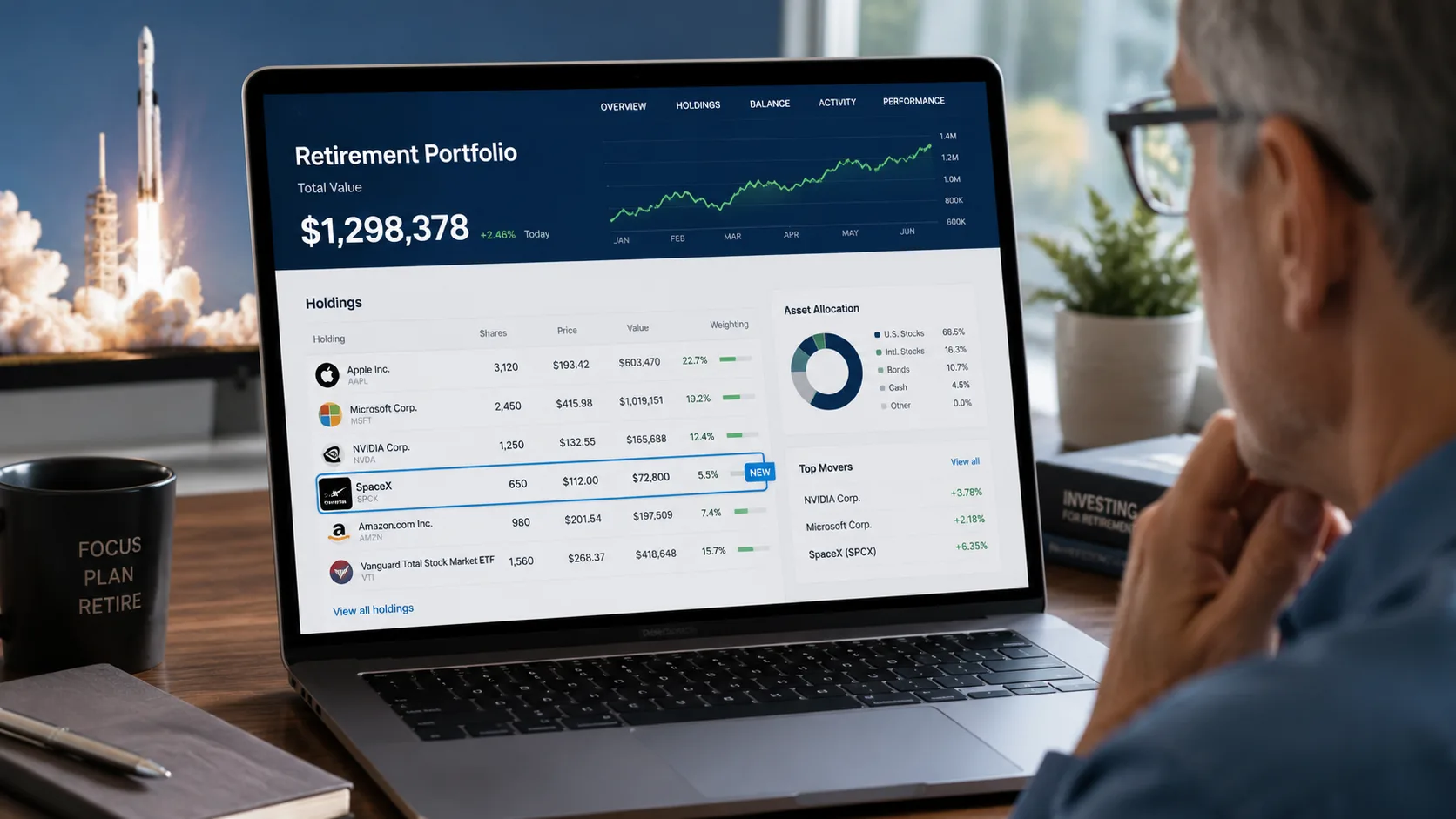
As SpaceX becomes eligible for inclusion in major benchmarks such as the Nasdaq-100 and eventually the S&P 500, index funds will be required to purchase shares.
That means investors holding popular ETFs and retirement funds may gain exposure automatically.
Initially, SpaceX’s impact on those indexes will likely be limited.
Although the company’s overall valuation is enormous, only a portion of its shares currently trade publicly. Over time, however, more shares are expected to enter the market as lockup restrictions expire and insiders gain the ability to sell.
If the stock continues rising while the public float expands, its influence inside major indexes could grow significantly.
In other words, even investors trying to avoid SpaceX may eventually own it through their retirement accounts.
The Bigger Risk Investors Should Be Watching
The real question isn’t whether SpaceX belongs in the market.
It’s whether investors are becoming too concentrated in a handful of mega-cap technology companies.
Today’s market is already heavily dependent on a small group of tech giants that have driven much of the S&P 500’s gains over the past several years.
Adding SpaceX, OpenAI, Anthropic, and other AI-related leaders to the public markets could further increase that concentration.
That’s not necessarily a problem for younger investors with decades before retirement.
But it can become a much bigger issue for investors approaching retirement age.
When portfolios become heavily tilted toward one sector, they often become more vulnerable to sharp swings if investor sentiment changes.
And history shows that even the strongest growth stories can experience painful corrections.
The Retirement Threat That Doesn’t Get Enough Attention
For retirees, one of the greatest risks isn’t a market crash itself.
It’s when the crash happens.
Financial planners refer to this as sequence-of-returns risk.
A major market decline during the first few years of retirement can have lasting consequences because investors are simultaneously withdrawing money while their portfolios are losing value.
The result is that fewer assets remain invested to participate in the eventual recovery.
Two investors can experience identical long-term returns and still end up with dramatically different retirement outcomes depending on when losses occur.
That’s why many advisors spend less time trying to predict the next winning stock and more time helping retirees manage risk.
A portfolio heavily concentrated in high-growth technology stocks may generate impressive gains during bull markets, but it can also expose retirees to greater volatility when they can least afford it.
What Smart Investors Are Doing Right Now
Investors don’t need to avoid SpaceX.
They do need to understand how much exposure they already have to growth-oriented technology stocks.
Many advisors recommend several strategies to help reduce concentration risk:
- Maintaining one to two years of living expenses in cash or cash equivalents
- Diversifying beyond large-cap U.S. technology stocks
- Adding international exposure
- Increasing allocations to value-oriented investments
- Including small- and mid-cap stocks alongside mega-cap holdings
- Periodically rebalancing portfolios to avoid oversized positions
These strategies may not generate headlines, but they can help investors weather periods of market volatility more effectively.
The Bottom Line
SpaceX may be the stock everyone is talking about today, but the bigger story is what happens next.
As the company moves into major indexes, millions of Americans could gain exposure through their retirement accounts without ever placing a trade.
For younger investors, that may simply be another long-term growth opportunity.
For retirees and those nearing retirement, it’s a reminder that diversification still matters.
The question isn’t whether SpaceX can keep climbing.
The question is whether your portfolio is prepared if it doesn’t.
About Author