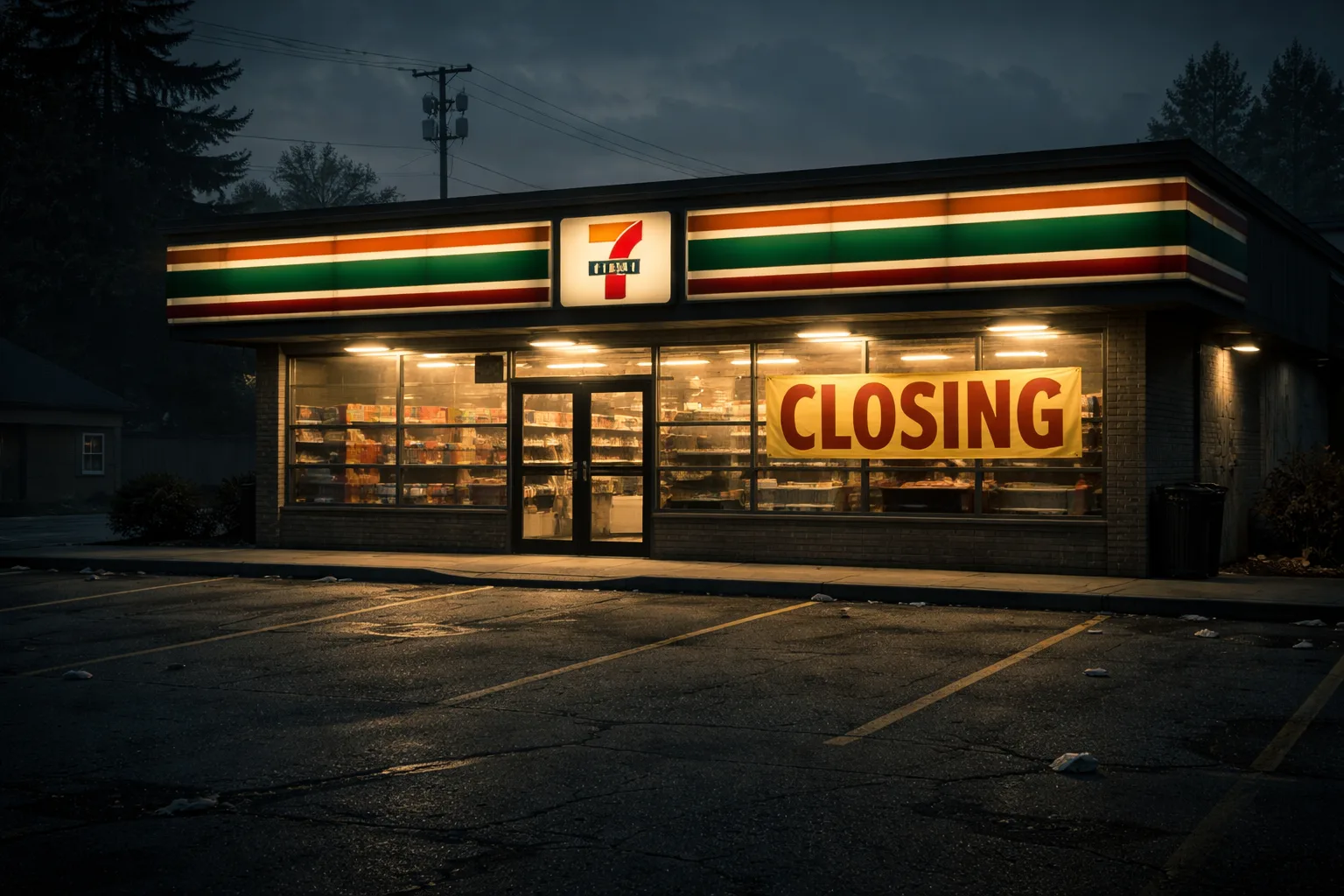
7-Eleven is planning to shut down hundreds of locations across North America, a move that reflects deeper shifts in consumer behavior, retail economics, and the future of brick-and-mortar convenience stores.
While the headline sounds alarming, the reality is more strategic than catastrophic. For investors, this is not just about store closures. It is about margin pressure, evolving demand, and how one of the most recognizable retail brands is adapting to a rapidly changing market.
7-Eleven to Close 645 Stores as Performance Slips
Parent company Seven & i Holdings recently revealed plans to close approximately 645 stores across North America during its 2026 fiscal year.
This is not a minor adjustment. It represents one of the largest footprint reductions the company has made in years.
At the same time, the company plans to open about 205 new stores, meaning the net number of locations will still decline significantly.
By the end of the fiscal year, 7-Eleven expects its North American store count to fall to roughly 12,272 locations. That is down from more than 13,000 locations just a couple of years ago.
Some of the closures will not be outright shutdowns. Instead, certain stores will be converted into wholesale fuel locations, signaling a shift toward higher-margin business lines.
Still, the direction is clear. The company is shrinking its physical retail presence in its most important market.
What’s Driving the Closures
The biggest issue is simple: fewer customers are walking through the door.
Seven & i has reported declining foot traffic across its North American stores, which has weighed on sales performance. This is a major red flag for any retail business, especially one that depends heavily on impulse purchases.
Several factors are contributing to this slowdown:
1. Inflation Is Changing Spending Habits
Consumers are becoming more selective with their spending. Convenience store purchases, which often carry higher prices, are among the first to be cut when budgets tighten.
2. Gas Demand Volatility
Many 7-Eleven locations rely on fuel sales to drive traffic. With fluctuating gas prices and increased fuel efficiency in vehicles, fewer stops at the pump can translate into fewer in-store purchases.
3. Competition Is Increasing
Convenience stores are no longer competing only with each other. They are now up against:
- Big-box retailers like Walmart and Costco
- Dollar stores offering cheaper alternatives
- Fast food chains expanding value menus
- Delivery apps that eliminate the need to leave home
4. Changing Consumer Behavior
Younger consumers in particular are shifting away from traditional convenience store habits. Health-conscious trends and the rise of e-commerce are reducing demand for classic convenience store products.
A Strategic Shift, Not Just a Retrenchment
Despite the closures, Seven & i is not retreating entirely.
The company is still investing in growth, just more selectively.
Opening 205 new stores while closing underperforming ones suggests a deliberate strategy focused on:
- Higher-performing locations
- Better demographics
- More efficient store formats
- Increased focus on fuel and high-margin items
This is less about contraction and more about optimization.
In other words, 7-Eleven is trimming the fat.
The Bigger Trend: Retail Is Being Forced to Adapt
7-Eleven is not alone.
Across the retail landscape, companies are reassessing their physical footprints. From department stores to pharmacies to fast food chains, closures have become a common strategy for improving profitability.
The message is clear:
Bigger is no longer better. Smarter is better.
Retailers are realizing that maintaining thousands of underperforming locations is a drag on margins and shareholder returns.
Instead, they are focusing on fewer, more profitable stores supported by:
- Stronger supply chains
- Digital integration
- Targeted geographic expansion
What This Means for Investors
This move by Seven & i Holdings carries several important implications.
1. Margin Over Growth
The company is prioritizing profitability over raw expansion. That is typically a positive signal for investors focused on earnings quality.
2. Short-Term Pain, Long-Term Gain
Store closures can hurt revenue in the short term. But they often improve margins and operational efficiency over time.
3. A Warning Sign for the Sector
Declining foot traffic is not just a 7-Eleven problem. It reflects broader weakness in physical retail, especially in lower-margin segments like convenience stores.
4. Opportunity in Fuel and Hybrid Models
The shift toward wholesale fuel sites suggests that energy-related revenue streams remain attractive. Investors should pay attention to companies that can successfully blend retail and fuel operations.
Could More Closures Be Coming?
It would not be surprising.
If consumer traffic continues to decline and operating costs remain elevated, additional store closures across the retail sector are likely.
Labor costs, theft, supply chain challenges, and inflation are all putting pressure on margins.
For companies like 7-Eleven, the path forward is clear:
Cut underperforming locations, invest in stronger ones, and adapt to how consumers actually shop today.
The Bottom Line
7-Eleven closing hundreds of stores is not a sign that the brand is failing.
It is a sign that the retail environment is changing fast.
For investors, the key takeaway is this:
The companies that survive and thrive will not be the ones with the most locations. They will be the ones that adapt the fastest.
Seven & i Holdings is making that bet now.
About Author